
There’s a specific kind of frustration reserved for light novels you can’t actually read. Not “can’t” because they’re obscure or too niche. “Can’t” because no English publisher has ever touched them. Violet Evergarden has been sitting in that position for over a decade. The anime is one of the most-watched series on Netflix globally, MAL score 8.69, ranked in the top 100 all-time. And yet the source material remains commercially inaccessible in English.
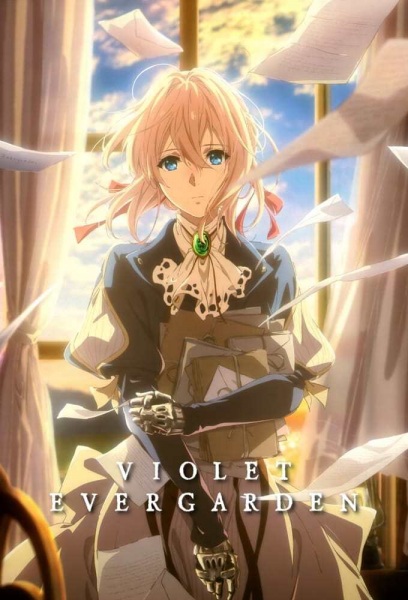
I’ve gone through the fan translations. I’ve watched the TV series, both films, and the OVA. Here’s the honest review: the light novel and the anime are not the same story. Not “the book goes deeper” or “the anime cut some stuff.” They’re genuinely different works that share a protagonist and a setting. If you’ve loved Violet Evergarden through the anime, understanding what the light novel actually is will change how you think about both.
TL;DR
- Worth reading — but treat it as a parallel story, not a continuation of the anime. They diverge completely after Vol 2.
- Only 12 of 24 LN chapters were adapted. Half this series has never been animated.
- No official English translation exists. Fan translations (JJTranslations) are the only way in for English readers.
- Four volumes, complete. Read in publication order: Vol 1 → Vol 2 → Gaiden → Vol 3 (Ever After).
What Is the Violet Evergarden Light Novel, Actually?
Violet Evergarden is a four-volume completed light novel series by Kana Akatsuki, illustrated by Akiko Takase, published under KA Esuma Bunko — Kyoto Animation’s own imprint. It won the grand prize at the 5th Kyoto Animation Award in 2014. The KyoAni Award is a novel competition that feeds directly into the studio’s publication and adaptation pipeline. The grand prize historically means the novel gets published and seriously considered for animation. Violet Evergarden is the only novel to have ever won that grand prize.
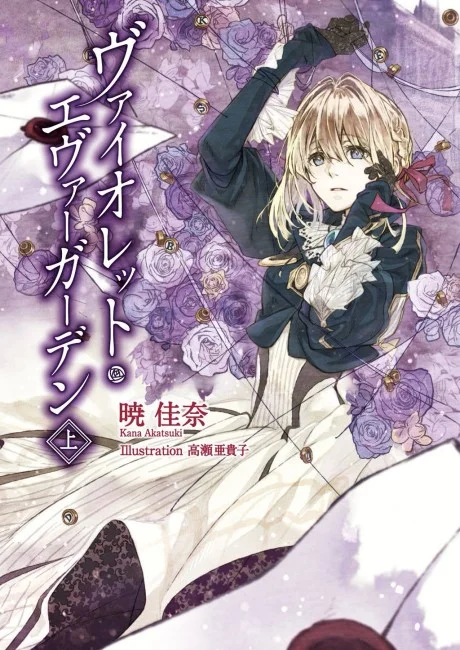
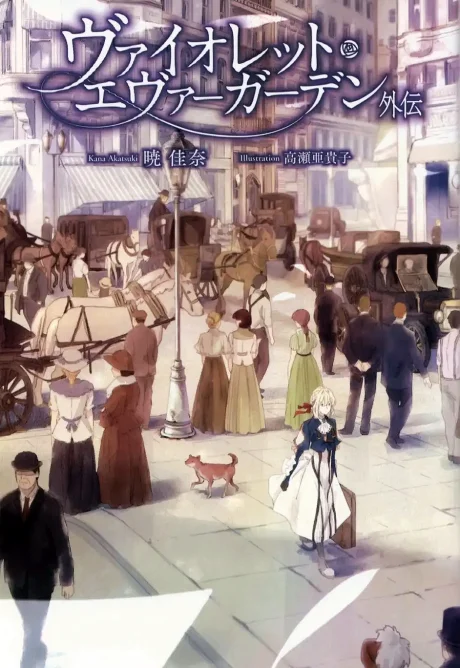
Volume 1 released December 2015. Volume 2 in December 2016. The Gaiden — a side story focusing on the Isabella York and Taylor Bartlett chapters — in March 2018. Volume 3, subtitled Ever After, in March 2020. Complete series. No continuation announced, and given that Vol 3 came out five years ago, none is coming.
KyoAni owns this IP at every level: publisher, studio, distributor. That unusual vertical integration is a significant part of why the translation situation is what it is. The premise matches the anime — Violet Evergarden is a former child soldier who becomes an Auto Memory Doll (a professional letter-writer) after the war. The emotional DNA is the same. Almost everything structural about the storytelling is different.
If you want to try the source material, the Japanese volumes are available on Amazon — but unless you read Japanese, you’ll be working from fan translations.
How Does the LN’s Structure Differ from the Anime?
The anime is chronological. You meet Violet waking up in a hospital. You watch her learn to exist as something other than a weapon. You experience her journey from her perspective, with her interiority, her confusion, her grief. The camera is on her face and inside her head simultaneously.
The light novel does none of that.
Kana Akatsuki wrote the LN in a non-linear structure where each chapter is narrated from a third-party observer’s perspective. Not Violet’s. Someone watching Violet. A client she writes a letter for. A soldier who served alongside her in the war. A bystander who catches a glimpse of her at a railway platform. These observers are assembling a portrait of who this woman is, and so are you. You read the LN the way you’d read a mystery about a person rather than a character study with direct interior access. Violet is described, encountered, witnessed. She is not voiced from within.
The closest the anime gets to this structure is the 2019 Eternity film. That film follows Isabella York and Taylor Bartlett instead of centering Violet — and the result feels remarkably close to the LN’s observer-POV logic. If you loved the Eternity film’s emotional texture, that’s the LN’s default mode across all four volumes.
The TV series and Eternity film together adapted roughly 12 of the 24 total LN chapters. The OVA and the 2020 film are entirely anime-original. About half of what Akatsuki wrote has never been animated. The anime begins with Violet waking in hospital and follows her chronologically; the LN starts mid-career, then flashes back and jumps forward across chapters. Readers piece together Violet’s history like a jigsaw puzzle, the same way the observers within each chapter are doing it.
Who Is Book-Violet, Really?
Anime-Violet appears to be around 14 when the post-war story begins. She makes mistakes as she learns. She’s visibly traumatized, emotionally raw, and responds to the world with a sincerity that makes you immediately protective of her. Episode 9 has a suicide attempt. She plays gently with children. The violence in her past reads as a wound she’s trying to heal from.
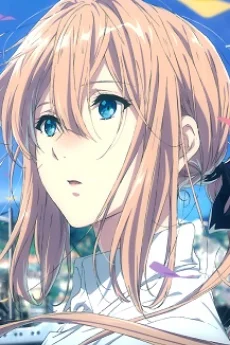
LN-Violet is approximately 16 when she becomes a Doll, after a two-year timeskip the anime removed. She’s already famous from day one. Clients request her by name. The observers who narrate each chapter encounter her as a figure of quiet awe before they encounter her as a person. She carries a concealed pistol. Her wartime weapon was a giant axe called “Witchcraft” — described as roughly her own body size. She teaches one of the girls she grows close to how to shoot. She refuses to tell anyone her age.
LN-Violet doesn’t express explicit regret for the people she killed during the war either. Anime-Violet is visibly haunted by that past. LN-Violet has a warrior’s distance from it. Neither version is the “correct” one. They’re written for different effects. The anime needed a character whose vulnerability was immediately visible. The LN builds Violet as myth first, person second — and slowly, through accumulated observation across chapters, you understand the person beneath the legendary reputation.
The “super soldier” elements are jarring on first contact if you came from the anime’s grounded tone. A giant axe she carries into battle. Supernatural physical composure. Concealed weapons. KyoAni removed all of this for tonal consistency, and most viewers feel that was the right call. In the LN, these elements serve the mythologizing project the observer-POV structure is constructing. They still surprised me.
How Different Is Gilbert in the Novel?
Significantly different. This is the single largest characterization divergence in the series, and if you came to the LN having loved the 2020 film, it will catch you off guard.
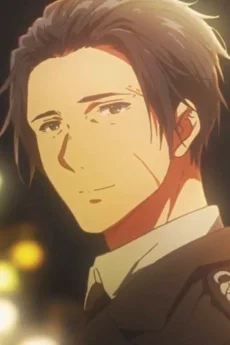
Anime-Gilbert is warm and protective. His relationship with Violet sits somewhere between father figure and the thing that becomes a love story. The 2020 film’s reunion is one of the most emotionally overwhelming sequences in recent anime. That conclusion exists only in the anime’s universe. There is no LN counterpart.
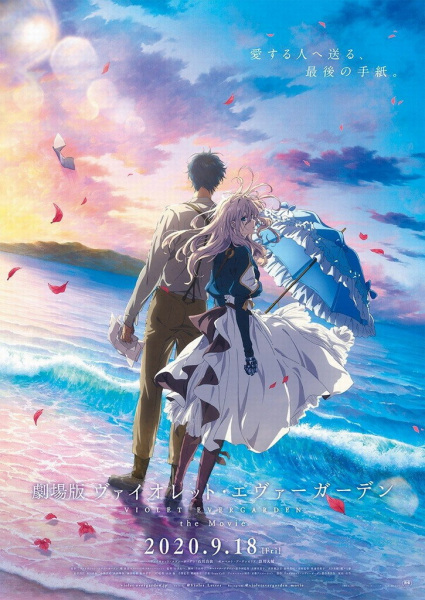
LN-Gilbert is considerably colder. The community comparison that surfaces most often: the way Dietfried — Gilbert’s brother — behaves in the 2020 film is much closer to how novel-Gilbert actually acts. Readers who arrived at the LN expecting anime-Gilbert found the novel version felt like a different person wearing the same name. The 2020 film’s warm, tender Gilbert was, for many LN readers, the most alienating thing the adaptation did.
Kana Akatsuki has been publicly comfortable with all of this. In interviews about the adaptation, she said: “A novel is a world in which the amount of information is overwhelmingly large, and the author is the sole leader.” She trusted the studio with the core essence of the work. Her framing: “Surely, once it all comes to an end, I think they will be able to understand that both are Violet Evergarden.” Two separate stories. Both legitimately the same work. That’s the only useful lens to bring to the LN.
What Is Kana Akatsuki’s Prose Like?
Literary — and I mean that specifically, not as vague praise. The most consistent description from readers who’ve worked through the original Japanese is “unlike anything else in the LN genre.” Akatsuki’s prose is classical register, formally elevated, with rhythms closer to literary fiction than standard LN publishing. The series won the KyoAni grand prize partly because it read nothing like a conventional light novel submission. It read like someone who’d spent time with serious fiction writing a light novel.
This is the primary reason the series hasn’t been commercially translated into English. KyoAni’s tight IP control creates one barrier. The prose complexity creates a second. A translator who can handle Akatsuki’s register while preserving the literary quality is difficult to find and expensive to commission. The market for a highly literary four-volume completed series without the obvious commercial hooks of ongoing isekai or progression fantasy is narrow. No English publisher has entered this conversation.
The available fan translation (JJTranslations) is variable. At its best, it conveys the structural intelligence of what Akatsuki is doing. At its worst, it flattens the register into functional prose that misses the literary texture. For a series where the writing style is a core part of the experience, reading in fan translation is a compromise. You’re reading the story through a filter. The filter matters more here than it would for a genre LN where prose quality is secondary to plot momentum.
Should You Read the VE Light Novel After Watching the Anime?
Yes. With calibrated expectations about what you’re getting into.
The community consensus after years of LN readers and anime-only viewers talking past each other has settled somewhere useful: treat the LN and the anime as parallel works. The anime is not a lesser version of the LN. The LN is not a corrected version of the anime. They’re separate Violet Evergarden stories that share DNA and diverge at the spine from Volume 2’s ending onward.
The case for reading is strong. Roughly half the LN was never animated. The mystery-box observer structure is an experience the anime simply cannot replicate, and once you stop expecting it to function like an anime, the chapters accumulate into something genuinely affecting. LN-Violet is more mythic, more extraordinary, more composed — qualities that complement rather than contradict anime-Violet once you stop trying to reconcile the two into a single character. The Gaiden volume’s Isabella York arc is one of the most emotionally sustained pieces of writing in the entire franchise.
The case for caution: if your attachment to Violet Evergarden is specifically the 2020 film’s conclusion — Gilbert and Violet’s reunion, that ending — the LN will not give you a version of that. The LN ends differently. LN-Gilbert is a harder character to love. If the romance resolution is what you’re protecting, that protection won’t survive contact with the source material.
Start from Volume 1. Don’t try to pick up where the anime left off, because the anime’s ending doesn’t exist in the LN’s timeline. Start at the beginning, treat it as a first encounter with a new story built around a familiar person, and the reading experience becomes something rewarding on its own terms.
What Are the Main Criticisms of the Light Novel?
The no-official-translation problem is the largest practical barrier. Fan translations exist and are accessible, but they’re not the same as a professionally edited, commercially published text. For a series where prose quality is foundational, this matters more than it would elsewhere.
The observer-POV structure alienates readers who want Violet’s interiority. The LN specifically denies it to you by design. If you need to know what Violet is thinking and feeling from inside her own head — if the emotional access point of the anime is what made the series work for you — this novel withholds that access across all four volumes. Some readers find the mystery-box approach deeply compelling. Others find it frustrating after spending 13 episodes inside Violet’s experience. Both reactions are legitimate.
LN-Violet’s emotional growth is also more subdued than the anime’s arc. Anime-Violet has visibly cathartic moments. Her realization in Episode 10 — “I want to live” — is a turning point you feel in your chest. The LN builds something quieter, through accumulated distance and observation. Less cathartic in individual moments, more cumulative as an experience. Readers who need the emotional payoff to be legible and immediate find the LN cold by comparison.
And it’s only four volumes. Complete and short. Readers who want more can’t have more. Volume 3 released in 2020, Akatsuki and KA Esuma Bunko have announced nothing, and four appears to be the intended endpoint. For a series that built this level of attachment globally, four volumes is a hard stop for a lot of people.
Frequently Asked Questions
Is there an official English translation of the Violet Evergarden light novel?
No. As of 2026, no official English translation exists. KA Esuma Bunko (Kyoto Animation’s imprint) has not licensed the series to any English publisher. Fan translations, primarily JJTranslations, are the only available option for English readers. KyoAni’s tight IP control and the highly literary Japanese prose are the two main barriers to commercial localization.
How many volumes does the Violet Evergarden light novel have?
Four. Volume 1 (December 2015), Volume 2 (December 2016), the Gaiden side story — Eternity and the Auto Memory Doll (March 2018), and Volume 3 / Ever After (March 2020). The series is complete with no continuation planned. Read in publication order starting from Vol 1.
Does the Violet Evergarden light novel have the same ending as the 2020 anime film?
No. The 2020 film is entirely anime-original with no LN source material. The LN and anime diverge completely from the end of Volume 2 onward. Gilbert and Violet’s reunion in the film exists only in the anime’s story. LN-Gilbert is also a considerably colder, harder character than the warm protective figure in the anime. Treat them as separate conclusions to two versions of the same story.
Is the Violet Evergarden light novel worth reading after watching the anime?
Yes, with adjusted expectations. About half the LN was never animated. The observer-POV structure and non-linear storytelling offer an experience the anime can’t replicate. Go in knowing it’s a parallel story — not a continuation — and start from Volume 1. If your attachment is specifically to the 2020 film’s ending, be aware the LN ends differently.
What order should I read the Violet Evergarden light novels in?
Publication order: Vol 1 → Vol 2 → Gaiden: Eternity and the Auto Memory Doll → Vol 3 (Ever After). The Gaiden is a side story that can be read after Vol 1 or Vol 2 without major spoilers, but publication order is the cleanest path through the series.