

My controversial take: Konosuba is funnier in the light novel than on screen. I’ve said this before and I’ll keep saying it. The anime is legitimately great, the voice cast is irreplaceable, and the physical comedy lands in ways that text can’t fully replicate. But Kazuma’s inner monologue, the real Kazuma, the one running constant commentary on how unfair everything is while also absolutely contributing to his own misfortune, is the actual core of Konosuba. And you only get that in the LN.
This article contains affiliate links. If you buy through these links, we earn a small commission at no extra cost to you.
TL;DR
- Konosuba is funnier in the light novel. Controversial, I know. The voice cast is irreplaceable and the physical comedy works better animated. But Kazuma’s inner monologue — the constant running commentary on how unfair everything is while he’s actively making it worse — is the real core of Konosuba, and you only get that in print.
- The anime covers roughly volumes 1-5. The remaining 12 volumes of main story plus a 2-volume epilogue are LN-only. The post-anime arcs are where the character relationships actually develop.
- What gets cut: Kazuma’s internal reactions (the funniest part), extended party dialogue, several side stories, and most of the character growth that happens between the comedy beats.
- All 17 main volumes + epilogue are out in English. Series is complete. You can binge the whole thing.
I’ve read all 17 volumes of the main series plus the Megumin and Dust spinoffs. I’ve watched the anime enough times that I can hear the voice acting in my head while reading. Here’s the honest breakdown of what each format does well, and what actually got cut.
More about Konosuba
The Split, Upfront
If you want the funniest moment-to-moment comedy experience, the anime wins. The voice cast, the timing, the reaction shots, Aqua’s various breakdowns rendered in full animation, that’s hard to beat. The anime knew what it was doing and leaned into it.
If you want Konosuba as an actual story, coherent, complete, with payoffs that land because the setup was there, the LN wins. Not by a little. By a lot. The anime burned setup for extra jokes. The LN had both.
Both are worth your time. But the anime is not a replacement for the LN. It’s more like an excellent highlight reel with original material that sometimes improves on the source and sometimes loses exactly the thing that made a scene work.
What the Anime Gets Right
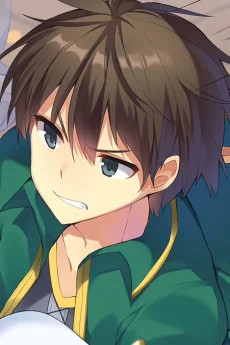
Satou Kazuma is one of those characters where the voice performance adds something the text doesn’t have. Jun Fukuyama found the exact register for Kazuma: perpetually tired, barely competent, smug about the wrong things, genuinely fond of his party in moments he would never admit to. The delivery in scenes like Explosion’s first payoff or the Aqua dungeon moment hits because Fukuyama plays the exasperation as real, not just gag setup.
Same for Rie Takahashi as Megumin. Her scream after casting Explosion is probably the single most iconic thing the anime added to the source material’s image. The LN describes the moment. The anime makes you feel it as a physical event.
The action sequences in the movie (Konosuba: God’s Blessing on This Wonderful World! Legend of Crimson) are the best visual interpretation of the Megumin/Yunyun vs Sylvia fight. The animation, the music, the building tension — Natsume Akatsuki wrote it well, but animation hit a ceiling the prose couldn’t reach in that specific moment. Even people who prefer the LN broadly tend to agree on the movie finale.
Kazuma’s Head — Where the LN Wins
Konosuba works because Kazuma is funny to be inside of. He’s petty, self-aware, occasionally heroic in ways he refuses to acknowledge, and running a continuous internal commentary on everything that’s going wrong and whose fault it is (usually Aqua’s). The anime shows you the result of that internal state. The LN puts you inside it.
That’s a meaningful difference. When Kazuma does something generous in the anime, it reads as a character beat. In the LN, you’re with him through the justification process, the way he convinces himself it’s actually strategically smart, then gets embarrassed anyway. The comedy is denser and more personal. It hits differently when you’ve been inside his head for two volumes.
A lot of anime-only viewers came away thinking Konosuba is pure slapstick. It’s not. There’s genuine character development, mostly Kazuma’s, mostly reluctant, mostly in the gaps between chaos. The anime version of that character work exists, but the show trimmed it for pacing.
Season 3 and the Serious Turn
Season 3 created real whiplash for some anime-only viewers. Suddenly Kazuma is doing things that feel earned and emotionally coherent. Stakes feel real. Characters behave like they’ve grown. If you went in expecting chaos and got something more considered, that’s not the show changing tone arbitrarily. It’s the LN payoffs finally arriving.
Akatsuki spent Volumes 1-7 building Kazuma’s arc quietly underneath all the comedy. He’s not the same guy who arrived in this world whining about getting a useless goddess. By volume 7 he has history with his party, a reputation in the city, genuine stakes. The anime kept the jokes and trimmed the accumulation. Season 3 is where that accumulation was supposed to arrive, and the anime had to rush-deliver context it spent two seasons not building.
The Eris arc specifically lands differently in the LN. What reads as a plot twist in the anime is a payoff in the novels because you’ve been with Kazuma long enough to understand what it means for him specifically. The anime-only experience isn’t wrong. It’s just missing the weight that makes that arc hit the way Akatsuki intended.
If Season 3 made you want to understand what you were watching more fully, that’s the right instinct. Read the LN from the beginning. Season 3 is where it pays off.

What the Anime Actually Cut
Season 1 took the most liberties. The cuts weren’t devastating to the plot, but they removed connective tissue that made later payoffs stronger.
Wiz’s introduction. In the anime, the party’s relationship with Wiz develops sort of naturally in the background. In the LN, you get the actual scene where they meet her, the context for why Aqua’s reaction is what it is, and the setup that makes the Wiz/Vanir dynamic pay off properly later. The anime stitched over the gap well enough that you don’t notice it missing, but reading the LN version is noticeably richer.
The Party Swap chapter. One of the more discussed omissions. In the LN, Kazuma ends up in a different party temporarily, which creates space for him to have perspective on his own group, see them through outside eyes, and do the reluctant-acknowledgment-of-fondness thing that’s at the core of his character. The anime skipped it. Not surprising given episode counts, but it’s one of the earlier moments where the LN’s Kazuma is more dimensional than the anime version.
The 120-point scene. The anime movie changed the final fight in a way that removed a specific setup-payoff from the LN version. Kazuma’s stat point management and the 120-point moment has a structural elegance in the original that the anime version replaced with anime-original content. The Sylvia second phase is a fine scene, but it’s a different scene. Readers noticed.
Kazuma meeting Dust’s party. In the LN, Dust’s crew gets a proper introduction that makes them feel like actual recurring characters rather than background faces. The anime handles them more casually. They have their own spinoff novel (Konosuba: God’s Blessing on this Wonderful World! Dust Spinoff) that fills them out further, but their presence in the main series benefits from the LN’s proper introduction.
Pop culture references and puns. The LN has Aqua referencing Ace Attorney and Danganronpa. The anime cut these, partly for copyright reasons. The Japanese writing humor in the original goes deeper than the adaptations can render, particularly references to 2000s internet and NEET culture that Akatsuki wove through the whole thing. This is one area where translation also matters: the official Yen Press releases are solid, but some of the layered jokes work better in the original Japanese than any adaptation.
Where the Anime Is Actually Better

Aqua’s suffering. Funny on the page, but the anime makes it physical and visual in a way that’s more immediately effective. Every Aqua breakdown is better on screen. Ai Kayano’s delivery of her crying scenes specifically, there’s something about hearing actual despair rendered as comedy that the text can’t quite replicate.
The anime-original Season 3 opening is mostly new content and it works. Turning the movie’s missing pieces into a proper episode introduction, with the right pacing and VA performances, is a case where the adaptation improved on what was there. Not everything the anime invented was a mistake.
Reaction shots. This is a small thing but it matters. The anime can cut to a character’s face. The LN has to describe the reaction. For a series this dependent on timing, being able to show a split-second expression is a real advantage. Some of the best Darkness moments in the series are just shots of her face.
What About the Manga?
Skip it unless you specifically want a visual version of scenes the anime didn’t adapt. The manga adapts a mix of the anime and LN, so it doesn’t fully commit to either. The art style is divisive (early chapters are rough) and it’s still ongoing, currently around Volume 11 of the LN. The Megumin spinoff manga is much better than the main series manga if you want something to read in that format.
Honestly: anime fans who want more Konosuba should read the LN, not the manga. The manga doesn’t fill the gap the way you’re hoping it will.
The Spinoffs Are Worth Your Time
Once you’re done with the main series, the spinoffs are where the universe stays interesting. Two of them are genuinely good on their own terms, not just fan service for people who want more of the same.
Konosuba: An Explosion on This Wonderful World! (8 volumes) — Megumin’s backstory before she met Kazuma. The whole thing is about her obsessive relationship with Explosion magic, which you think you already understand from the main series and turns out you don’t. Yunyun is the other lead and she’s used much better here than in the main series. If you liked Megumin at all, this is not optional.
Konosuba: God’s Blessing on This Wonderful World! Dust Spinoff (6 volumes) — Dust from Dust’s party, the guy the anime treated as a running background joke. Turns out he has a whole backstory that the main series deliberately keeps offscreen. It’s a different register than the main series, more overtly plotty, but Akatsuki knows how to structure a reveal and this spinoff has a good one. If you want to understand why the main series kept cutting back to Dust without explaining him, this is where it pays off.
The Megumin spinoff got a manga and an anime adaptation (Konosuba: An Explosion on This Wonderful World!). The anime is decent but the LN is better, mostly because Megumin’s internal voice is funnier in prose than in dialogue alone.
Anime Coverage — Which Volumes Each Season Adapts
| Season / Film | LN Volumes Covered | Notable Cuts |
|---|---|---|
| Season 1 (10 eps) | Vol. 1–2 | Wiz introduction, Party Swap chapter, Dust’s party intro |
| Season 2 (10 eps) | Vol. 3–5 | Some Kazuma introspection, minor side scenes |
| Legend of Crimson (film) | Vol. 5 (Explosion spinoff) + original | 120-point Steal setup replaced with anime-original Sylvia second phase |
| Season 3 (12 eps) | Vol. 6–7 | Eris arc setup context, some Kazuma character accumulation |
| Not yet adapted | Vol. 8–17 | Full second half of the series — Kazuma’s arc payoff, endgame |
The anime ends at Volume 7. Volumes 8 through 17 are the back half of the series and are completely unadapted. That’s roughly as much story as the anime covered, all of it still in print from Yen Press.
Where to Start

Start from Volume 1. Even if you know the anime cold, the LN Volume 1 is a faster read than you expect and it has the Wiz introduction and the Party Swap content that the anime skipped. Reading it with the VA voices in your head is actually a good experience, the two versions layer on each other well.
If you want to jump straight past what the anime covered, Volume 7 (epilogue 2) to Volume 8 is the recommended jump-in point for continuing from the anime. But you’ll be missing context, and Konosuba rewards going back to the beginning more than most series do.
Official translations are Yen Press. There are also audiobooks narrated by the English dub VAs for Kazuma and Megumin, which is a fun format option if you want to stay close to the anime performance while getting the full text. Currently through Volume 9.
TL;DR Comparison
| Category | Light Novel | Anime |
|---|---|---|
| Kazuma’s inner monologue | Full, dense, funnier in different ways | Minimal, behavior shown, not thought |
| Comedy style | Character-driven, reference-heavy, puns | Visual gags, voice performances, timing |
| Story completeness | Full 17 volumes, done | Missing Party Swap, Wiz intro, 120-pt scene |
| Wiz introduction | Proper scene with full context | Glossed over |
| Dust’s party | Real introduction, recurring presence | Background characters |
| Movie finale | 120-pt setup intact | Anime-original Sylvia second phase |
| Aqua suffering | Funny on page | Better in animation |
| Manga | — | Skip; read Megumin spinoff manga instead |
Frequently Asked Questions
Is the Konosuba light novel better than the anime?
Depends what you want. The LN is better as a complete story: more content, better setup for payoffs, Kazuma’s full inner monologue. The anime is better for visual comedy: voice performances, reaction shots, animation. Both are great. But the LN is the actual finished work; the anime is an adaptation that made trade-offs.
What did the Konosuba anime leave out?
The biggest omissions are Wiz’s first introduction scene, the Party Swap chapter, Kazuma meeting Dust’s party properly, and the 120-point setup in the movie. Season 1 cut the most content relative to the source. The anime also trimmed serious/introspective Kazuma moments in favor of comedy, which becomes more noticeable in the later volumes.
Where should I start Konosuba LN if I’ve seen the anime?
Volume 1, ideally. Volumes 1-4 have cut content the anime skipped, and going back doesn’t feel like a waste. If you genuinely just want to continue past what the anime covered, start at Volume 7 epilogue 2, then go into Volume 8.
Should I read the Konosuba manga?
Probably not, unless you specifically want a visual version of LN-only content. The Megumin spinoff manga is better than the main series. For the full story, read the LN. For the visual experience, watch the anime.
Should I read the Konosuba spinoff novels?
Yes, at least two of them. The Megumin spinoff (An Explosion on This Wonderful World!, 8 volumes) is essential if you liked her at all. It fills in her backstory and uses Yunyun far better than the main series does. The Dust spinoff (6 volumes) answers who Dust actually is and why the main series kept cutting back to him. Both are complete.
How long is the Konosuba light novel series?
17 volumes for the main series, complete. The Megumin spinoff is 8 volumes, the Dust spinoff is 6. There are also shorter spinoffs and side stories. Reading order: main series first, then whichever spinoff character you liked most. The main series ending is genuinely satisfying — Akatsuki stuck the landing.
[…] Konosuba. It’s complete at 17 volumes, the comedy makes it a fast read, and it doesn’t require familiarity with isekai tropes to enjoy. Mushoku Tensei is better overall, but its protagonist is a tough sell for newcomers. […]
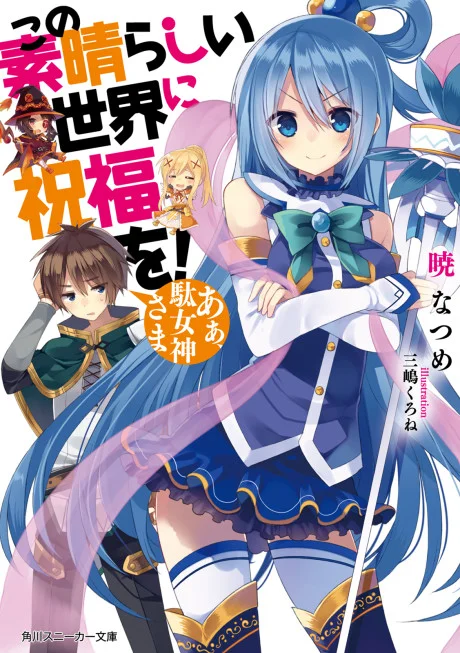
[…] “KonoSuba: God’s Blessing on This Wonderful World!” is a comedic fantasy light novel series written by Natsume Akatsuki and illustrated by Kurone Mishima The story follows a shut-in gamer named Kazuma Satou, who dies a ridiculous death but is given the chance to be reincarnated in a fantasy world with one wish. However, his wish to bring a powerful weapon with him is granted by a lazy god named Aqua, who also joins him in his new adventure. Along with two other eccentric companions, they embark on a series of comical and often absurd quests to defeat the demon king and save the world. […]