

Secrets of the Silent Witch shouldn’t work as well as it does. The premise is a mashup of tropes you’ve seen before: overpowered mage, academy setting, undercover mission, socially awkward protagonist. On paper, it reads like a checklist. On the page, it reads like something genuinely human — a story about a person who can destroy armies but can’t order food at a restaurant, and a world that treats both of those facts with equal seriousness.
MAL gives it an 8.39 for the light novel and 8.11 for the anime. Those scores are earned. Matsuri Isora wrote a fantasy series that’s secretly a character study, and the character at the center of that study — Monica Everett, the Silent Witch, one of the kingdom’s Seven Sages — is the most convincingly anxious protagonist I’ve read in light novel fiction.
TL;DR
Secrets of the Silent Witch is a fantasy light novel that uses its academy setting and political intrigue to tell a story about social anxiety, isolation, and the slow, painful process of learning to exist around other people. The magic system is clever. The political threads are engaging. The supporting cast is strong enough that several characters could anchor their own series. But Monica is the reason to read this. Her anxiety is written with specificity that feels experienced rather than researched, and her growth across 12 volumes is the emotional spine that holds everything else together. Read it if you want fantasy that cares about its protagonist’s inner world as much as her outer power.
Monica Everett Is Not a Standard Overpowered Protagonist
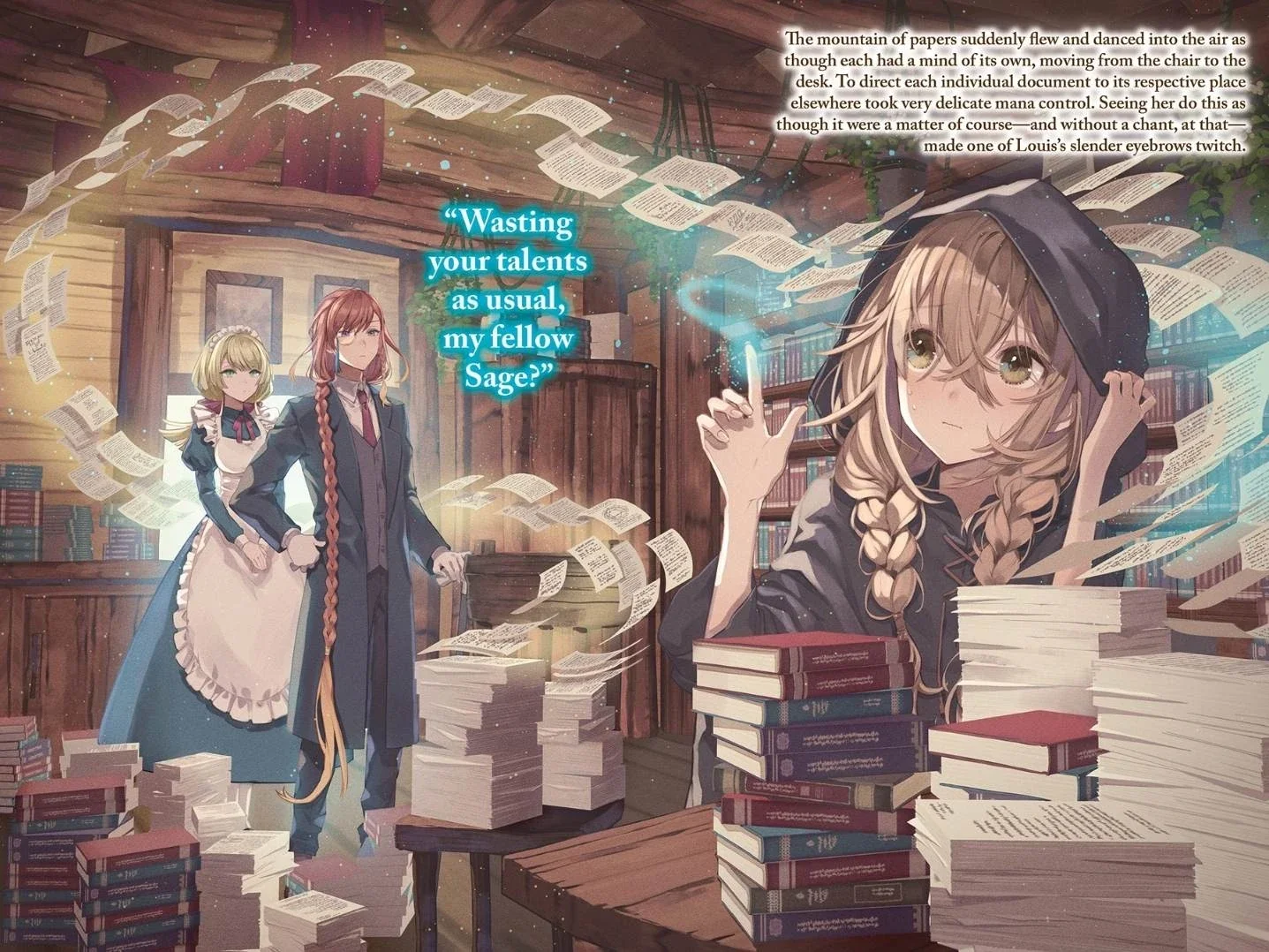
The Silent Witch can cast without incantations. In a world where magic requires spoken formulae, Monica does the calculations in her head — silently, instantly, at a level that earned her a seat among the Seven Sages before she was old enough to look the part. She is, by any objective measure, a monster in combat.
She’s also barely functional in a social setting. Not in the cute anime way where a character blushes and stutters for comic effect. In the way where she goes non-verbal when too many people look at her. Where she rehearses a single sentence twelve times in her head before saying it and still fumbles the delivery. Where the prospect of eating lunch in a cafeteria generates the same physiological response as a battlefield threat.
The novels treat this with a seriousness that the anime, for all its quality, could only approximate. Prose lets you live inside Monica’s spiraling thoughts. You experience the specific catastrophes she imagines when someone asks her a direct question. You feel the relief when a conversation ends without her saying something she’ll replay in her head for the next three hours. The specificity is what makes it work. This isn’t “shy character” shorthand. It’s a detailed, consistent, internally logical portrayal of someone for whom social interaction is genuinely exhausting.
And then the story asks her to go undercover in a magic academy and protect a prince by staying close to him. Attend classes. Make friends. Maintain a cover identity. Everything that’s easy for a normal person and agonizing for her. The tension isn’t whether Monica can handle the magical threats. It’s whether she can handle asking someone to pass the salt.
The Academy Setting Earns Its Place
I’m tired of academy settings in light novels. Most of them exist because the author wanted a school environment and bolted a magic system onto it. Serendia Academy in Silent Witch exists for a structural reason: Monica needs to be somewhere that forces constant social interaction. The academy isn’t the point. Monica being unable to escape human contact is the point.
That said, the academy itself is well-built. The class system, the student politics, the faculty dynamics — they all function as backdrop for the actual story while also providing the political framework that becomes important in later volumes. The prince Monica is protecting, Felix Ridill, sits at the intersection of academic politics and kingdom-level intrigue. His position makes the academy relevant beyond just being a school where magic happens.
The social hierarchy among students mirrors the political hierarchy of the kingdom. Alliances formed in classrooms echo alliances formed in courts. It’s not subtle, but it doesn’t need to be — it gives the academy stakes beyond academic performance and ties Monica’s undercover mission to something larger than keeping one person safe.
The Supporting Cast Punches Above Its Weight
Isabelle Norton is the standout. She’s Monica’s classmate, a noble’s daughter with the social confidence Monica lacks entirely, and she decides to befriend Monica with a directness that’s both endearing and slightly terrifying. The dynamic works because Isabelle isn’t just a device to pull Monica out of her shell. She has her own agenda, her own insecurities, and her own arc that intersects with Monica’s in ways that pay off across multiple volumes.

Nero, Monica’s familiar who takes the form of a black cat, serves as her emotional anchor. He’s the one being she’s comfortable around, and their interactions provide the warmth that keeps the story from becoming oppressively anxious. He’s also genuinely funny — his commentary on human behavior through the lens of a magical creature gives the series some of its best comedic moments.

Felix Ridill is a slow burn. Early volumes present him as the standard prince character — charming, politically aware, slightly mysterious. The novels earn his complexity gradually. His awareness of Monica’s mission, the layers of his political position, the genuine relationships he forms despite knowing people are constantly trying to use him — by the middle volumes he’s one of the most interesting characters in the series, and the Monica-Felix dynamic becomes more compelling as both characters understand each other better.
Lana Colette and Cyril Ashley round out the core group with their own distinct roles. Lana brings earnest energy that contrasts with Monica’s guardedness. Cyril operates in the political sphere with a competence that makes him useful to both the plot and Monica’s mission in ways the novels develop carefully across volumes.
The Magic System Is Smarter Than It Needs to Be
Monica’s unique ability — silent, incantation-free casting through mental arithmetic — isn’t just a power gimmick. The novels explore why this ability is terrifying in a world built around spoken magic. She doesn’t just skip the incantation step. She processes the mathematical foundations of spells in real time, which means she understands magic at a structural level that other casters don’t. She sees the code behind the spells. Everyone else sees the interface.
This has plot implications that the story handles well. Monica’s understanding of magical architecture makes her uniquely suited to identifying flaws in existing magical systems — defensive barriers, institutional enchantments, the foundational magic that keeps the kingdom’s infrastructure running. Her anxiety keeps her from using this knowledge proactively. But when circumstances force her hand, the gap between what she can do and what people expect from a quiet, mousy student creates some of the series’ best moments.
What Doesn’t Work
The pacing in volumes 2-3 sags slightly. The academy introduction takes its time — necessarily, since the character relationships need room to develop, but noticeably if you’re reading for plot momentum. The series finds its pace by volume 4, and from there the balance between character work and plot advancement stays consistent.
Some of the political threads in the later volumes get complicated enough that you need to track which noble faction wants what. If you’re not paying attention to the names and allegiances, the political maneuvering can feel dense. This isn’t a flaw of the writing exactly — the complexity is the point — but it means the series demands more engagement than a typical light novel.
The web novel origins occasionally show through. Certain plot resolutions arrive a beat too quickly, echoing the chapter-by-chapter serialization format of the web version. The light novel smooths most of these seams, but a few remain in the early volumes before the revision process seems to have become more thorough.
How Does the Anime Compare?
The anime adapted volumes 1-3 in a single season and did it well. MAL 8.11, strong visual production, a voice cast that defined several characters for the fanbase. If you’ve watched it, the novels give you the extended version — Monica’s full internal experience, the slower character development between set pieces, the institutional detail the anime trimmed for pacing.
The anime is a legitimate entry point. But the novels are where the story lives. The gap between “good adaptation” and “complete experience” is wider here than in most series because so much of Silent Witch’s appeal is internal. Monica’s anxiety isn’t a plot point. It’s a perspective. And perspectives work better in prose.
Who Should Read This?
Read Secrets of the Silent Witch if you want a fantasy series with a female protagonist who’s overpowered in magic and underpowered in every social situation. If you like academy settings that serve the characters rather than the other way around. If you want political intrigue that builds slowly and pays off across multiple volumes. If the idea of a character study wrapped in a fantasy plot appeals to you more than a fantasy plot with characters attached.
Skip it if you need fast pacing from page one. Skip it if social anxiety as a central character trait sounds annoying rather than compelling. Skip it if you want straightforward power fantasy without the vulnerability. This is a series that asks you to care about whether its protagonist can survive a group conversation. If that sounds boring, this isn’t your book. If that sounds like the hardest fight in fantasy, welcome. Monica’s been waiting for someone who gets it.
FAQ
Q: Is this a romance series?
A: Romantic elements develop slowly. The series prioritizes Monica’s personal growth over romantic progression. If it’s a romance, it’s the slowest-burn version imaginable.
Q: Do I need to watch the anime first?
A: No. The novels are the complete experience. The anime is a solid entry point but covers only volumes 1-3 of 12.
Q: How does it compare to other female-protagonist light novels?
A: Closer to Ascendance of a Bookworm (brilliant protagonist navigating social structures) than to villainess isekai. The tone is gentler than most dark fantasy but more grounded than most academy stories.
Q: Is the spinoff worth reading?
A: “Silent Witch Another” follows Louis Miller and is already complete. It’s optional — enriches the world but isn’t required for the main story.
Q: Will the web novel’s ending match the light novel’s?
A: The web novel (211 chapters, complete) provides the story’s blueprint, but the light novel revises significantly. The destination should be similar; the journey there is expanded and different enough to feel fresh.