

I need to be upfront about something. Ascendance of a Bookworm is my favorite light novel series. It’s in my top three alongside Mushoku Tensei and Re:Zero, and if someone forced me to pick just one, this is the one I’d keep. So take everything I say here with that bias acknowledged.
This article contains affiliate links. If you buy through these links, we earn a small commission at no extra cost to you.
TL;DR
- My favorite light novel series, full stop. I need to be upfront about that bias. Ascendance of a Bookworm is in my top three alongside Mushoku Tensei and Re:Zero, and if I had to pick one, this is it.
- 33 volumes across 5 parts, complete. Published by J-Novel Club. The full story is available in English right now. One of the few completed series at this length that actually sticks the ending.
- It’s a 33-volume commitment. Some people bounce off it hard — the early volumes are slow and Myne can be polarizing. I think they’re wrong, but you should know the entry cost.
- The worldbuilding is unmatched. Bookworm builds the most detailed, internally consistent fantasy setting I’ve encountered in light novels. The magic system, the political structure, the economics — everything connects.
But I’m also going to be honest about what doesn’t work. Because 33 volumes is a massive commitment, and you deserve to know what you’re signing up for before you drop that kind of time and money. Some people bounce off this series hard. I want to explain why they bounce, and why I think they’re wrong. Mostly.
More about Ascendance of a Bookworm
The Premise Sounds Boring. It’s Not.
A college student who loves books dies and reincarnates as a sickly five-year-old girl in a medieval world where books are rare luxury items only nobles can afford. She decides to make her own books. That’s the pitch.
I get why people scroll past that. It sounds like a cozy crafting isekai. And Part 1 does lean into that vibe. Myne figures out how to make paper. She tries different ink recipes. She makes simple picture books. If that description makes you yawn, I hear you. Part 1 is the slowest section of the series by a wide margin.
But here’s what the premise doesn’t tell you: this series is actually about class warfare, religious politics, magical feudalism. One girl’s obsessive personality bulldozing through a rigid social hierarchy. The books are just the excuse. Myne’s goal of creating a printing press puts her in direct conflict with every power structure in her world. Nobles control information. Commoners don’t read. A commoner who wants to democratize books is, in this setting, a revolutionary. She just doesn’t realize it for the first several volumes.
Miya Kazuki wrote this series with the ending planned from the start. Readers who’ve finished all 33 volumes consistently point to this as the thing that sets Bookworm apart. Throwaway details in Part 1 become critical plot points in Part 4. A joke about how Myne can’t sit still during ceremonies becomes a plot-relevant character trait ten volumes later. Kazuki wasn’t improvising. Every brick was placed with the final structure in mind.
The Five Parts
Bookworm is divided into five Parts, each with its own subtitle and thematic focus. The Part structure isn’t just marketing. Each one fundamentally changes Myne’s circumstances and social position. The scope of the story shifts with every transition. It’s almost like five connected series sharing a protagonist.
Part 1: Daughter of a Soldier (3 volumes)
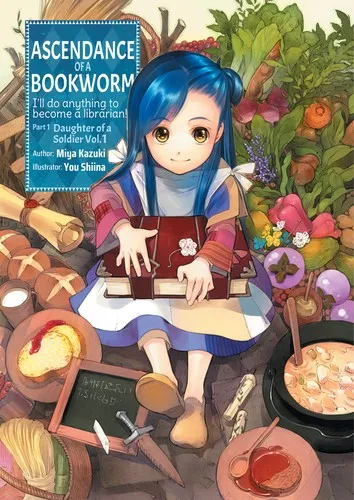
Myne is a commoner’s daughter in the city of Ehrenfest. She’s frail, bedridden half the time from a condition called the Devouring, and surrounded by a loving family that can’t afford the medicine she needs. She tries to make books using whatever materials a five-year-old commoner can access. Most of her attempts fail. She succeeds at making paper. She meets Benno, a merchant who recognizes her potential.
This is the slowest stretch of the series. Three volumes of Myne experimenting with clay tablets, papyrus alternatives, ink mixtures. The community is split on Part 1. Some people love the detailed crafting. Others stall out completely. The reader who told me “even the anime put me to sleep” was talking about this section.
My take: Part 1 is essential but not representative. It establishes Myne’s character and her family. The class system that drives everything afterward is built here. The emotional core of the entire series (Myne’s relationship with her commoner family) is built here. You need it. But if you’re struggling, know that Part 2 is where the series transforms.
Part 2: Apprentice Shrine Maiden (4 volumes)
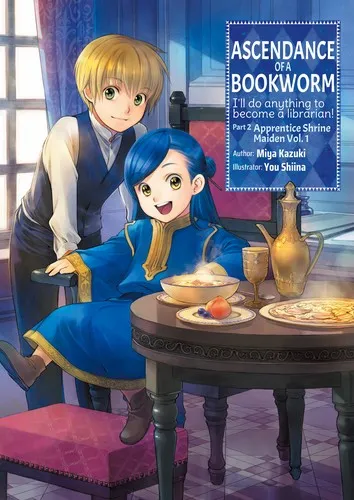
Myne enters the temple as a blue-robed shrine maiden to survive the Devouring. Suddenly she’s navigating religious hierarchy and managing orphans. She butts heads with the corrupt High Bishop. Ferdinand, the High Priest, becomes her mentor and one of the best characters in the series.
This is where Bookworm stops being a crafting story and becomes a political one. Myne’s commoner values clash with noble expectations. She treats orphans like people. The temple treats them like disposable labor. She introduces new products (rinsham, sweets, paper) that generate revenue but also attract dangerous attention from nobles who want to control her.
Part 2 is where most readers get hooked. The temple arc gives Myne real stakes and real consequences. Her actions have weight here. If Part 1 didn’t grab you, Part 2 will tell you definitively whether this series is for you.
Part 3: Adopted Daughter of an Archduke (5 volumes)
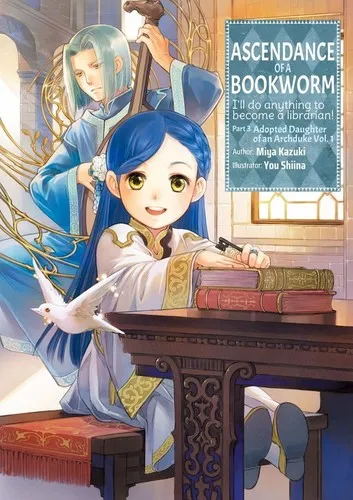
Myne becomes Rozemyne, adopted into the Archduke’s family. Her commoner identity is erased. She now operates at the highest level of Ehrenfest’s nobility while hiding who she used to be. The political complexity jumps significantly.
I had a rough time with the first volume of Part 3. The shift in setting and social dynamics felt disorienting. Rozemyne goes from being a scrappy commoner with a small support network to being a noble with retainers, attendants, and a whole new set of social rules. The information density increases. You’re learning noble customs and magical systems alongside an entirely new political structure.
But by the third volume, I couldn’t stop reading. The political maneuvering gets genuinely tense. Rozemyne’s unique position (a commoner with noble status, a child with adult knowledge, a book-obsessed girl in a world that doesn’t value literacy) creates friction with everyone around her. The character dynamics deepen. Ferdinand becomes more protective. Sylvester grows more conflicted. Rozemyne’s retainers start developing their own arcs.
Season 4 of the anime, produced by Wit Studio, premieres April 4, 2026, and covers Part 3. If you’ve been waiting for the anime to catch up, this is the arc that converts watchers into readers. The anime can’t capture the internal political calculus that makes Part 3 work. For the full comparison, see my LN vs anime breakdown.
Part 4: Founder of the Royal Academy’s So-Called Library Committee (9 volumes)
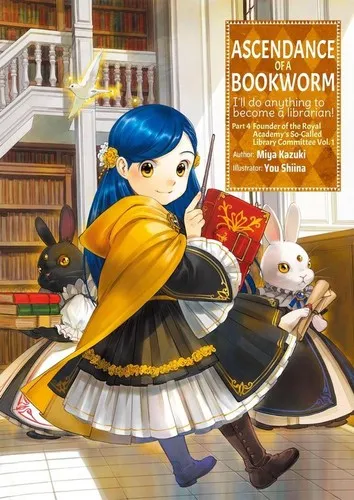
This is peak Bookworm. The community agrees on this almost unanimously, and so do I.
Rozemyne attends the Royal Academy, where duchies compete for status and political alliances are formed between noble children. She founds a library committee (her dream from Volume 1 finally taking shape). But the inter-duchy politics are vicious, and her unusual background makes her a target.
Nine volumes sounds like a lot for one arc. It doesn’t feel long. Kazuki packed Part 4 with some of the best character moments in the series. The Royal Academy setting gives every character room to develop independently of Rozemyne. You see her retainers growing into their own people. Rivals become allies. The consequences of decisions made two Parts ago rippling forward.
Part 4 is also where the magic system fully clicks. Bookworm’s magic is tied to religion, seasons, and the land itself. It’s not a combat system. It’s a world-building system. And in Part 4, Kazuki finally has enough foundation laid to show you how deep it goes. People compare Bookworm’s world-building to Brandon Sanderson. I think that comparison is earned here.
The ending of Part 4 is devastating. I won’t spoil it. But if you’ve been reading for twenty-one volumes by that point, it hits like nothing else in light novels has hit me.
Part 5: Avatar of a Goddess (12 volumes)

The final stretch. Twelve volumes of escalating stakes and political chaos. Rozemyne’s accumulated influence finally being put to the test. The scope expands beyond Ehrenfest to the entire country. Everything Kazuki set up across the previous four Parts converges.
Part 5 is the most divisive section among fans. Some people love the epic scale. Others feel it drags in the middle volumes (around P5V5-P5V8) where the political maneuvering gets extremely dense. I’m somewhere in between. The payoff is worth it, but there are stretches where I was reading through political negotiations that felt like they could have been tighter.
The ending, though. Volume 33 (P5V12) wraps the series in a way that respects everything that came before it. Not rushed. Not sequel-bait. A proper conclusion to a story that was planned from the beginning. I’ve read fan reactions from people who felt empty after finishing because they’d spent so long in this world. That’s the kind of ending this is. Not sad. Complete.
What Makes It Special
The world-building is on another level. I’ve read a lot of isekai. Most of them hand-wave their settings. “It’s a medieval fantasy world with guilds and stuff.” Bookworm builds a complete society. The currency system has consistent values. The class structure has rules that actually constrain the plot. The magic system is tied to agriculture, religion, and governance in ways that affect every aspect of daily life. When Kazuki introduces a new concept, you can trace how it connects to things she established twenty volumes earlier.
Myne/Rozemyne is a genuinely complex protagonist. She starts selfish. Her obsession with books borders on pathological. She bulldozes through social situations because she doesn’t understand (or care about) the consequences. And she grows. Slowly, over 33 volumes, she learns to balance her goals with the people around her. She develops empathy, not because the plot demands it, but because the people she meets teach it to her. By Part 5, she’s fundamentally different from the girl in Part 1, but you can trace every step of that change.
The supporting cast has real depth. Ferdinand isn’t just a mentor figure. He has his own trauma, his own political calculations, his own emotional blind spots. Benno isn’t just a helpful merchant. He’s a businessman who sees opportunity in Myne and has to balance profit with genuine affection. Even minor characters who appear for a few scenes in Part 2 become important players in Part 4. Kazuki doesn’t waste characters.
Consequences matter. When Myne makes a mistake, it doesn’t get resolved in the same volume. It echoes forward. A social faux pas in Part 2 becomes a political vulnerability in Part 3. A kindness she showed to an orphan in the temple becomes a crucial alliance in Part 4. This is what people mean when they say Kazuki planned the ending from the start. The cause-and-effect chains are long and consistent.
Ferdinand Deserves His Own Section

I can’t review Bookworm without talking about Ferdinand separately. He’s the High Priest of Ehrenfest’s temple when Myne arrives, and he becomes the most important relationship in the series. Not romantic (at least not straightforwardly). It’s more complicated than that.
Ferdinand is brilliant, cold, politically savvy. Deeply damaged. He sees Myne as a problem to manage. Then as a useful tool. Then as something he doesn’t quite have a word for. Their dynamic evolves across all five Parts, and it’s the emotional spine of the series. Every reader I’ve talked to who loves Bookworm mentions Ferdinand within the first thirty seconds.
What Kazuki does well is showing you Ferdinand’s perspective through side stories that recontextualize things you thought you understood from Myne’s POV. A scene that seemed like Ferdinand being harsh in the main narrative becomes heartbreaking when you see the political calculations he was running behind the scenes. The fanbooks expand on this further, and they’re worth reading for his characterization alone.
If you like mentor-student dynamics with genuine complexity (not the “wise old man dispenses advice” type, but two people who fundamentally don’t understand each other learning to work together), Ferdinand and Rozemyne’s relationship is the best execution of that I’ve seen in light novels.
The Side Stories Matter
Bookworm uses side stories more effectively than any other light novel series I’ve read. Each volume includes chapters from perspectives other than Myne/Rozemyne. Ferdinand processing what just happened from his angle. Benno calculating how Myne’s latest invention affects his business. A retainer dealing with the emotional fallout of a decision Rozemyne made without realizing its impact.
These aren’t filler. They’re load-bearing. Some of the biggest emotional moments in the series happen in side stories. And because you’re seeing events from multiple angles, the world feels alive in a way that single-POV narratives can’t replicate. Rozemyne thinks she solved a problem. The side story shows you three new problems she just created without knowing it.
The nine fanbooks published alongside the main series contain additional side stories that are referenced in later volumes. You can read Bookworm without them, but readers who include the fanbooks report a richer experience. I read them and agree.
Where It Struggles
I love this series. But I’m not going to pretend it’s perfect.
Part 1 is a legitimate barrier to entry. Three volumes of a five-year-old trying to make paper. The pacing is slow. The stakes are low. The world feels small. Readers who need action or tension to stay engaged will struggle. I tell people to give it through Part 2 Volume 1 before deciding, but that’s asking for seven volumes of patience. Not everyone has that.
The economics go deep. Really deep. If you don’t care about trade negotiations and pricing structures, you will hit walls in this series. Kazuki loves economic detail. I personally find it fascinating because it makes the world feel real. But I’ve talked to readers who skimmed entire chapters of merchant discussions. Your mileage depends entirely on how much you enjoy “protagonist optimizes a supply chain” as a plot beat.
Information density in later Parts. By Part 4, you’re juggling dozens of named characters across multiple duchies, each with their own political positions and family connections. Kazuki doesn’t hold your hand. She introduces a character in a side story, references them casually five main chapters later, then expects you to remember who they are three volumes later. I kept notes. Not everyone wants to keep notes while reading light novels.
Part 5 pacing. Twelve volumes for the final arc is a lot. Volumes 5 through 8 of Part 5 get bogged down in political negotiations that, while necessary for the plot, don’t have the same energy as the Royal Academy sections. The tension is there, but it’s political tension rather than personal tension, and that hits differently.
33 volumes is expensive. J-Novel Club digital editions run about $7 each. Physical editions from the same publisher are $15+. At 33 volumes, you’re looking at $230-500 depending on format. A J-Novel Club membership ($5/month) gives you access to prepublication chapters, which is the most cost-effective way to read the series. But it’s still a significant investment of both money and time.
The Anime Adaptation
Three seasons have aired, with a fourth premiering April 4, 2026, by Wit Studio (Attack on Titan, Spy x Family).
- Season 1 (14 episodes, Fall 2019): Part 1 — Daughter of a Soldier
- Season 2 (12 episodes, Spring 2020): Part 2 Volumes 1–2
- Season 3 (10 episodes, Spring 2022): Part 2 Volumes 3–4
- Season 4 (April 2026, Wit Studio): Part 3 — Adopted Daughter of an Archduke
Season 1 does a decent job with Part 1. Seasons 2 and 3 compress Part 2 significantly, and the community considers the adaptation weaker for those arcs. The anime can’t replicate Myne’s internal monologue, which carries most of the humor and characterization. You watch the anime and see what happens. You read the light novel and understand why it happens. For this series, that distinction matters more than it does for most adaptations.
The switch to Wit Studio for Season 4 is exciting. The production values should jump. But even with a better studio, the anime can only scratch the surface of what Part 3 contains. If you enjoy Season 4, read the light novel. The depth difference is enormous.
The Web Novel and Sequel
The web novel ran from 2013 to 2017 on Shousetsuka ni Narou, where Kazuki posted the complete story for free before TO Books published the light novel. The LN is an expanded, polished rewrite. The core story beats are the same, but the LN adds scenes and develops side characters further. It also includes You Shiina’s illustrations, which are gorgeous.
After finishing the main series, Kazuki started a sequel: Ascendance of a Bookworm: Hannelore’s Fifth Year at the Royal Academy. It follows Hannelore, Rozemyne’s friend from another duchy, and takes place after the main story. J-Novel Club is translating it. If you finish all 33 volumes and still want more (you will), the Hannelore sequel exists.
There are also nine fanbooks with side stories, character profiles, world-building details. Some of these side stories are referenced in the main narrative. They’re supplementary but rewarding if you’re invested in the world.
Who This Is For (And Who Should Skip It)
Read it if: You want a completed series with meticulously planned story structure. Political intrigue and detailed world-building are your thing. If you liked The Apothecary Diaries and want something with even more depth, this is it. Action is not required for your engagement.
Skip it if: Fast pacing from page one is non-negotiable. Economic and political detail bores you. A short, self-contained story is what you’re after. If the idea of reading detailed descriptions of how medieval paper-making works sounds tedious, this isn’t going to work for you.
How to Read It
The series is fully translated in English by J-Novel Club. 33 volumes, completed September 2024. You can buy individual ebooks or subscribe to J-Novel Club for prepublication access. Physical editions are available through J-Novel Club’s print line.
My recommendation: buy Part 1 Volume 1 digitally. If it hooks you, get a J-Novel Club membership and read through prepubs. If Part 1 feels slow, push through to Part 2 Volume 1 before you decide. That’s the volume where the series shows you what it’s really about.
The Bottom Line
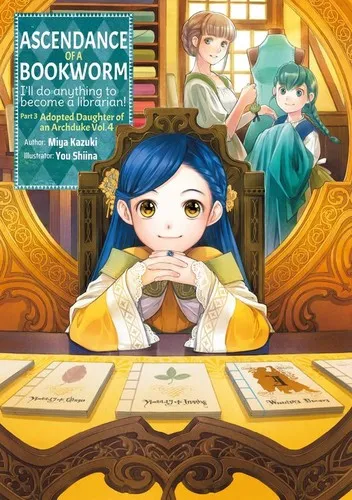
Ascendance of a Bookworm is a 33-volume commitment that earns every page. The world-building is meticulous. The protagonist is complex and flawed and grows in ways that feel genuine. The political intrigue gets more sophisticated with every Part. And the ending respects the journey.
It’s not for everyone. The slow start loses readers. The economic detail alienates some. The sheer volume count is intimidating. But for the readers who connect with it, there’s nothing else like it in the light novel space. I’ve seen people describe finishing Bookworm as leaving a void that no other series can fill. I felt the same way. And then I read the Hannelore sequel and felt slightly better.
This is the series I recommend first when someone asks me what to read. Not because it’s the easiest entry point (it isn’t). Because it’s the best story I’ve found in this medium. Thirty-three volumes of a girl who just wanted to read books, and ended up changing a world. If that doesn’t sound interesting on paper, I get it. But Kazuki made it the best light novel series I’ve ever read. Start with Part 1 Volume 1. Give it through Part 2. You’ll know.
FAQ
Is Ascendance of a Bookworm worth reading?
Yes, if you have patience for a slow-building story. Part 1 is the weakest section. The series improves dramatically from Part 2 onward. By Part 4, it’s the best ongoing light novel experience I’ve had.
How many volumes does Ascendance of a Bookworm have?
33 volumes across 5 Parts. Part 1: 3 volumes, Part 2: 4 volumes, Part 3: 5 volumes, Part 4: 9 volumes, Part 5: 12 volumes. The series is complete in both Japanese and English.
Is the Bookworm light novel finished?
Yes. The main series ended with Volume 33 (Part 5, Volume 12) in December 2023 in Japan and September 2024 in English. A sequel series following the character Hannelore is ongoing.
Is the light novel better than the anime?
Significantly. The anime covers only Parts 1-2 across three seasons and compresses heavily. The light novel has far more world-building and character development. The internal monologue alone justifies reading the source material. Season 4 (April 2026, Wit Studio) covers Part 3.
Where should I start reading after the anime?
After Season 3, start at Part 3 Volume 1. The anime covered Parts 1 and 2 (7 volumes). I’d recommend reading from Volume 1 for the full experience, since the anime compresses significantly.
Which Part of Bookworm is the best?
Part 4 (Royal Academy arc, 9 volumes) is widely considered the peak. Part 1 is the slowest. Part 3 has a rough start but becomes gripping. Part 5 has the biggest scope but some pacing issues in the middle.
Is Ascendance of a Bookworm similar to The Apothecary Diaries?
Yes. Both feature intelligent female protagonists navigating rigid social hierarchies through specialized knowledge. Both prioritize world-building over action. Bookworm is longer (33 volumes vs 16 ongoing) with deeper political complexity. Fans of either series regularly recommend the other.