

This article contains affiliate links. If you buy through these links, we earn a small commission at no extra cost to you.
I started High School DxD in 2016 on a dare. A friend who considered himself a shonen purist handed me volume 1 with genuine contempt and said “prove me wrong.” I read all four available volumes that weekend and ordered the next five from Amazon that Monday.
That was ten years and 25 volumes ago.
I’ve recommended DxD to more people than probably any other series I’ve pushed in that time, and gotten more defensive about it in reply than anything else I’ve ever suggested. So here’s the honest version: the one I wish I had before I started.
TL;DR
- High School DxD is a complete 25-volume supernatural battle series by Ichiei Ishibumi, published in English by Yen Press.
- The anime adapts only volumes 1-10; over 60% of the story is unadapted and only accessible in the light novel.
- Heavy ecchi is front-loaded in volumes 1-4 and never fully disappears. The world-building and character depth in volumes 7-18 are the series’ strongest arguments for itself.
- If the fanservice in volumes 1-4 does not lose you, the series earns the investment back substantially.

What Is High School DxD Actually About?
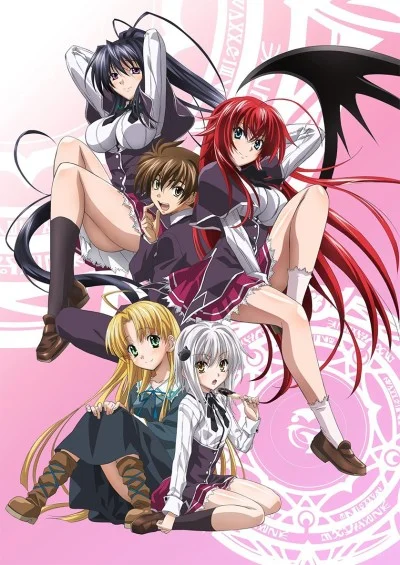
Issei Hyoudou is a second-year at Kuoh Academy. He’s a pervert. Not subtly — the series opens on him fantasizing about starting a harem and eyeing girls from behind a bush. His first-ever date ends with the girl revealing herself to be a fallen angel and stabbing him through the chest.
He wakes up as a devil.
Rias Gremory, heiress to one of the highest-class devil families, with the kind of presence that makes every scene heavier, has resurrected him as her Pawn using the Evil Piece system. It’s a chess-based structure where powerful devils collect and reincarnate humans into their peerage. Each piece type grants different abilities. Issei, as a Pawn, has eight pieces and the theoretical ceiling of a promoted Queen. His job is to serve Rias’s household and survive in a three-way political standoff between devils, angels, and fallen angels.

But here’s what makes it actually interesting: Issei awakened with the Boosted Gear, a Sacred Gear, a divine artifact embedded into a human soul, that houses the Welsh Dragon Ddraig. His ability doubles his power every ten seconds. The ceiling is theoretically infinite. The catch is that he starts from rock bottom and has to survive long enough to let it compound.
That’s the real premise. The ecchi is the packaging. The series underneath is about a protagonist who earns every power-up through stubborn effort and genuine emotional conviction, set inside a supernatural cosmology with more internal logic than most battle series bother with.
How Does the Light Novel Compare to the Anime?
Seasons 1 and 2 are solid adaptations. They cover volumes 1-4 reasonably well. The Rating Game against Riser Phoenix in volume 2 translates cleanly to screen, and the Excalibur arc in volumes 3-4 holds up. If you watched S1 and S2 and liked them, you already know you’ll like the light novel.
Season 3 BorN is where things fell apart. TNK crammed volumes 5-7 into one cour, then wrote an original ending for episodes 10-12 that directly contradicted established Sacred Gear mechanics and the internal logic of the Devil system. Author Ichiei Ishibumi confirmed publicly those episodes are non-canonical. When Passione replaced TNK for Season 4, they opened with an Episode 0 specifically to retcon BorN’s damage by re-adapting volume 8 before continuing the story. It’s a heavily documented canonical retcon, arguably the most egregious in modern ecchi anime.
Volume 8 matters. It contains the key development in Rias and Issei’s relationship that BorN skipped entirely. If you watched BorN and thought the emotional arc in Season 4 felt hollow, that’s the missing piece.
Season 4 Hero (2018) is actually good. Passione updated the art style to match Miyama-Zero’s illustrations more faithfully, and the adaptation of volumes 9-10 is the cleanest work since Season 2. Then the anime stops.
Volumes 11-25 are fully unadapted. That’s 15 volumes: over 60% of the main story. The Heroic Oppai Dragon arc (volumes 7-12), the Qlippoth arc (volumes 13-18), the Apocalypse arc (volumes 19-25). None of it has ever been animated. No Season 5 announcement as of April 2026, despite 7.8 million copies in print and a studio with 15 volumes of source material sitting ready.
The light novel’s biggest structural advantage over the anime is Issei’s internal monologue. It’s richer, more specific, and more emotionally honest than anything the adaptation conveys. His progression from volume-1 pervert to volumes-10-18 protagonist genuinely lands when you’re inside his head the whole way. The emotional scenes — and there are some that hit harder than I expected — work because you’ve built up that context.

Is the Ecchi Content Actually a Dealbreaker?
I’m going to give you the honest answer instead of the reassuring one: maybe.
The ecchi in DxD is front-loaded, unapologetic, and integral to Issei’s character as written. Volumes 1-4 are the most fanservice-heavy section of the series. His inner monologue in those chapters is exhausting if you’re not into it. He thinks about breasts constantly, comments on them constantly, and the narrative treats this not as a flaw to be corrected but as a defining feature.
Here’s what actually changes: around volume 5, the series starts stacking genuine stakes alongside the fanservice. By volume 8, Issei’s motivation has evolved into something more emotionally complex. He’s protective. He’s loyal. His “I want to be a harem king” framing starts to reveal itself as a cover for a protagonist who actually cares deeply about every person in his circle. Volumes 10-18 contain character work that moved me, and I was genuinely surprised it did.
But DxD does not become a battle series that happens to have some ecchi. It stays ecchi throughout. The fanservice does not fade as the story gets more serious. Both coexist for all 25 volumes. If you’re tolerating the opening chapters hoping it eventually disappears, it won’t. If you can enjoy both modes simultaneously, or actively enjoy the fanservice, this is a non-issue and the series rewards you substantially.
Quick note on the controversy: New Zealand’s Office of Film and Literature Classification banned it in 2014, claiming it normalized sexual pursuit of minors. They reclassified it as R16 in 2022 after a review. That controversy never spread to Japan, the US, or UK markets, and sales continued without disruption.

Which Arcs Are the Best — and Which Are Just Filler?
Community consensus and my own read align here: the Heroic Oppai Dragon arc (volumes 7-12) is peak DxD.
By volume 7, Issei has grown enough that you are actually invested in him. The arc introduces the Hero Faction, led by Cao Cao wielding a Longinus-class spear, and frames them as ideological opponents rather than flat power-level obstacles. The promotion exam in volume 12 is the climax the series builds toward for 12 volumes, and it delivers. The arc only partially made it into the anime — Season 4 covers volumes 9-10, leaving the best of it fully unadapted. If you’re deciding whether to commit, get yourself to volume 7 and judge from there.
Volumes 1-2 (the Red Dragon Emperor’s Awakening arc) are the entry point. Necessary, enjoyable, and the Rating Game against Riser Phoenix in volume 2 is one of the better battle climaxes in the early harem-battle genre. Volumes 3-4 (the Excalibur arc) are where Kiba Yuuto gets his backstory, which humanizes the peerage in ways the opener doesn’t bother with.
Volumes 13-18 (the Qlippoth arc) are the most divisive section. Issei’s death and revival as Pseudo-DxD in volumes 11-12 carries directly into here, and the arc introduces Evil Dragons as the primary antagonist force. The harem filler chapters scattered through this stretch feel repetitive between major beats. I’d call it uneven — the ceiling is high, the execution is inconsistent.
Volumes 19-25 conclude the series. Power scaling goes full god-tier. Trihexa’s release and the faction-wide alliance are massive in concept. The ending, for most readers, delivers. I found it satisfying. The earlier elegance of the chess system mapping character roles to actual tactical stakes gives way to energy-beam fights that are harder to track, but by volume 19 you’ve already made your judgment on the series.

What Are the Biggest Weaknesses Worth Knowing?
No series reaches 25 volumes without accumulating problems.
The ecchi front-loading in volumes 1-4 creates a real entry barrier for readers who’d genuinely enjoy the later arcs. It’s a packaging problem. The series inside volumes 7-18 deserves a wider readership than the opening will allow it.
Shin High School DxD, the sequel series, is on indefinite hiatus. Ishibumi cited health issues. The last volume came out in February 2020. That’s over six years with no new entry and no announcement of resumption. The story is unresolved. If you finish the main series and go looking for Shin DxD, you’ll find four volumes (no English license, though Baka-Tsuki fan translations exist for early volumes) and then nothing. That’s a real caveat for anyone who invests 25 volumes and wants a continuation.
Mid-series filler in volumes 13-18 has legitimate pacing issues. Harem dynamics that feel fresh in volumes 5-8 cycle through the same beats more mechanically here. It doesn’t wreck the arc, but it’s noticeable after several volumes.
Power scaling in the final arc loses clarity. The threats in volumes 19-25 are described as existential on a cosmological scale, and the precision of earlier Sacred Gear combat gives way to something harder to visualize.
Is the World-Building Actually Good, or Is That Just Fan Cope?
Genuine question people ask, because “the world-building is great” is what every fan says about every harem series to defend recommending it. So let me be specific.
The three-faction system is built with internal logic. Devils, Angels, and Fallen Angels carved up the supernatural order after a war that nearly destroyed all three. The peace treaty governing their coexistence has actual stakes and actual factions that want to break it for coherent reasons. The Evil Piece chess system maps character roles to real tactical functions: a Rook-class fighter behaves differently in combat than a Knight-class fighter or a Bishop-class magic user. Issei as a Pawn with eight pieces is mechanically interesting because Pawns can promote — it’s not just flavor, it shapes how his power growth works.
The 13 Longinus Sacred Gears are well-differentiated. Each one has a specific power with specific limitations. Cao Cao’s True Longinus, Issei’s Boosted Gear, Vali’s Divine Dividing. They interact with each other in ways that the narrative pays off. The mythology integration (Norse, Christian, Greek, Hindu, Celtic cosmologies woven into one framework) is ambitious and mostly coherent. It’s not perfect, but it does the work.
The community consensus that the world-building is DxD’s biggest selling point beyond the fanservice is accurate. It rewards investment.


Should You Read High School DxD?
If you watched the anime and liked it: yes, pick up the light novel. You’ve seen roughly a third of the series. Volumes 11-25 are sitting there unadapted, including the arcs the community cares most about.
If you tried the anime and dropped it because of the ecchi: the light novel is not going to solve that. The fanservice is consistent throughout. If S1 was unwatchable for you, the books are the same experience in a different format.
If you’re coming in fresh with a tolerance for ecchi and genuine interest in supernatural world-building: start with volume 1. Push through volumes 1-4 knowing they’re the most ecchi-heavy section of the entire run. Volume 5 is where the series starts to reveal itself. Volume 7 is where it commits.

Yen Press publishes the English editions. As of April 2026, they’ve released 15 volumes with volume 16 on the way. The remaining volumes (16-25) will likely trickle in through 2027-2029 at their current pace of 3–4 volumes per year. You can grab the series on Amazon here — volume 1 ISBN is 9781975312251.
For readers wanting similar series: Testament of Sister New Devil is the closest match for the ecchi/battle combination. Trinity Seven runs lighter on fanservice with a stronger magic system. How Not to Summon a Demon Lord gives you ecchi and battle in an isekai frame. Date A Live is a harem series with less fanservice and more romance focus. The Asterisk War covers the battle-school format if you want the action without the ecchi entirely.
High School DxD is exactly what it advertises, and significantly more than it looks like from the outside. The entry cost is real. The payoff is real too.