

This article contains affiliate links. If you buy through these links, we earn a small commission at no extra cost to you.
This post may contain affiliate links. If you buy something through one of those links, you won’t pay a penny more, but I’ll get a small commission that helps keep this site running.

Here’s the No Game No Life reading order: 1 through 10. In English. Published by Yen Press. Done.
That’s it. You don’t need a guide for this. There are no side stories with confusing placement. No alternate timeline novels. No “read volume 4 after volume 7 for the chronological experience” nonsense. NGNL is a straight line from the first page to the last published page and the order is the order they came out.
So why does this article exist?
Because the simple reading order hides a complicated reality. The anime covered volumes 1-3 and then volume 6 (as the Zero movie). Volumes 4, 5, and 7-10 have never been adapted. The Japanese release has 12 volumes but only 10 are in English. Yuu Kamiya publishes at a pace that makes George R.R. Martin look productive, with gaps of three to four years between volumes. The series isn’t finished. It might never be finished. The reading order is easy. The decision of whether to start (or where to pick back up after the anime) is the part that needs a guide.
TL;DR
No Game No Life has 10 English volumes (Yen Press) and 12 Japanese volumes. Read 1-10 in order. The anime adapted volumes 1-3 (Season 1) and volume 6 (No Game No Life: Zero movie), skipping volumes 4-5 entirely. If you watched the anime, start at volume 4. The series is on indefinite pseudo-hiatus with multi-year gaps between releases. Kamiya is both writer and illustrator, which explains the pace but doesn’t make waiting easier. No season 2 announced.
How Many Volumes Are There?
Twelve in Japanese. Ten in English. The gap matters.
Kamiya started the series in 2012 with MF Bunko J (Kadokawa). Yen Press picked up the English license and has published through volume 10. Volumes 11 and 12 exist in Japanese but don’t have English release dates announced. Fan translations cover the gap if you’re willing to go that route, but the official English release stops at volume 10 for now.
Here’s the timeline that tells you everything about the publication pace:
| Volume | JP Release | EN Release |
|---|---|---|
| 1 | April 2012 | March 2014 |
| 2 | September 2012 | July 2014 |
| 3 | January 2013 | November 2014 |
| 4 | May 2013 | March 2015 |
| 5 | December 2013 | July 2015 |
| 6 | January 2014 | January 2016 |
| 7 | July 2014 | July 2016 |
| 8 | March 2015 | January 2017 |
| 9 | August 2016 | August 2017 |
| 10 | July 2018 | May 2019 |
| 11 | ~2021 | TBA |
| 12 | ~2025 | TBA |
Volumes 1-8 came out at a reasonable clip, roughly two per year in Japan. Then the gaps opened up. Volume 9 to 10 was almost two years. Volume 10 to 11 was about three years. Then 11 to 12 was over four. Kamiya writes AND illustrates every volume himself. The art is spectacular. Some of the best in the entire LN medium. That dual workload is the reason for the pace, and it’s the reason most fans have made peace with it rather than getting angry. Hard to complain about slow releases when every volume looks like an art book that happens to contain a novel.
What Did the Anime Cover?

Season 1 (12 episodes, Madhouse, 2014) adapted volumes 1-3. Faithful adaptation. Madhouse’s color palette (those saturated pinks and purples) became iconic. The games translated well to animation. If you watched Season 1, you’ve experienced the core setup: Sora and Shiro arriving in Disboard, the Ten Pledges, the games against Steph, the Warbeast arc.
No Game No Life: Zero (movie, 2017) adapted volume 6. This is the prequel story set 6,000 years before the main timeline, following Riku and Schwi during the Great War before Tet established the Ten Pledges. The movie is beautiful, and it’s self-contained enough that you can appreciate it without the surrounding volumes. It also completely skips volumes 4 and 5.
That skip matters. Volumes 4-5 contain the Eastern Federation arc continuation and the Elven Gard arc, content the anime never touched. The movie jumped past it entirely. If you’ve seen the anime and the movie, you’ve read 1-3 and 6. Volumes 4, 5, 7, 8, 9, and 10 are completely new to you. That’s six unadapted volumes out of ten available in English.
The Full Reading Order
Read them in order. Every volume builds directly on the previous one. There’s no jumping around.
 game-no-life-vol1.jpg” alt=”No Game No Life Vol 1 light novel cover” class=”wp-image-2525″/>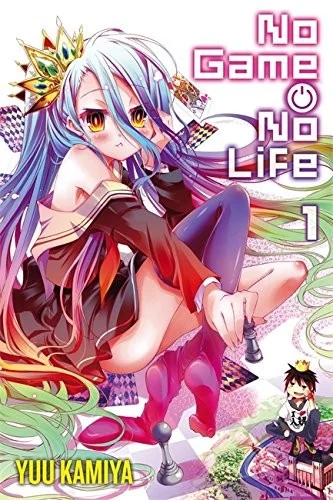

Volume 1 — Sora and Shiro arrive in Disboard. The blank siblings get summoned by Tet, the God of Games. The Ten Pledges establish the rules. The coronation game against Steph. This is the setup, and it’s efficient about it. Kamiya wastes no time.
Volume 2 — The Warbeast challenge begins. Izuna and the Eastern Federation. The first genuinely complex game in the series. This is where you start to see Kamiya’s approach to game design — the rules are explained, the loopholes are available if you’re paying attention, and Sora’s solution uses all of them.
Volume 3 — The Warbeast arc concludes. The full plan comes together. If you watched the anime, this is roughly where Season 1 ends. Imanity gains its second race piece.
Volume 4 — Where the anime left you hanging. The Elven Gard arc starts here. Sora and Shiro take on Elven Gard, and the political dynamics shift from straightforward challenges to something closer to geopolitical chess. The games get more abstract. The stakes get higher. This is the volume where the series stops being “two genius siblings play games” and starts becoming a meditation on what games actually mean in a world built on them.

Volume 5 — Elven Gard arc continues. The game against the Elves is unlike anything in the previous volumes. Kamiya structures it as a real-time strategy scenario with multiple moving parts and hidden information. Reading it is like watching someone play 4D chess while everyone else is playing checkers. Best game in the series up to this point.
Volume 6 — No Game No Life: Zero. The prequel. Riku and Schwi’s story. If you saw the movie, you’ve experienced this one. Reading it adds Kamiya’s prose and Riku’s internal monologue, which the movie compressed. The emotional payoff hits differently in text. You spend more time with Riku’s desperation and Schwi’s attempts to understand emotion. Worth reading even if you saw the movie.


Volume 7 — Back to the present timeline. The Dhampir arc begins. The game here involves an entirely new race and a mechanic that forces Sora into a position where his usual confidence doesn’t apply. The series’ emotional range expands. This is also where Kamiya starts dropping hints about the larger mythology of Disboard that pay off in later volumes.
Volume 8 — The Dhampir arc concludes. Some fans consider this the peak of the series. The final game in this arc is a multi-layered puzzle that operates on principles Kamiya established across the previous seven volumes. The moment you realize what Sora and Shiro’s actual plan was — not the surface plan but the real one underneath — is one of the best reveals in any LN I’ve read.
Volume 9 — The Old Deus arc begins. The scope jumps dramatically. Everything up to this point has been about collecting race pieces and outsmarting representatives. Volume 9 escalates to challenging entities that exist on a fundamentally different level. The rules of engagement change. The comedy-to-drama ratio shifts toward drama. Kamiya’s writing matures noticeably here.
Volume 10 — The last English volume. This is where Yen Press’s translation currently ends. The Old Deus arc continues with games that operate on metaphysical principles rather than the relatively grounded logic of earlier volumes. The series is clearly building toward something, and volume 10 ends in a way that makes the lack of volume 11 in English genuinely painful. You will feel the hiatus here.
Where Should You Start After the Anime?

After Season 1 only: Volume 4. The anime ended at volume 3. Volume 4 is entirely new content.
After Season 1 and the Zero movie: Still volume 4. The movie adapted volume 6, but volumes 4-5 are essential setup that the movie skipped. Read 4 and 5 first, then reread 6 if you want (or skip it since you’ve seen the movie). Then continue from 7.
Fresh start, no anime: Volume 1. The anime is good, but Kamiya’s prose adds layers the animation can’t capture. His author’s notes alone are worth the read — he explains his game design process and the mathematical principles behind each challenge. The art is obviously present in both formats, but the LN illustrations have a detail level that animation can’t match on a per-frame basis.
Should You Even Start This Series?
I include this section because every NGNL reading-order discussion eventually turns into the same question: “Should I read it if it might never end?”
My answer: read what exists. Ten English volumes is substantial. The games are some of the most clever writing in any LN. The art is peerless. And unlike series that only work as complete narratives (where an unfinished ending would ruin the experience), NGNL’s volume-to-volume game structure means each book delivers its own satisfying arc. Volume 10 ends on a forward-looking note, not a cliffhanger. You won’t feel cheated if the series never continues. You’ll feel frustrated, sure. Disappointed. Wistful. The standard emotions of the NGNL fandom for the past decade. Join the club. We’ve got strong opinions about publication schedules, and we’re used to waiting.
The alternative — skipping the series because it’s unfinished — means missing some of the best game theory writing in fiction. Kamiya constructs puzzles that respect the reader’s intelligence. He gives you the tools to figure out the solution before Sora reveals it, and when you can’t (which is most of the time), the reveal still makes logical sense rather than feeling like an asspull. That quality of writing doesn’t come with a completion guarantee, and waiting for one means you might wait forever.
What About Volumes 11-12?
Japanese only. No announced English release dates from Yen Press. Fan translations exist with varying quality. Volume 11 continues the Old Deus arc. Volume 12 released in late 2025 after the longest gap in the series’ history.
If Yen Press resumes the translation, the gap from volume 10 (May 2019 English release) means there would be at least a six-year pause in official English publication. That’s not unprecedented (some series have had longer gaps), but it’s worth knowing before you plan your reading around official releases.