
This article contains affiliate links. If you buy through these links, we earn a small commission at no extra cost to you.
This post may contain affiliate links. If you buy something through one of those links, you won’t pay a penny more, but I’ll get a small commission that helps keep this site running.
The No Game No Life anime is one of the best advertisements for a light novel that has ever been made. Madhouse took Yuu Kamiya’s first three volumes, gave them a color palette that looks like someone dropped acid inside a candy factory, and produced twelve episodes that made the entire anime community want a second season. That was 2014. It’s 2026. There is no second season.
The anime did its job too well. It sold people on a story that the adaptation barely started telling, then vanished. The Zero movie in 2017 adapted one more volume and also vanished. Twelve years of “No Game No Life Season 2 when?” memes, and the answer keeps being the same: read the light novel.
So here’s the actual comparison. What does the anime do better than the LN? What does the LN do that the anime can’t? And is this one of those cases where the source material is obviously superior, or is it more complicated than that?
More complicated. Obviously.
TL;DR
No Game No Life’s anime (Madhouse, 2014) adapted LN volumes 1-3 across 12 episodes. The Zero movie (2017) adapted volume 6. Volumes 4-5 and 7-10 in English have never been animated. The anime is a genuinely excellent adaptation with iconic visual design, but it covers roughly 30% of the available English story. The LN provides Kamiya’s game explanations in full, his author commentary on game design theory, and 6+ volumes of unadapted content including what most fans consider the series’ best arcs (volumes 7-8). No Season 2 is announced. The LN is the only way to continue past where the anime stops.
What Does the Anime Adapt?
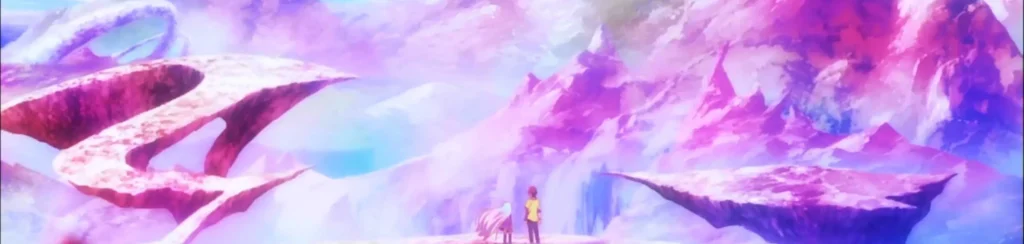
Season 1 covers volumes 1-3. Sora and Shiro’s arrival in Disboard through the Warbeast arc. The adaptation is faithful. Madhouse didn’t cut major plot points or rearrange arcs. The games play out the same way. The character introductions match. If you watched the anime and then read volumes 1-3, you’d recognize everything.
The Zero movie covers volume 6. Riku and Schwi’s prequel story during the Great War, set 6,000 years before the main timeline. This is where things get interesting for the comparison, because the movie completely skips volumes 4 and 5. The anime goes from volume 3 to volume 6, leaving two full novels of content in the gap. The Elven Gard arc, which many readers consider the point where the series’ games become genuinely complex, has never been animated.
After the movie: nothing. Ten English volumes exist. Four have been adapted. Six haven’t.
Where the Anime Wins
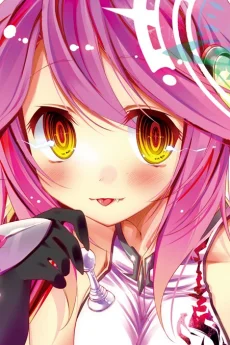
Madhouse’s visual design. Full stop. The saturated color palette that defines NGNL’s anime identity doesn’t exist in any other show. The pinks, purples, and teals of Disboard are so distinctive that a single screenshot is recognizable from across a room. Kamiya’s LN illustrations are excellent, but they’re static images in a book. Madhouse animated the aesthetic and made it iconic.
The games gain a dimension in animation. Reading about a game of materialization shiritori is engaging. Watching it play out visually, with the world transforming in real-time as objects are named and destroyed, adds spectacle that prose can’t replicate. The othello game against Jibril in particular benefits from animation because the visual escalation (continent removal, atmosphere stripping, the use of a hydrogen bomb as a game piece) creates a sense of scale that works better on screen than on the page.
Voice acting matters here more than in most adaptations. Sora’s confidence and Shiro’s quiet precision are performed well enough that many LN readers hear the VAs in their heads when reading subsequent volumes. The casting was that good.
The opening and ending themes are worth mentioning because they captured the series’ energy so perfectly that they became inseparable from the NGNL identity. Konomi Suzuki’s “This Game” isn’t just a good anime OP. It’s the NGNL OP. Twelve years later, it still shows up in “greatest anime openings” discussions.
Where the Light Novel Wins

The games. The games in the anime are entertaining visual spectacles. The games in the LN are puzzles you can actually follow. Kamiya doesn’t just show you that Sora figured out a clever solution. He explains the logical framework behind it. The rules of each game are laid out precisely. The constraints are defined. The information asymmetry between players is made explicit. When Sora’s strategy is revealed, you can trace the reasoning backward and see how each move built toward the result.
This matters most in volumes 4-5 (the Elven Gard arc) and volumes 7-8 (the Dhampir arc), which have never been animated. The games in these arcs are the most complex in the series. The Elven Gard game functions as a real-time strategy scenario with hidden information. The Dhampir game in volume 8 is a multi-layered puzzle that some fans consider the peak of the entire series. You cannot experience these in any other format right now.
Kamiya’s author notes. This is unique to the LN format. At the end of each volume, Kamiya writes afterwords where he discusses the game design process, the mathematical principles he used, and the real-world game theory concepts that informed each challenge. These notes are genuinely educational. They’re also funny, because Kamiya writes them in the same irreverent voice as his fiction. Losing these in the anime adaptation is understandable (afterwords don’t translate to screen), but they’re a meaningful part of the experience.
Kamiya’s art. He writes AND illustrates every volume. The LN illustrations are detailed, expressive, and frequently beautiful in ways that screenshots from the anime can’t match. A single Kamiya color illustration has the kind of compositional care that an animation studio distributes across hundreds of frames. The art is half the reason fans tolerate the glacial publication pace.
Worldbuilding depth. The anime gives you the surface of Disboard. The LN gives you the framework. The Exceed races, their abilities, their political structures, the implications of the Ten Pledges for each race’s survival strategy. All of this exists in the anime as background flavor. In the LN, it’s the foundation the games are built on, and understanding it makes the games more satisfying.
The Volume 4-5 Gap Is the Biggest Issue
The anime adapted volumes 1-3. The movie adapted volume 6. Volumes 4 and 5 don’t exist in animated form. This isn’t a case where the anime trimmed some content. It skipped two entire novels.
The Elven Gard arc in volumes 4-5 introduces Elven Gard’s political system, the machinations of their power structure, and a game against the Elves that functions differently from anything in the anime. The stakes are higher. The game mechanics are more complex. Sora and Shiro’s coordination reaches a level that the first three volumes only hinted at.
If you watched the anime and then the movie, you went from volume 3’s content to volume 6’s content with no bridge. The movie works as a standalone prequel, which is why this gap doesn’t feel jarring to anime-only viewers. They don’t know what they missed. Readers do.
What About Volume 6 Specifically?

The Zero movie is a good adaptation. The animation is gorgeous. Riku and Schwi’s story lands emotionally in both formats. If you saw the movie, reading volume 6 is optional but rewarding. Kamiya’s prose gives Riku more interior monologue than the movie can fit, and Schwi’s attempts to understand human emotion are described with a precision that the movie conveys through expression and voice acting instead.
The difference is in depth, not in substance. The movie tells the same story. The LN tells it with more texture. Neither version is definitively better. Both are worth experiencing.
Is the Source Material Always Better?
Not here. The NGNL anime is one of the rare cases where the adaptation adds genuine value that the source material doesn’t have. The visual design is transcendent. The voice performances are strong. The games gain a spectacle dimension that text can’t provide.
The LN is the more complete experience because it contains 60-70% more story, the game logic is deeper, and Kamiya’s dual role as writer-illustrator creates a unified artistic vision that the anime interprets rather than replicates. If you had to pick one format, pick the LN. More content, the author’s full intent, and the afterwords that the anime can never include.
The ideal path is both. Watch the anime for the visual experience of volumes 1-3 and the Zero movie for volume 6. Read the LN for everything else. Start at volume 4 after the anime.
Will There Ever Be a Season 2?
No announcement as of 2026. The gap is twelve years. Madhouse hasn’t indicated interest. The source material’s slow publication pace (multi-year gaps between volumes) makes a financial case for continuation harder. The community has largely accepted that the anime is a complete work at twelve episodes and one movie, even though the story it’s based on is far from done.
If a Season 2 were ever announced, the logical starting point would be volume 4 (Elven Gard arc). Six unadapted English volumes exist. The content is there. The demand is there. The production isn’t.
If you want to know the full volume lineup, check our No Game No Life reading order guide. For whether the series will ever wrap up, see our breakdown of whether NGNL is finished. And if you’re wondering whether the LN itself holds up, here’s our full review.