

This article contains affiliate links. If you buy through these links, we earn a small commission at no extra cost to you.
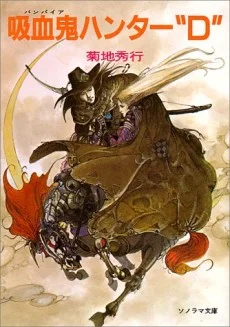
Most people know Vampire Hunter D from one of two anime films: the 1985 original or the 2000 sequel Bloodlust. Both are good. Both are also adapted from a novel series that now runs to over fifty volumes and counting. Two films. Fifty-seven novels. That ratio should tell you something about how much the anime left out.
I came to D backwards. Watched Bloodlust first because someone on a forum said it was “Castlevania before Castlevania existed.” Read the first novel a year later and realized the film I’d seen was based on book three. Not book one. Book three. The actual first novel — the one the 1985 film adapts — was a completely different story with characters I’d never heard of.
TL;DR
The two Vampire Hunter D films adapt novels 1 and 3 out of a 57-book series that’s been running since 1983. Thirty volumes are available in English through Dark Horse. The novels expand a post-apocalyptic gothic world that the anime barely introduces: vampire aristocracy politics, D’s origin as a dhampir, and decades of Frontier mythology the films never had time for. The prose is pulpy and the translation quality varies, but for dark fantasy fans, there’s nothing else like it.
What Do the Two Films Actually Adapt?
The 1985 film covers novel 1. D arrives in a frontier village, takes a job protecting Doris Lang after she’s bitten by Count Magnus Lee, fights the Count’s forces, and rides out. Basic structure: ronin comes to town, solves the problem, leaves.
Bloodlust (2000) adapts novel 3, “Demon Deathchase.” D is hired to rescue Charlotte Elbourne from the vampire noble Meier Link. He’s competing against a team of human hunters called the Marcus Brothers. The story is a pursuit across the Frontier with an actual moral question at its center: what if the vampire and the woman are genuinely in love?
Novels 2, 4, 5, 6, 7, 8, 9, 10, 11, 12… all the way to 57. None of them have been adapted into anime. That’s fifty-four novels with zero screen time.
What the 1985 Film Cut from Novel 1
The film kept the skeleton of the story but stripped out a lot of meat.
Rei-Ginsei. The novel has a significant human antagonist named Rei-Ginsei who runs a gang of mutants (Gimlet, Golem, Chullah) serving Count Lee. In the film, Rei-Ginsei’s role gets merged with the Count’s werewolf servant Garou. The novel version of Rei is more dangerous and more complicated — he tries to recruit D and offers him power. D refuses coldly. The film condenses all of that into a generic minion.
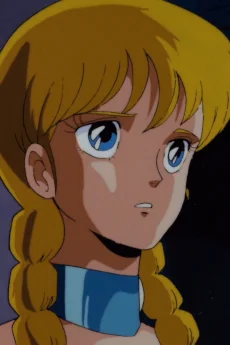
Doris Lang’s agency. This is the big one. Novel Doris is a frontier woman who fights. She shoots, she strategizes, she doesn’t just wait to be rescued. The film starts her strong but slides her into damsel territory by the midpoint. Kikuchi gave Doris real weight on the page. The anime gave her a supporting role in her own story.
The Nobility’s politics. Count Lee in the novel exists within a decaying aristocratic system. The vampires aren’t just monsters — they’re a feudal class losing grip on a world that’s moved past them. The film hints at this but doesn’t have time to develop it. In the novels, this becomes a recurring theme that spans dozens of books.
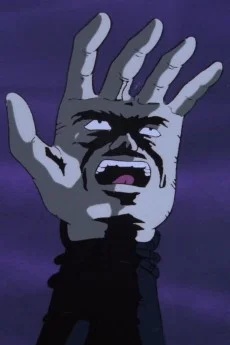
Left Hand’s personality. The symbiotic face in D’s palm gets a lot more dialogue in the novel. He’s funnier and more sarcastic. His relationship with D has texture that the film only sketches.
What Bloodlust Got Right (and Wrong) About Novel 3
Bloodlust is a better adaptation than the 1985 film. Director Yoshiaki Kawajiri at Madhouse had the budget and the skill to match the source material’s ambition. The Marcus Brothers, the chase structure, the moral ambiguity of Charlotte and Meier Link’s relationship — all of it lands harder on screen than it has any right to.
Where it falls short: Leila’s character arc gets compressed. In the novel, her backstory and her relationship with D have more room to breathe. The film hits the emotional beats but rushes the buildup. And the ending, which the film turns into a bittersweet visual montage, plays differently on the page. Quieter. Less cinematic. More lonely.
But honestly? Bloodlust might be the rare case where the adaptation rivals the source. The animation quality is that good. If someone told me Bloodlust was their favorite version of the story, I wouldn’t argue.
The Scope of What Anime Fans Are Missing
Here’s where the gap between two films and fifty-seven novels becomes absurd.
The Frontier — D’s world — is post-apocalyptic Earth roughly 10,000 years in the future. Nuclear war destroyed civilization. Vampires (the “Nobility”) ruled for millennia, genetically engineering monsters, building gothic castles with advanced technology hidden inside medieval aesthetics. Humans eventually revolted. The novels are set in the aftermath: the Nobility is dying out, and their castles are crumbling. D wanders through what’s left.
Every novel is essentially a standalone adventure. D arrives somewhere, encounters a problem involving vampires or their leftover creations, solves it, and rides off. The format is episodic. But across dozens of books, Kikuchi builds a world that’s absurdly detailed: different regions of the Frontier with distinct ecosystems, Noble families with their own histories and feuds, technological artifacts from the vampires’ golden age.
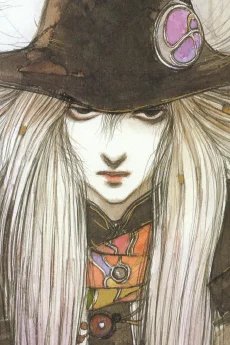
D is the son of the Sacred Ancestor — the most powerful vampire who ever existed. This gets hinted at early and confirmed gradually over the course of the series. It explains why D is so powerful, why other vampires react to him with a mix of fear and reverence, and why his internal conflict between human and vampire halves has actual stakes.
The anime films give you D the cool loner with a sword. The novels give you D the walking tragedy. Someone who can’t die, can’t belong anywhere, hunts his own kind across a world that fears him almost as much as it needs him.
Is the Novel Series Worth Reading?
Real talk: the prose is pulpy. Kikuchi writes action-heavy light novel prose from the 1980s. It reads like it. Sentences are short. Descriptions lean on atmosphere over precision. There are moments where the writing feels repetitive because the episodic format means each novel reintroduces D and Left Hand’s dynamic from scratch.
The English translation by Kevin Leahy (30 volumes through Dark Horse, the most recent being Gold Fiend in July 2024) is competent but uneven. Some volumes flow well. Others feel stilted. Dark Horse has also started releasing omnibus editions that bundle three novels per book, which is the cheapest way in.
But here’s the thing — if you like dark fantasy, there is nothing else that scratches this itch. The Frontier is a post-apocalyptic setting with more depth than anything else in the genre I’ve read. And D works as a protagonist precisely because Kikuchi doesn’t try to make him relatable. He’s half-vampire and functionally immortal. He’s deeply alone. The novels don’t fix that. They just keep putting him in situations where it matters.
Start with volume 1. If the tone works for you, you’ll know by page 50.
Anime Coverage Table
| Source | Adapted From | What It Covers |
|---|---|---|
| Vampire Hunter D (1985 film) | Novel 1 | D protects Doris Lang from Count Magnus Lee |
| Vampire Hunter D: Bloodlust (2000) | Novel 3 | D pursues Meier Link, competes with the Marcus Brothers |
| Novels 2, 4-57 | Not adapted | 54 standalone adventures across the Frontier |
Two films from fifty-seven novels. The anime barely opens the door.
FAQ
Is Vampire Hunter D a light novel?
Yes. The series started in 1983, written by Hideyuki Kikuchi with illustrations by Yoshitaka Amano (who also designed characters for Final Fantasy). It’s one of the longest-running light novel series in Japan with 57 volumes as of early 2025.
How many Vampire Hunter D books are there in English?
Thirty volumes are available in English through Dark Horse, translated by Kevin Leahy. The most recent release is Gold Fiend (volume 30) from July 2024. Dark Horse also publishes omnibus editions bundling three novels each.
Which Vampire Hunter D novel does Bloodlust adapt?
Novel 3, titled “Demon Deathchase.” The 1985 film adapts novel 1.
Is Hideyuki Kikuchi still writing Vampire Hunter D?
Yes. The 57th Japanese volume shipped in January 2025. A new serialization, “The Noble Butcher,” began in July 2025. Kikuchi has been writing the series continuously since 1983.
Where should I start reading Vampire Hunter D?
Volume 1. Each novel is largely standalone, but starting at the beginning gives you the foundational world-building and D’s relationship with Left Hand. The omnibus editions (Book One collects volumes 1-3) are the most cost-effective entry point.