

This article contains affiliate links. If you buy through these links, we earn a small commission at no extra cost to you.
This post may contain affiliate links. If you buy something through one of those links, you won’t pay a penny more, but I’ll get a small commission that helps keep this site running.

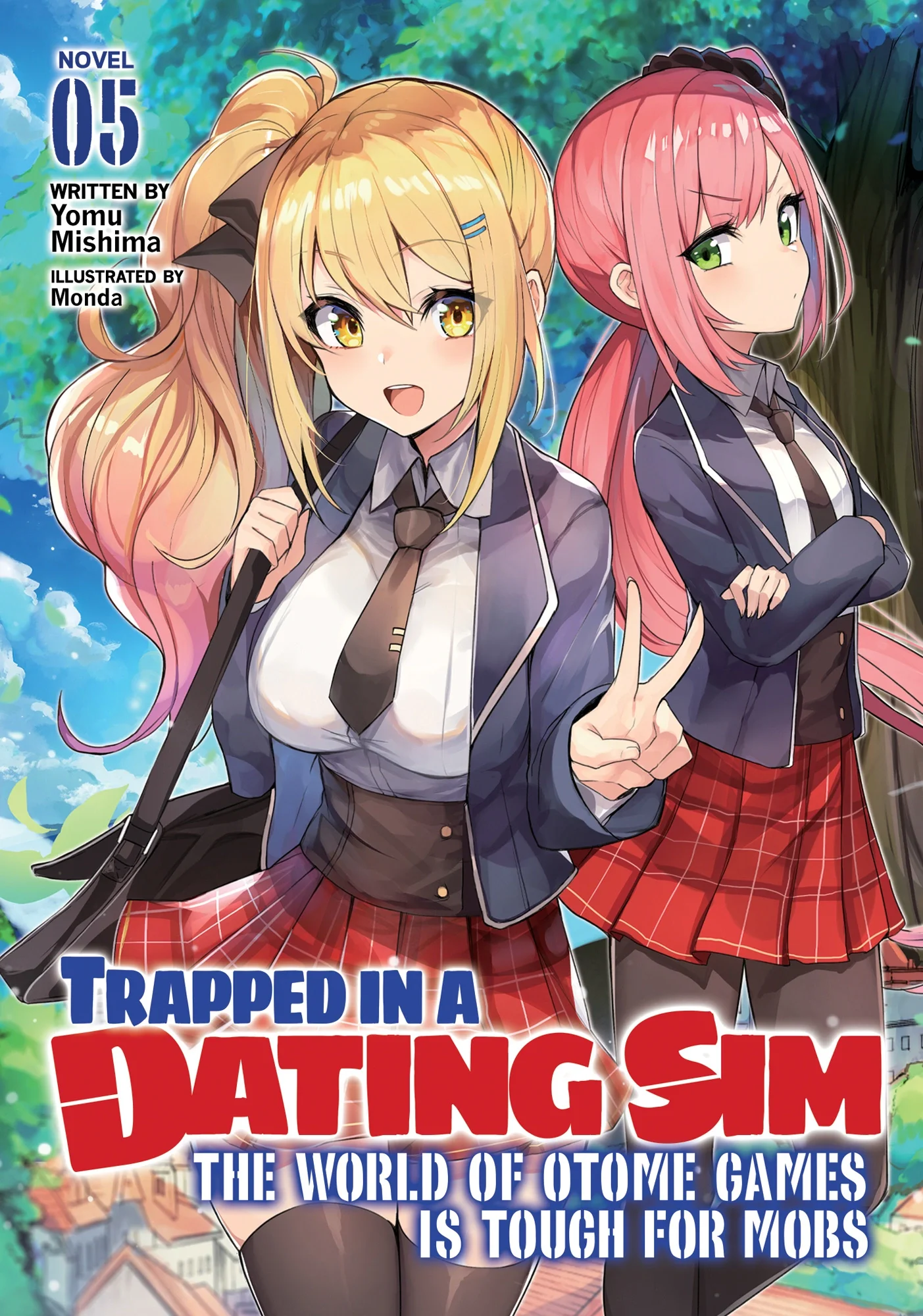
I picked up Trapped in a Dating Sim expecting throwaway isekai. The cover art looked generic. The title sounded like a gag premise that would run out of steam by volume three. The anime — the one season that existed when I started reading — had character designs so bad they became a meme before the first episode even aired. Every reason to skip this existed. I read it anyway because someone on Reddit called the Leon/Luxion dynamic “the best comedy duo in any LN” and that claim was outrageous enough to test.
They were right. I hate that they were right, because now I have to recommend a series with the word “dating sim” in the title to people who will absolutely judge me for it.
Trapped in a Dating Sim (Otome Game Sekai wa Mob ni Kibishii Sekai desu — Mobseka if you want the shorthand everyone uses) is a thirteen-volume light novel by Yomu Mishima. Complete. Published between May 2018 and March 2024. Seven Seas has all thirteen volumes in English. There’s also a web novel (176 chapters, also finished) and a manga adaptation that’s still ongoing. Season 2 of the anime hits in July 2026. If you’re here because that announcement made you curious about the source material, good instinct. The LN is where this story actually works.
TL;DR
Trapped in a Dating Sim is a 13-volume isekai LN where the protagonist gets reincarnated as a background character in an otome game world. Starts as sharp comedy, escalates into political intrigue and mech warfare. Leon Bartfort is one of the best isekai protagonists in the genre — cynical, competent, and genuinely funny. His AI companion Luxion steals every scene. The series peaks in volumes 5-9, stumbles slightly with compressed pacing in volumes 12-13, but delivers a complete and satisfying story. MAL score 8.00. Worth reading before Season 2 drops in July 2026, because the anime covered roughly 15% of the story with mediocre production quality.
The Premise Sounds Dumb Until It Isn’t
Leon Bartfort died in his previous life after being forced to complete an otome game by his sister. He wakes up reincarnated inside that game as a mob character — the kind of background NPC who exists to fill seats in the academy and get ignored by everyone who matters. The world runs on otome game logic: women hold social power and handsome princes dominate the hierarchy. Average-looking guys like Leon are invisible servants.
The joke is that Leon knows the entire game. Every route. Every hidden item. Every secret boss. He’s got the walkthrough memorized, and he uses it ruthlessly while maintaining a “just a humble mob” facade that fools absolutely nobody for longer than about two volumes.
That could have been the whole series. Overpowered protagonist exploits meta-knowledge in a fantasy school setting. We’ve seen that premise executed a dozen different ways, and most of them stop being interesting once the power fantasy runs out of opponents. Mishima knows that, and the evidence is in how fast Mobseka pivots. By volume 3, the school setting is already cracking open. Volume 5 drops you into the middle of a war that has nothing to do with dating sims. Volume 8, the scope has expanded to include lost civilizations, competing AI factions, and geopolitical conflicts that make the original otome game framework feel like a tutorial level.
The premise is the hook. What happens after the premise is the actual story.
Leon Bartfort Carries This Series

I need to talk about Leon because he’s the reason this works and the reason it doesn’t fall apart when the plot gets ambitious. Most isekai protagonists fit one of two templates: the power fantasy blank slate who exists for self-insertion, or the genuinely compelling character who happens to be overpowered. Leon is solidly in the second category, but with a twist that makes him more interesting than most. He doesn’t want to be the hero. Unlike the fifty other LN protagonists who claim to want a quiet life before accepting their destiny in chapter three, Leon genuinely means it. He resists the plot for multiple volumes. He tries to stay in the background, deliberately avoiding the main storyline events because getting involved means losing the comfortable mob existence he’s been building.
Circumstances drag him in regardless, because the game’s plot is collapsing without the original protagonist doing their job, and Leon is the only person who understands why everything is going wrong. His frustration at being forced into relevance is one of the best running jokes in the series. By volume 4 he’s openly complaining to Luxion about how being a hero is terrible for his social life, and by volume 7 he’s accepted his role while maintaining the grumpy baseline attitude that makes him fun to follow.
What makes Leon work beyond the comedy is that Mishima gives him real moments of vulnerability underneath the sarcasm. His cynicism isn’t a personality — it’s a defense mechanism from his past life. The series doesn’t make a huge deal out of this, which is the right call. It threads through his relationships with Angelica and Olivia in ways that feel natural rather than melodramatic. When Leon drops the act and says something genuine, those moments land because the humor around them has established a baseline that makes sincerity feel earned.
He’s also genuinely smart. Not “the author says he’s smart” smart. Leon makes tactical decisions during the combat arcs that you can follow and evaluate, and they mostly hold up. His approach to the mech battles in particular reads like someone who actually played the game and remembers which strategies work. There’s a fight in volume 6 where he exploits a terrain advantage that was foreshadowed two volumes earlier, and that kind of setup-payoff is rare in isekai writing.
Luxion Is the Real Co-Protagonist

I cannot overstate how much Luxion elevates this series. He’s an ancient AI weapon from a lost civilization that Leon discovers using his game knowledge. In gameplay terms, Luxion was a secret endgame item. In narrative terms, he becomes Leon’s constant companion and tactical advisor. Also, the source of approximately 40% of the series’ best lines.
The dynamic works because Luxion has opinions. Strong ones. He views Leon with a mixture of intellectual respect and emotional exasperation that reads like a long-suffering butler who’s been assigned to the worst master in history. Luxion’s deadpan commentary on Leon’s decisions — particularly the romantic ones — never gets old across thirteen volumes. That’s hard to pull off. Most comedy dynamics in LNs wear thin by volume five or six. Luxion stays fresh because Mishima keeps giving him new situations to react to, and his reactions evolve as the stakes change.
There’s a moment in volume 9 where Luxion’s backstory starts becoming relevant to the main plot, and it recontextualizes the entire relationship. I won’t spoil the specifics, but what felt like a comedy partnership gains a dimension of genuine stakes when you realize Luxion’s sardonic detachment might not be purely personality. The shift is subtle enough that you can miss it on a first read, and it rewards rereading the early volumes with new context.
The World Gets Bigger Than You Expect

Mobseka’s first two volumes are a school story. By volume 5, the school barely matters. The otome game world turns out to be a post-apocalyptic civilization built on the ruins of something much larger and much more dangerous than a dating sim. The mech combat that surprises anime-only viewers in the first season isn’t a gimmick. It’s the foundation of the setting’s military technology, inherited from a previous civilization whose remnants — including Luxion — are scattered across the world.
This expansion works because Mishima builds it gradually. Each volume adds a layer to the world without retconning what came before. The academy politics of volume 1 feed into the kingdom-level conflicts of volumes 3-4, which connect to the inter-kingdom wars of volumes 5-8, which eventually lead to revelations about the world’s origin in volumes 9-11. The scope gets legitimately ambitious. Not “we’re fighting a god now” ambitious in the lazy power-scaling way. Ambitious in the sense that the political alliances, resource wars, and technological mysteries create a world that feels lived-in and internally consistent.
The weakest part of the worldbuilding is the Republic arc in the middle volumes. Mishima introduces a new set of characters and a new political entity that takes screen time away from the main cast. Some readers love this section — it does interesting things with the otome game conceit by introducing a second game’s world. The pacing flags, though. Leon is less central. Luxion has less to do. The new characters need development time that the series arguably can’t spare given its thirteen-volume constraint. I enjoyed it on a plot level but missed the core cast’s energy.
The Romance Is Messy (On Purpose)

This is a harem series. That comes with expectations and baggage, and I think Mobseka handles it better than most while still stumbling in predictable places.
Angelica and Olivia are the primary love interests. Angelica is a disgraced noble whose engagement to the prince was publicly broken. She starts the series as a proud woman who’s been humiliated. Her arc across thirteen volumes tracks her rebuilding her identity independent of the social systems that defined her worth. It’s genuinely good character writing for this genre. Olivia is the original game’s protagonist — a commoner scholarship student who was supposed to romance the academy’s pretty boys. In Leon’s disrupted timeline, she ends up sidelined from her own story. The dynamic between her growing resentment at losing her narrative role and her genuine affection for Leon creates tension that Mishima handles with more nuance than you’d expect.
Marie deserves separate mention. She’s Leon’s sister from his previous life, also reincarnated, and she’s been trying to play the game properly by capturing all the love interests for herself. The reveal of her identity and her relationship with Leon is one of the series’ best moments. Their sibling dynamic — antagonistic but fundamentally caring — adds an emotional dimension that most isekai harem series don’t have access to because they don’t have this kind of structural relationship baked into the premise.
Where the romance stumbles is in resolution. Mishima clearly set up a polyamorous endgame from early on, but the execution in the final volumes feels rushed. Characters who’ve had volumes of development get their romantic conclusions compressed into a few pages. The emotional payoffs are there in broad strokes, but they needed more space. This is the thirteen-volume constraint at work. Fourteen or fifteen would have let these threads breathe.
Pacing: Strong Start, Strong Middle, Compressed End
Volumes 1-2 are a tight, funny introduction. The next two escalate the stakes convincingly. Volumes 5-9 are the peak of the series — the war arcs, the Luxion revelations, the best character moments for Leon and the core cast. This is where Mishima’s writing hits its stride. The comedy and drama balance is nearly perfect. Fights have both spectacle and strategy. The political maneuvering feels real.
Volumes 10-11 are solid but feel transitional. The Republic arc introduces necessary worldbuilding but slows the momentum. Volume 12 starts the finale and volume 13 ends it, and both are too compressed. Plot threads that deserved full volumes get chapters. Character beats that needed room to land get paragraphs. The ending itself is satisfying — Leon’s arc concludes in a way that feels true to who he’s been since volume 1. The journey to that ending moves too fast in its last stretch, though.
This is a common problem with complete LN series. When an author knows the ending and the publisher has agreed on a volume count, the final act often feels squeezed. It happened to Konosuba (though less severely). It happened to Goblin Slayer‘s web novel. Mishima doesn’t botch the landing. The ending works. You can feel the constraint.
Who Should Read This
If you liked Konosuba’s comedy but wanted more plot. Overlord‘s “protagonist doesn’t fit the genre they’re in” energy but with a lighter tone. Or maybe you read Re:Zero and thought “what if the protagonist actually complained about being the hero instead of suffering in silence.” Mobseka isn’t directly comparable to any of these, but it shares DNA with all of them.
The mech combat will either be a selling point or a turnoff depending on your tastes. It’s not hard sci-fi mecha — think closer to fantasy robots than Gundam. If you bounced off the idea because the title says “dating sim,” give it three volumes. The dating sim framework is scaffolding that gets replaced by something more ambitious.
Who Should Skip This
If harem dynamics are a hard no regardless of execution quality. If you need the romance to be the central focus rather than a subplot that runs alongside political intrigue. If compressed endings frustrate you enough to ruin the journey. Or if you’re exclusively interested in the anime — Season 1 adapted two out of thirteen volumes with production quality that became a community joke. The anime is a trailer for the LN. The LN is the actual product.
How Does It Compare to the Anime?
The anime covered volumes 1-2. ENGI’s production was functional at best. The character designs were the biggest issue — the eyes became a meme the moment the first trailer dropped. Every Reddit thread, every forum post, every comment section was people saying some variation of “they did the girls dirty.” Angelica’s LN illustrations are gorgeous. Her manga design is great. The anime version looked off in a way that undercut the entire visual appeal of the series. Same for Olivia. Same for everyone.
Voice acting saved it. Leon’s VA nailed the sarcastic energy. Luxion’s delivery was perfect. The Leon/Luxion banter in audio form was strong enough that fans recommended watching the anime purely for their scenes. Visually, the anime undersold everything the source material does well.
Season 2 arrives July 2026 with new character designs based on community feedback. Whether it improves enough to match the source material is an open question. What I can say is that thirteen volumes of story exist, the anime has covered two of them, and even in the best-case scenario where every future season is perfectly adapted, you’re looking at six or seven seasons to cover the full story. Read the LN.
The Marie Route (Side Story)
After you finish the main thirteen volumes, there’s the Marie Route — an alternate timeline where Leon successfully stays a mob character and Marie takes on the protagonist role more directly. Nineteen chapters. Same cast, different outcomes. It’s lighter than the main series and works as a palette cleanser after the compressed finale. Not essential, but worth the read if you want more Leon/Luxion banter in a lower-stakes setting.
Final Verdict
Mobseka is a smarter series than its title suggests. Leon is a top-tier isekai protagonist. Luxion is the best AI companion character I’ve read in any LN. The worldbuilding expands from dating sim comedy to something genuinely ambitious without losing the humor that makes the early volumes work. The ending is rushed but functional. The romance is messy but honest about being messy. Thirteen volumes. Complete. All in English. With Season 2 dropping in July 2026, there’s no better time to start reading a series that most people dismissed based on a title and a terrible anime character design.
Start from volume 1. You’ll know by volume 3 whether this is for you. If Leon’s brand of sarcastic competence clicks, you’ve got ten more volumes of escalating stakes and Luxion’s contempt to look forward to.