

This article contains affiliate links. If you buy through these links, we earn a small commission at no extra cost to you.
If you only know this series from the anime then I need you to forget everything about it for like five minutes cause the light novel is a completely different experience and I’m not saying that the way people usually say it where they mean “the source material is a little better.” I mean the anime actively damaged this series’ reputation to the point where most people don’t even know the LN is good, and that’s a shame cause what nigojuu built here is one of the more unique things happening in the light novel space right now.
I picked this up after someone on r/LightNovels basically said “ignore the anime and read the novel, the mystery is actually worth your time” and I went in skeptical cause, you know, I watched the anime. The car png. The out-of-order adaptation. The MAL score sitting at 6.44 which is genuinely rough for a series that had that much pre-air hype. But they were right and I burned through both official EN volumes in a day and then went straight to the fan translations cause I couldn’t stop, which should tell you something about how well the mystery hooks you once it’s presented the way nigojuu intended.
TL;DR
- The Detective Is Already Dead (TanMoshi) is a mystery-romance-supernatural light novel that’s significantly better than its anime suggests. The story follows Kimitsuka, former assistant to a legendary detective named Siesta who died before the series begins. The hook is the contrast between past timeline adventures and present aftermath, woven together with a deepening mystery about Siesta’s legacy, a criminal organization called SPES, and the girls connected to Siesta’s past. 13 volumes ongoing in Japan, 2 in English (Yen On). MAL LN score: 7.71. Season 2 Fall 2026.
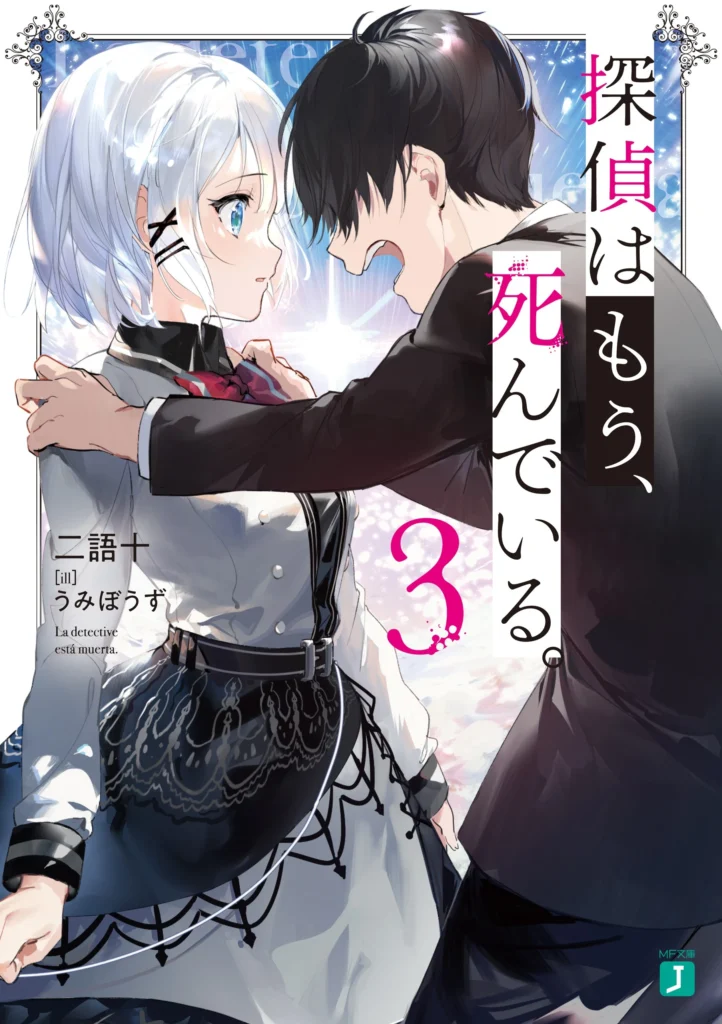
The Mystery That Actually Works

The premise sounds straightforward: a detective dies, her former assistant has to move on. But what nigojuu does with that premise is a lot more layered than the summary suggests, and I want to say the way it unfolds across the first few volumes is genuinely clever in a way that I didn’t expect from a series that got marketed as a rom-com mystery. Siesta isn’t just dead. Her legacy is alive in ways that are sometimes literal and sometimes metaphorical, and the line between the two keeps shifting as the story progresses.
Kimitsuka and Siesta’s past adventures are told through flashbacks that run alongside the present timeline, and the contrast between the two is where the series finds its emotional core. The past is fun, it’s adventurous, there’s banter and globe-trotting detective work and a criminal organization called SPES causing problems. The present is melancholic, quieter, defined by absence. Kimitsuka is surrounded by girls who are all connected to Siesta in different ways and he has to figure out what those connections mean while also dealing with the fact that the most important person in his life is gone (or is she, cause the series plays with that question in ways I won’t spoil but trust me it gets complicated).
The mystery structure is what separates TanMoshi from other LN mystery series and I want to be clear about what I mean by that. This isn’t a case-of-the-week detective story. The mystery is the entire narrative framework. Who was Siesta really? What is SPES after? Why does Nagisa have Siesta’s heart and what does that actually mean? Each volume answers some questions and introduces new ones, and nigojuu is good at making the reveals feel earned rather than pulled out of nowhere. I’ve read mystery LNs where the twists feel random and disconnected from the setup (I’m looking at you, Danganronpa spin-off novels) and TanMoshi doesn’t have that problem, at least through the volumes I’ve read.
The Characters

Kimitsuka is interesting in a way that the anime completely failed to convey. In the anime he comes across as a generic protagonist who things happen to. In the LN you get his internal monologue and it turns out he’s genuinely perceptive, self-deprecating in ways that are funny without being annoying, and carrying more emotional weight than he lets on. His self-description as someone who “attracts trouble” is played for laughs but there’s a real sadness underneath it that becomes more apparent as the series goes on and you realize the trouble he attracts has cost him people he cares about.
Siesta is the standout though and I think she’s one of the more memorable characters I’ve encountered in the medium in a while. She’s dead at the start of the series and she’s still the most interesting person in it, which is a weird thing to pull off and I’m honestly not sure how nigojuu manages it. Her presence in the flashbacks is magnetic (she’s smart, irreverent, clearly hiding things behind her playful exterior) and her absence in the present timeline creates this vacuum that every other character is responding to whether they realize it or not. That’s impressive character work for someone who technically isn’t alive for most of the story.
Nagisa received Siesta’s heart through a transplant and bears a resemblance to her, which is either a coincidence or something much deeper depending on how far you’ve read. I want to say her arc is the one that surprised me the most cause it goes in directions I wasn’t expecting and the emotional payoff in volume 2 in particular hit harder than I thought it would. Yui and the SPES-adjacent characters add complexity but I’ll be honest I think some of them are stronger than others and a couple of the antagonist reveals felt a bit convenient, though that might change as I read further in the fan translations.
The comparison I keep reaching for when people ask what this reads like is some unholy blend of Monogatari and your standard MF Bunko J rom-com, and the comparison only half works, which might be the point. It has Monogatari’s thing where the supernatural elements are really just delivery mechanisms for character psychology, and Kimitsuka’s narration has a little of that Araragi self-awareness, minus the parts of Araragi that make you want to close the book and take a walk. But it’s also breezier than Monogatari, more willing to just be a fun light novel for a chapter at a time, and the mystery spine gives it forward momentum that Monogatari never really cared about having. I don’t know. Every time I try to place this series next to something else the fit is wrong in some way, and I’ve mostly decided the lack of a clean comparison is the recommendation.
The Honest Negatives

The “detective” label is kind of misleading and I think it sets up wrong expectations for some readers. If you go in expecting Hyouka-style deductive reasoning or Holmes-like case solving you’re going to be disappointed cause TanMoshi is more supernatural drama than pure mystery. The mystery elements are there and they’re good, but the series is equally interested in romance and character drama and supernatural plot mechanics, and some readers find that blend works against the tension rather than enhancing it (I personally think it works but I can see the argument).
The early timeline jumping can be disorienting. Volume 1 in particular jumps between past and present in ways that aren’t always clearly signposted, and I remember being confused about when certain events were happening relative to each other. By volume 2 the structure clicks and it stops being an issue, but that first volume confusion is real and I’ve seen it cited as the reason people dropped the series, which is unfortunate cause they’re dropping it right before it gets good.
The harem-adjacent elements exist and they’re exactly as awkward as you’d expect. Multiple girls connected to the protagonist through a dead woman whose legacy binds them together, that’s the setup for a harem whether nigojuu intends it that way or not. The series handles it better than most LNs handle that dynamic (the girls have their own arcs and motivations beyond “likes MC”) but if you’re allergic to even the suggestion of harem elements in your mystery series, fair warning.
And the EN release is at 2 volumes out of 13. I’m not going to belabor this cause I covered it in the reading order article but it’s relevant to a review recommendation: telling someone “you should read this” hits different when the official version is barely started and the alternative is fan translations of inconsistent quality.
Who Should Read This
If you watched the anime and thought “this had potential but the execution was terrible,” the LN is the version where the potential is realized. The mystery structure works when presented in order, Kimitsuka is a better character with internal monologue, and Siesta’s presence carries more weight in prose than it did in a season of questionable animation.
If you want something in the mystery-romance-supernatural space that isn’t doing what every other series does, TanMoshi is genuinely unique in the LN medium. I can’t really name another series that does the same thing, and I’ve been reading LNs long enough that “I can’t name a comparison” actually means something to me cause usually I can point to three similar series for anything.
If you need your mystery to be pure deduction with no supernatural elements, or if you need a complete EN release before committing, this might not be the right time for you. But the series is worth keeping on your radar cause S2 is coming Fall 2026 and Yen On will eventually catch up, and when they do this is going to be one of those series people wish they’d started earlier.
[…] the LN then has to untangle, and that’s not a great way to experience a mystery series. The review goes deeper into why the LN works as well as it […]