

Ascendance of a Bookworm has a light novel. It has an anime. It also has manga. Five separate manga series, each drawn by a different artist, each covering a different “Part” of the story. Parts 3 and 4 are still being published. Part 5 just launched in January 2026. The English translations are split between two publishers. The whole manga collectively covers maybe half of the 33-volume light novel.
You just finished the anime. You want more. The manga looks appealing — visual storytelling, familiar characters, easier entry than dense prose. The Bookworm community has strong opinions about this choice, though, and they lean heavily in one direction. Here’s the full breakdown.
TL;DR
- Ascendance of a Bookworm has 5 separate manga adaptations covering Parts 1-5 of the light novel, drawn by three different artists
- Parts 1-2 are complete. Parts 3-5 are ongoing
- English translations exist through J-Novel Club (Parts 1-3) and Yen Press (Part 4), but lag behind the Japanese releases
- The light novel is the complete version of the story at 33 volumes. Community consensus is clear: read the LN first, use the manga as a visual supplement
How Is the Bookworm Manga Structured?
Unlike most light novel adaptations that get a single manga, Bookworm splits its manga across five separate series that match the LN’s five-part structure. Each Part is essentially its own manga title, and they’ve been serialized in parallel rather than sequentially. This creates a situation where Part 4 has 11 volumes published in Japan while Part 2 only finished in September 2025.
Here’s the full map:
Part 1, drawn by Suzuka, ran from 2015 to 2018. Seven volumes. Complete. This covers Myne’s early days as a commoner’s daughter learning to make paper and simple books. Suzuka’s art is rounded and expressive, with soft linework that matches the cozy crafting tone of the early story.
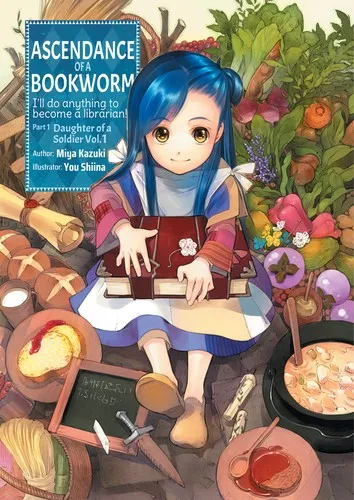
Part 2, also drawn by Suzuka, ran from 2018 to September 2025. Thirteen volumes. Complete. This covers Myne’s time at the temple as an apprentice shrine maiden. Suzuka’s consistency across Parts 1 and 2 means the visual style stays cohesive for the first 20 volumes of manga.
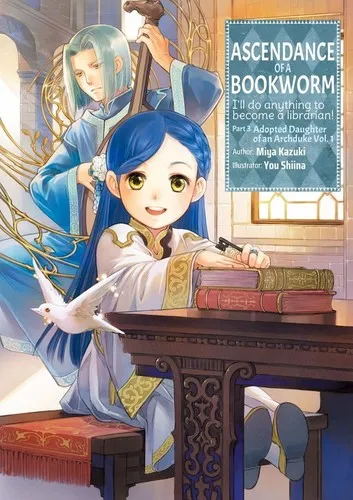
Part 3 is where things shift. Ryo Namino took over as artist, serializing through Niconico Seiga starting in 2018. This covers the Adopted Daughter arc, and it’s still ongoing with at least 9 Japanese volumes. Namino’s style is cleaner and more defined than Suzuka’s, which fits the noble court setting but creates a noticeable visual break from Parts 1-2.
Part 4, drawn by Hikaru Katsuki, started in December 2020 and has 11 Japanese volumes. Still ongoing. Katsuki brings yet another visual interpretation to the characters, and by this point you’re looking at your third distinct art style for the same cast.
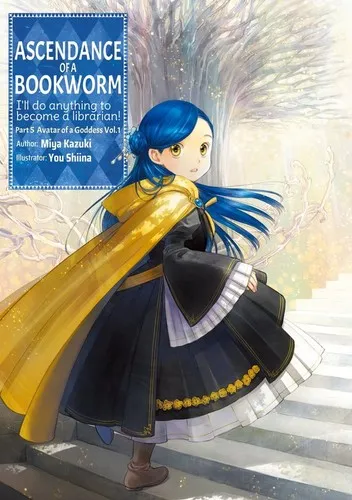
Part 5 launched in January 2026 with Suzuka returning as artist. Only a few chapters exist so far. There’s also a spinoff, Hannelore’s Fifth Year at the Royal Academy, drawn by Rei Kusakabe, which started in September 2025.
One r/HonzukiNoGekokujou user mapped the chaos clearly: “The first part is fully done and translated. Part 2 is about 90% done and 75% officially translated. Part 3 is about halfway done and 1/3 translated, done by a different manga artist in parallel to Part 2. Part 4 is about 1/3 done and less than 10% translated, by a third manga artist.”
That parallel production is the key difference from other LN manga approaches. Bookworm’s manga Parts overlap in production. You can be reading Part 4 chapters in Japanese while Part 2 is still releasing in English. It’s a scheduling puzzle that the light novel simply doesn’t have.
Does the Manga Have Official English Translations?
Yes, and this is actually a significant advantage over many LN-to-manga adaptations. It’s complicated, though.
Parts 1 through 3 are published in English by J-Novel Club, the same publisher handling the light novel translation for those parts. Physical print editions exist. Part 4 switched publishers to Yen Press, with Volume 1 releasing in December 2025 and Volume 2 in April 2026. Part 5 has no English announcement yet.
The translation gap is real though. Parts 3 and 4 in English are well behind the Japanese releases. Several volumes of Part 3 and most of Part 4 remain untranslated. One community member broke down the gaps: “Part 2 volume 12 and 13 have not been translated yet. Part 3 volumes 6 through 9 are not translated. Part 4 volumes 7 through 11 are not.”
So even with official translations, you’re going to hit walls. The light novel, by contrast, is fully translated in English. All 33 volumes of the main story plus side story collections and fanbooks are available through J-Novel Club.
What Does the Manga Cut From the Light Novel?
This is where the conversation gets one-sided. Heavily.
Bookworm’s defining quality as a light novel is its density. Myne’s first-person narration carries the entire story, and Kazuki Miya (writing as Miya Kazuki) packs every volume with worldbuilding detail that most authors would spread across three books. The papermaking process. The ink recipes. The social hierarchies of the temple. The exact mechanics of mana compression. The political maneuvering between noble factions. None of this is filler. It all feeds into the plot eventually, sometimes volumes later.

The manga compresses or eliminates most of Myne’s internal monologue. In the light novel, you spend pages inside her head as she calculates her next move, draws on her past-life knowledge, or processes the gap between her modern Japanese sensibilities and the medieval world’s brutal class system. The manga shows her actions but can’t reproduce the reasoning behind them. When Myne makes a decision that seems impulsive in the manga, it’s often because the three paragraphs of deliberation that preceded it in the LN got cut for space.
The side character perspective chapters take the hardest hit. The Bookworm LN is famous for its POV shifts. Full chapters from Ferdinand’s perspective. Scenes showing how nobles perceive Myne’s disruptive behavior. Bezewanst’s scheming seen from inside his own head. These chapters are what transform the series from “girl makes books” into a political drama with dozens of moving pieces. The manga can’t include most of them without grinding its pacing to a halt.
u/shaddura put it directly in r/HonzukiNoGekokujou: “the light novel is the source material, and the manga is another adaptation (which is even less comprehensive than the anime).”
That’s a striking claim. The manga, despite being a visual medium with more space per volume than a 24-minute episode, actually covers less ground than the anime adaptation in some areas. The anime at least compressed all of Parts 1 and 2 into three seasons. The manga is still catching up on Parts 3 and 4 years later.
u/RozeTank reinforced this: “I’ll be frank, both the anime and manga have no way of fitting the amount of detail that” the LN contains. u/Aliatana added: “A lot of the world building and lore of magic is cut, and several characters are introduced late and scenes cut. The LNs also have tons of side stories from other characters which helps make all the characters more fleshed out.”
What Does the Manga Do Well?
The manga isn’t worthless. It fills a role that the other formats can’t.
Suzuka’s artwork for Parts 1 and 2 is genuinely charming. Her character expressions capture Myne’s theatrical reactions and Ferdinand’s barely-concealed exasperation in ways that add personality the prose can only describe. The manga’s visual comedy beats land differently than the LN’s written ones. Myne’s chibi rage faces. Benno’s incredulous stares. The physical comedy of Myne collapsing from mana overuse. These moments work better in panels than in paragraphs.
The worldbuilding gets a visual anchor. The LN describes the temple architecture, the noble estates, the classroom layouts. The manga draws them. If you’ve read the LN and wondered exactly what Ehrenfest’s castle looks like, or how the noble’s quarter is spatially arranged relative to the temple, the manga provides answers that the LN’s sparse illustrations don’t.
Character designs get fully realized. The LN has You Shiina’s beautiful illustrations, but they’re limited to a few per volume. The manga shows every character in every scene, which means you get visual interpretations of minor characters who never received an official illustration in the LN. For a series with a cast as large as Bookworm’s, that visual reference library has real value.
Part 3 under Ryo Namino deserves specific mention. The transition to noble society comes with a shift to more detailed architectural backgrounds and formal character posing that matches the story’s tonal change. Whether you prefer Suzuka’s warmth or Namino’s precision is personal taste, but the fact that the art style evolves with the story’s setting is a deliberate choice that works.
Should You Read the Light Novel or the Manga?
The light novel. Not close. The Bookworm community is emphatic about this.
When someone posts “where do I start after the anime?” on r/HonzukiNoGekokujou, the responses are variations of the same answer. u/mrdumbazcanb: “Do the light novels. The Manga for each part is at different states of completion.” u/MangoTurtl: “I’d heavily encourage you to just read the LN. From the start.” u/ManinaPanina: “From the start. There’s too much extra info in the LN, a lot of chapters from other people’s perspectives. You’ll NOT understand essential characters if you don’t read it from the beginning.”
The practical argument is straightforward. The light novel is complete at 33 volumes. Every volume is translated in English. You can read from Part 1 Volume 1 to Part 5 Volume 12 without hitting a single gap. The manga has two completed parts and three ongoing ones at various stages. English translations lag behind by years. You’re also buying from J-Novel Club for some parts and Yen Press for others.
The storytelling argument is even stronger. Bookworm is a series built on accumulated detail. Myne’s schemes work because you’ve spent volumes understanding the social rules she’s exploiting. Ferdinand’s protectiveness makes sense because you’ve read his POV chapters showing what he sees in Myne that reminds him of his own past. The political betrayals in Part 4 land because you’ve tracked the noble faction dynamics across hundreds of pages. The manga gives you the events. The LN gives you the understanding.
u/Sneaky_Snivy227 made a practical point that often gets overlooked: “the manga volumes are literally the same price as the light novels and, yet, they’re thinner than the light novels.” You get less story per dollar with the manga. For a series this long, that cost difference adds up.
Can You Use the Manga as a Supplement After the LN?
This is where the manga earns its place, and several community members describe exactly this approach.
u/Mysterious-Hurry-758 nailed the use case: “don’t read the manga for story. Read the LN and then read the manga for extra clarification on what stuff like buildings and servants moving around looks like.” That’s the right framing. The manga is a visual companion, not a narrative replacement.
The best manga parts for supplementary reading:
Part 1 (7 volumes, Suzuka) is the easiest recommendation. Complete. Fully translated. It covers the cozy crafting section of the story where visual worldbuilding adds the most. Seeing Myne’s paper-making process drawn out panel by panel is satisfying after reading the LN’s technical descriptions.
Part 2 (13 volumes, Suzuka) covers the temple arc and is now complete in Japanese. Suzuka’s character work with Ferdinand is a highlight. The visual dynamics between Myne and the temple hierarchy translate well to manga format.
Part 3 (Namino, ongoing) and Part 4 (Katsuki, ongoing) are harder to recommend as supplements because they’re incomplete. Starting a manga arc and then hitting an untranslated wall at volume 6 is frustrating. Wait for more volumes to accumulate before diving in.
Part 5 just started. Four chapters exist. Check back in 2028.
What Is the Bookworm Manga Reading Order?
If you decide to read the manga, follow the Part numbering: Part 1, then Part 2, then Part 3, then Part 4, then Part 5. Don’t read them in parallel even though they’re published in parallel. The story is sequential.
Be aware of the art style transitions. Parts 1 and 2 share Suzuka’s consistent style. Part 3 under Namino looks noticeably different. Part 4 under Katsuki is different again. Then Suzuka returns for Part 5, which creates a jarring loop back to the original style after two different artists. It’s not as extreme as Mahouka‘s twelve-artist situation, but the shifts are visible.
For the English translations, Parts 1-3 are on J-Novel Club and Part 4 is on Yen Press. You’ll need accounts with both platforms to read everything available, or buy physical volumes from their respective publishers. The translation quality is consistent across both publishers, which is at least one thing you don’t have to worry about.
How Does the Manga Compare to the Anime?
The anime is arguably a better supplement than the manga for someone who’s already read the LN. Three seasons cover all of Parts 1 and 2 with consistent character designs and professional voice acting. Season 4, covering Part 3, premiered in Spring 2026.
The anime’s advantage over the manga: consistency. One production team, one visual style, one continuous watch. The manga’s three-artist split creates visual discontinuity that the anime avoids entirely.
The manga’s advantage over the anime: pacing. The anime compresses volumes into episodes, cutting scenes and rushing arcs. The manga takes more panel space with individual moments. If a scene felt rushed in the anime, the manga probably gives it more room.
But neither the anime nor the manga can replace the LN’s depth. u/LaPlAcE-66 was blunt about the anime specifically: “season 2 and especially 3 did a horrid adaptation of part 2. Truly awful job there.” The community already calls the anime adaptation incomplete. The manga covers even less ground.

Should You Bother With the Bookworm Manga at All?
If you’ve read the LN and want more Bookworm content, the manga is worth your time. Start with Parts 1 and 2 for Suzuka’s complete, charming adaptation of the early story. Use it as a visual reference guide for the world and characters. Enjoy the comedy beats that hit differently in panel format.
If you haven’t read the LN, and you’re choosing where to start, go straight to the light novel. You can grab Part 1 Volume 1 from Amazon or digitally through J-Novel Club. Read the story as Miya Kazuki wrote it, with the full worldbuilding density and perspective shifts that make Bookworm work. The political intricacy alone justifies the prose format.
The community’s position on this is settled. LN first. Manga as a visual companion. The manga isn’t bad. It’s just not the whole story. With 33 volumes of a fantasy world this meticulously built, you want the whole story.
For the complete reading order of the light novel series, check my Ascendance of a Bookworm reading order guide. For how the LN compares to the anime adaptation, see my Bookworm LN vs anime breakdown. If you’re not sure whether to commit to 33 volumes, my full Bookworm review covers what makes it worth the investment.
Frequently Asked Questions
Does Ascendance of a Bookworm have a manga?
Yes. The series has five separate manga adaptations, one for each Part of the light novel. Parts 1 and 2 are drawn by Suzuka (complete), Part 3 by Ryo Namino (ongoing), Part 4 by Hikaru Katsuki (ongoing), and Part 5 by Suzuka again (just launched January 2026). Parts 1-3 are published in English by J-Novel Club. Part 4 is published by Yen Press.
Is the Bookworm manga or light novel better?
The light novel is better for the complete story. The manga cuts Myne’s extensive internal monologue and eliminates most side character perspective chapters. The worldbuilding detail that makes the series work gets compressed beyond recognition. The manga is best used as a visual supplement after reading the LN.
What is the Bookworm manga reading order?
Read in Part order: Part 1 (7 volumes), Part 2 (13 volumes), Part 3 (ongoing), Part 4 (ongoing), Part 5 (just started). Don’t read them in parallel despite their parallel publication. The story is sequential.
Why are there different artists for the Bookworm manga?
Each Part was assigned to a different manga artist, likely to allow parallel production. Suzuka drew Parts 1, 2, and 5. Ryo Namino draws Part 3. Hikaru Katsuki draws Part 4. This means three manga parts were being produced simultaneously, which speeds up the adaptation but creates visual inconsistency.
Is the Bookworm manga available in English?
Parts 1-3 are published in English by J-Novel Club. Part 4 is published by Yen Press, with Volume 1 releasing December 2025. Part 5 has no English release announced. The English translations lag behind the Japanese releases, with several volumes of Parts 3 and 4 still untranslated.