
This article contains affiliate links. If you buy through these links, we earn a small commission at no extra cost to you.
Lerche’s 2016 adaptation did its job. Twelve episodes, 16 magical girls, a body count that climbs faster than you’d expect from a show with this much pink in its color palette. The premise landed. The deaths delivered. Snow White stood alone in the wreckage by the finale, and most people either filed the whole thing under “Madoka clone” or forgot about it entirely.
I watched S1 back when it aired, thought “huh, that was fine,” and moved on. I read volume 1 two years later on a whim. By volume 4, I realized the anime had shown me the prologue to a series I’d dismissed as finished.
The MAL score of 6.95 tells you where S1 landed: polarizing. Half the audience saw a trashy battle royale with cute characters. The other half recognized something more ambitious underneath. LN readers were in the second camp, backed by ten more years of material that proved them right.
MGRP’s adaptation problem isn’t what Lerche changed. They played it mostly straight. The problem is that they adapted the weakest volume in an 18-volume series, and the one feature that separates the LN from every other dark magical girl story doesn’t translate to screen at all.
TL;DR
- Lerche’s 12-episode adaptation (Fall 2016) covers volume 1 faithfully. The character deaths hit hard in animation, and 16 distinct magical girl designs make the cast visually memorable. But the LN’s defining strength — perspective chapters from every combatant, letting you understand each girl’s reasoning before she dies — gets flattened into Snow White’s viewpoint. The anime adapted the weakest volume. The series gets dramatically better starting with Restart (volumes 2-3), which Season 2 covers this October under new studio SynergySP. If you bounced off the anime, the novels deserve another shot.
What Does the Anime Get Right?
The deaths. Say what you will about S1’s reputation as “discount Madoka,” Lerche understood that the elimination format lives or dies on making each death feel like it costs something. The first few hits land with genuine shock. Seeing characters you’d spent episodes getting attached to go down in colorful, violent sequences has an impact that prose describes but can’t replicate. The animation isn’t exceptional, but the concept carries it.
The character designs carry the show. Sixteen magical girls is a lot of characters to introduce in 12 episodes, and somehow each one is visually distinct enough that you can track who’s who. Swim Swim’s cold expression, Ripple’s ninja aesthetic, La Pucelle’s knight armor — Lerche and character designer Yukiko Aikei made the right call investing in designs that communicate personality before a single line of dialogue. You can tell them apart by silhouette alone, which matters when half of them won’t survive the season.
Fav works on screen. The mascot administrator with the suspiciously cheerful voice pulling strings behind a smartphone game — that archetype plays perfectly in anime form. His cutesy animations contrasting with increasingly grim announcements create a dissonance that text can describe but animation sells. Every time Fav appears with that smile while announcing the next elimination, the screen itself feels like it’s lying to you.
What Does the Anime Lose?
Perspective chapters. This is where the gap between LN and anime becomes a canyon.
In Endo’s novels, you don’t just follow Snow White. You get chapters from nearly every combatant’s point of view. Swim Swim’s cold logic. Ruler’s desperate scramble for control. Calamity Mary’s unhinged reasoning. Cranberry sitting above it all, bored. Before a character dies, you’ve spent time inside her head. You understand why she made the choices that got her killed.
The anime doesn’t have this. It can’t, really — 12 episodes for 16 characters doesn’t leave room for internal monologue from everyone. So you watch the deaths from Snow White’s perspective, and they land as shock value rather than tragedy. In the novel, when a character you’ve spent chapters understanding gets eliminated, it hits differently. You’re not surprised she died. You’re gutted because you understood her, and she still couldn’t make it work.
The fan community has been saying it for years: “the fun part about the novels is you get to see all the combatants’ POVs.” That’s not a minor enhancement. It’s the entire emotional architecture of the series.
The political complexity. One Reddit commenter nailed it — MGRP “is less Mystery and more Politics than Madoka. Think more like Fate Series.” The factions in volume 1 have alliances, betrayals, resource management, and strategic positioning that the anime simplifies into “who’s fighting whom this week.”
The novel tracks each faction’s resources and Magical Candies (the survival currency) in granular detail, mapping how shifting allegiances reshape the power structure chapter by chapter. You understand why certain alliances form. You see exactly when and why they collapse. The anime gets the broad strokes right but loses the chess game underneath.
Snow White’s starting point. Here’s a frustration the anime created that only LN readers understand. Snow White in volume 1 is at her absolute weakest. Naive, passive, idealistic to a fault. Anime-only viewers see her as a bland protagonist and never come back.
In the novels, that passivity is the point. Snow White’s entire arc across 18 volumes is a transformation from someone who believes magical girls should save people into someone who will do whatever it takes to ensure they do. LN readers call her “John Wick Snow White” by the later volumes, and they aren’t exaggerating. The character the anime presents as its least interesting element becomes the series’ greatest long-term payoff. But you’d never know from 12 episodes.
What Does the Anime Do Better?
Death scenes in motion. Reading that a character died and watching it happen are fundamentally different experiences. Lerche’s direction during the elimination sequences layers color shifts over sound design in ways that prose can’t match. The moment you see a character’s magical girl form shatter, that visual has no text equivalent. For the first-watch shock experience, the anime delivers in a way the novel approximates but can’t replicate.
Fav’s voice acting. Kurumi Mamiya’s performance as Fav turns a suspicious mascot into something genuinely unsettling. The gap between the cute voice and the cruel content of every announcement is wider in audio than it is on the page. You read Fav as menacing. You hear Fav as menacing while sounding adorable. The dissonance is more effective when your ears are processing it in real time.
The opening minutes hook. The anime opens with a flash-forward to destruction before rewinding to the cheerful beginning. It’s a classic anime hook that works — you know things will go wrong, but the pastel opening episode gives you just enough comfort that the first death still catches you. The novel opens more conventionally. The anime’s structural choice is one of the few areas where the adaptation improves on the source.
Should You Read the Light Novels After Watching?
Yes. From volume 1, not from where the anime left off.
I know, you just watched it. The perspective chapters make it a different experience though. You’ll know the plot beats, but you won’t know why Swim Swim made her choice, what Ruler was actually thinking, or how the Magical Candy economy shaped everyone’s decisions. Two hours of reading gives you the emotional infrastructure the anime couldn’t build in 12 episodes.
More importantly, the reading order takes you past volume 1 into territory the anime hasn’t touched. Restart (volumes 2-3) is where the series earns its reputation. Limited, Jokers, ACES — each arc shifts genre while keeping the “anyone can die” stakes. The franchise you experienced in the anime is a fraction of what Endo built.
If you bounced off the anime thinking MGRP was shallow shock value, the full review covers why sticking with the series past volume 1 pays off.
What About Season 2?
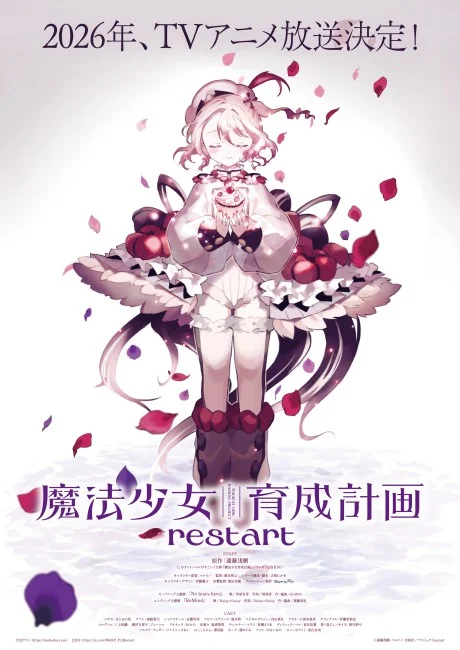
Season 2 premieres October 2026. The studio changed from Lerche to SynergySP, and it adapts the Restart arc (volumes 2-3) — a serial killer mystery in a virtual game world with a new cast and a few familiar faces.
This is the arc where MGRP stops being “Madoka but more violent” and starts being its own thing. The new cast brings more complex motivations. The mystery structure replaces the straight elimination bracket. Snow White shows the first signs of the hardened version she becomes later. If Lerche’s S1 was the premise, SynergySP’s S2 is the pitch for what the series actually is.
The studio change raises questions. Lerche’s S1 wasn’t outstanding, but the character designs and death sequences worked. SynergySP has a mixed track record. Whether they can handle the Restart arc’s more complex narrative — multiple factions, a murder mystery running parallel to the survival game, political maneuvering — is an open question. The source material is better. Whether the adaptation matches it depends on how much perspective switching they’re willing to attempt.
The 10-year gap between seasons is unusual but works in MGRP’s favor. The nostalgia factor plus “what was this show again?” curiosity should bring back viewers who forgot they watched S1 a decade ago. The material is stronger this time around.