

This article contains affiliate links. If you buy through these links, we earn a small commission at no extra cost to you.
There’s a moment early in volume 1 where Sasaki, having just learned genuine magic from the immortal sage currently living in his apartment as a Java sparrow, sits down and calculates the exchange-rate arbitrage between two worlds. Not the adventure potential. The arbitrage. He wants to know how much sugar he needs to move to retire early, and the book walks through his math with total sincerity, and that was the moment I knew this series and I were going to get along.
I bought volume 1 during a BookWalker coin sale in spring 2024, a couple weeks after the anime finished airing, and I read it inside of a week, mostly because every discussion thread about the show had at least one LN reader in the replies insisting the books were operating on a different level. The books are, in fact, operating on a different level. Whether that level is for you depends almost entirely on how you feel about one specific thing, and I’ll get to it, but the short version is I’ve been recommending this series all year to a very specific type of tired adult reader and the hit rate has been honestly great.
TL;DR
- Sasaki and Peeps follows a 39-year-old salaryman whose pet sparrow turns out to be an otherworld sage, kicking off a two-world trading scheme that keeps getting interrupted by psychics, magical girls, death games, and an angel-demon proxy war. The adult protagonist is the entire selling point and it delivers. 13 volumes in Japan (ongoing), 8 in English from Yen On, MAL LN score around 7. Season 2 of the anime arrives Fall 2026. Recommended, with real caveats about pacing sprawl.

Why Does the Adult Protagonist Actually Matter?
Cause he behaves like one, and I mean that structurally, not as flavor text. Sasaki is cautious. He lies to government agencies out of self-preservation and feels bad about it. When offered power, his first thought is what it costs and his second thought is whether he can monetize it quietly without anyone bothering him. The biggest thread on r/LightNovels about this series — 249 points, I went back and checked cause I remembered it being big — is entirely about how refreshing it is to have an actual adult as the focus, someone whose age limits him from doing whatever a teenager would do. That’s the consensus draw and the consensus is right.
The contrast engine here is Sasaki’s flat, tired, deeply reasonable narration running underneath completely unreasonable events. A kaiju hits Japan somewhere around volume 4 and he’s thinking about logistics and liability. That gap between tone and content is the joke, and it’s a joke that a certain kind of reader (me, 30s, corporate job, chronic BookWalker habit) finds funnier than almost anything a comedy series does on purpose.
And Peeps himself makes the dynamic work. The sage-in-a-sparrow could easily be a gimmick mascot but he’s more like a genuinely wise business partner who happens to weigh 25 grams, and the mutual respect between him and Sasaki is quietly the most functional relationship in the series. People compare this setup to 80,000 Gold, the other world-commerce isekai, and the comparison half-works — S&P cares a bit more about its financial details, though honestly both series eventually drift away from the commerce toward their bigger plots, which I’ve decided not to hold against either of them.
The Genre Stack: Feature and Bug
Here’s the thing you need to make peace with before starting. This series runs four-plus storylines simultaneously: the otherworld’s political fantasy, the psychic bureau’s urban battles, a magical girl conflict, an angel-versus-demon proxy war, and a neighbor subplot that starts sad and goes somewhere much darker. One of the top comments in the anime finale thread put it perfectly, this show loves opening two new plot threads for every one it closes, and the books are where that habit comes from.
When the stack works, it really works. Volume 4 collides three of those factions plus the aforementioned kaiju and it’s the series at full power, everything paying off at once while Sasaki tries to keep his side hustle from being noticed. When it doesn’t work, you’re forty pages into otherworld succession politics wondering when the sparrow is coming back. The otherworld chapters drag, I’m just going to say it, Count Müller and Prince Adonis are fine but I have never once picked this series up thinking “I hope this volume is mostly about Adonis.”
My other structural gripe: the sprawl has a body count in dropped momentum. I said after volume 5 resolved the succession arc that the series had turned a corner on actually closing threads, and, well, volume 6 opened the alien storyline and volume 13 is out here introducing new POV characters. At this point I treat the sprawl as the series’ permanent personality rather than a phase it’s growing out of. Grade my earlier optimism accordingly.
The Characters Worth Knowing
Futarishizuka is the fan favorite and it isn’t close. Body-hopping psychic, starts as an antagonist, becomes something between an ally and a recurring natural disaster, and every scene she’s in gets funnier and less predictable. Hoshizaki, Sasaki’s bureau partner, is the gung-ho counterweight to his caution and their fieldwork chemistry carries the psychic arcs.

And then there’s the neighbor. The girl next door, from an abusive home, whose fixation on Sasaki develops into the series’ infamous yandere thread — “Yandere Female Lead” is literally one of the top tags on the MangaUpdates page. Some readers think it’s the boldest writing in the series, an genuinely uncomfortable portrait of what neglect does to a kid. Others think it’s the thing dragging an otherwise fun series somewhere it can’t handle. I go back and forth every couple volumes and I’m not going to pretend I’ve settled it.
One more thing worth knowing, cause the fandom brings it up constantly as context: Buncololi’s earlier web novels were notorious for deliberately unpleasant protagonists, and S&P is his mainstream breakout precisely because Sasaki is decent. You can occasionally feel the older instincts poking through the floorboards, mostly in how coldly pragmatic Sasaki is allowed to be. He leaves someone in an otherworld prison in volume 2 for entirely rational reasons and a chunk of the readership has never forgiven him.
How Does It Actually Read?
Deliberate. That’s the word I keep coming back to. Buncololi writes long chapters where not much happens except Sasaki thinking through a problem from five angles, and your enjoyment of this series is almost perfectly predicted by whether that sentence sounded cozy or excruciating to you. The prose itself is functional rather than pretty, this is not a series you read for sentence-level craft, its a series you read for accumulated voice. The English translation carries that voice fine, though Peeps’ formal old-man register comes out a little stiffer in English than it apparently is in Japanese, a nitpick I’ve seen other readers make too so at least I’m in company.
The Honest Negatives
The score split tells a story. MAL has the LN at 7.03, AniList has it at 58, and while AniList LN scores skew weird on small samples, that’s still a real gap. My read: this series is an 8/10 for its target reader and a 5/10 for everyone else, and the averages are just those two camps annihilating each other. There’s also a loud minority take about the optics of a middle-aged protagonist surrounded by younger female characters — the series defuses it explicitly and repeatedly, Sasaki could not be less interested, but if the setup itself is a dealbreaker no amount of textual defusing will help.
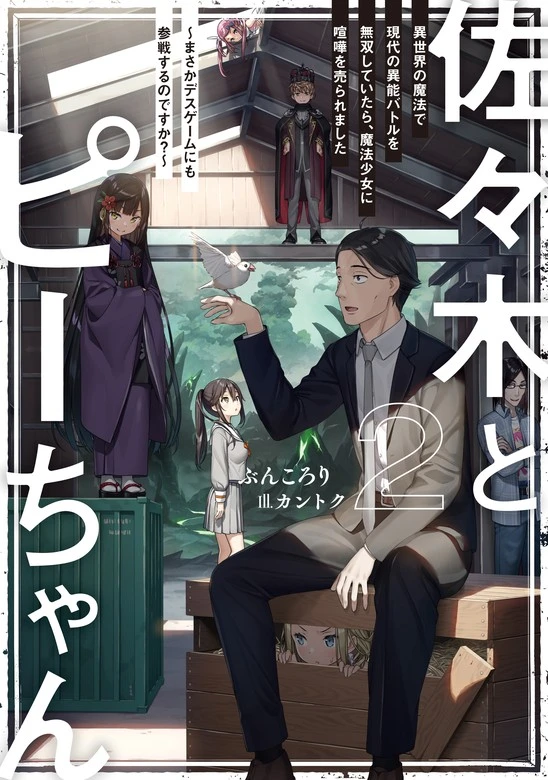
The pacing sprawl is real and I’ve covered it. The otherworld politics drag is real. The neighbor thread is a genuine content warning situation for abuse. And Kantoku’s art, which is gorgeous and absolutely moved units including mine, writes checks the tone doesn’t always cash — these covers say cozy, the death game arc does not say cozy.
Verdict: Who Is This Actually For?
If you are an adult who reads isekai and quietly wishes the protagonist would just once file paperwork, take the deal with the government, and hedge their risks — buy volume 1 today, this is the most you-coded series in print. If you bounce off slow, deliberate pacing or need one focused storyline, this will exhaust you by volume 3 or 4.
I’m eight volumes deep in English, reading ahead in spoilers I probably shouldn’t, and already resigned to buying whatever deluxe edition gets announced around Season 2. That’s the review, really. The rest was detail.
[…] argument in this article and I’m going to make it the whole way through, so buckle in: the Sasaki and Peeps anime isn’t bad, it’s translated. Translated out of the only language the series […]