

The Violet Evergarden light novel is one of the strangest reading experiences I’ve had coming off an anime. I watched the show in 2018, cried approximately five times, and figured the books would feel like extended behind-the-scenes footage. They don’t. The novel’s Violet and the anime’s Violet are almost different characters. The structure of the novel is unlike anything I’d read in the light novel space. There’s no official English translation, which means you’re navigating fan work before you even get to the story itself.
If you’re here for a quick answer: four volumes, read them in publication order, and don’t expect the books to continue from where the 2020 movie left off. That ending lives only in the anime universe. If you want the full breakdown — the differences, the translation situation, whether it’s worth reading after the anime — that’s what this guide covers.
TL;DR
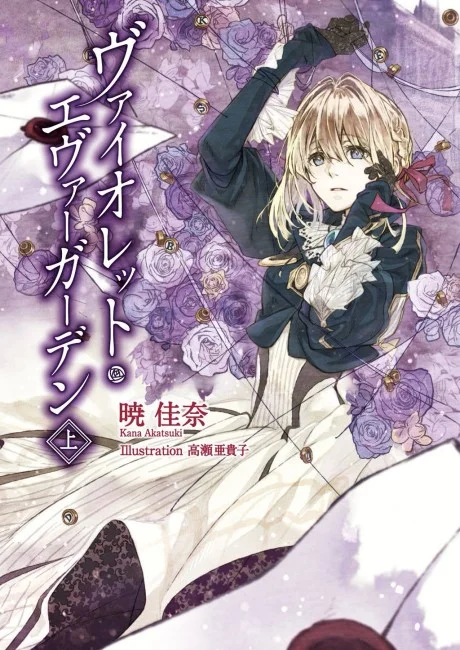
- Publication order: Vol 1 → Vol 2 → Gaiden: Eternity → Vol 3 (Ever After)
- Complete series, 4 volumes, no continuation planned
- No official English translation — fan translations only (JJTranslations)
- The LN and anime are parallel stories with major divergences; start from Vol 1, not where the anime ends
What Is the Violet Evergarden Light Novel Reading Order?
Simple. Start from Volume 1 and go in publication order.
- Vol 1 — December 25, 2015
- Vol 2 — December 26, 2016
- Gaiden: Eternity and the Auto Memory Doll — March 23, 2018
- Vol 3 / Ever After — March 27, 2020
That’s the complete series. No spin-off novels, no prequel volumes. The Gaiden is the only side story, and it slots naturally between Vol 2 and Vol 3 without spoiling anything you haven’t already encountered.
I see people ask whether to read the Gaiden first because the Eternity film came out in 2019 before the 2020 movie. Don’t do that. The Gaiden chapters assume you already know who Claudia Hodgins is and have seen Violet working as a Doll. Vol 1 gives you the context to care about those Isabella and Taylor storylines.
The only case for reading the Gaiden right after Vol 1 is if you’ve already watched the Eternity film and want to see the source material before continuing. That works fine. But publication order is the default and works better for most readers.
How Many Volumes Does Violet Evergarden Have?
Four, counting the Gaiden. Three if you’re only counting the numbered main volumes. Here’s what’s in each one.
Volume 1 (December 25, 2015) drops you mid-career. Violet is already working as an Auto Memory Doll, already has a reputation, already moves through the world with an unsettling composure. There is no hospital awakening scene, no slow start. The novel’s non-linear structure begins immediately. You’re piecing her together from other people’s observations before you have full context for who she is or what she survived.
Volume 2 (December 26, 2016) is where the LN and anime version of the story permanently split. Vol 2’s ending and Episode 13’s ending are completely incompatible. They cannot be reconciled as the same timeline. From that point, the two are separate universes. Neither one is the “real” version. They’re different stories that share a premise.
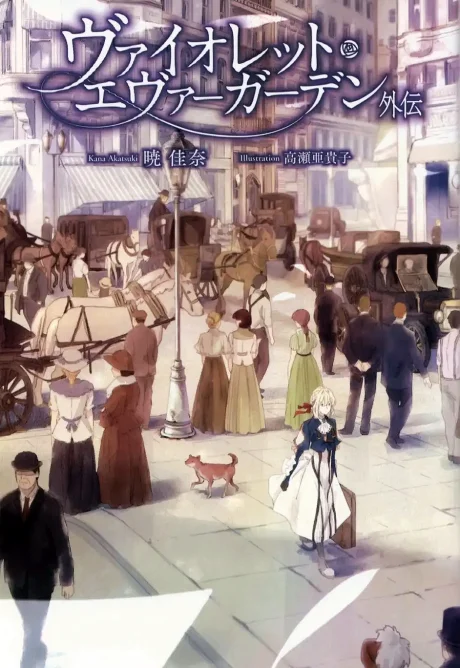
Gaiden: Eternity and the Auto Memory Doll (March 23, 2018, ISBN 978-4-907064-81-5) follows Isabella York at a boarding school where Violet has been sent to tutor her, and then Isabella’s younger sister Taylor. Violet is present, but you’re watching her through Isabella’s eyes. This is the volume most structurally similar to how the anime works in the Eternity film — the story centers on someone else while Violet orbits. If you’ve seen the film, most of this will feel familiar.
Volume 3 / Ever After (March 27, 2020) is the conclusion. Note the date: this released eight months after the KyoAni arson attack in July 2019. A lot of readers came to it carrying that grief, and the novel’s themes — letters left behind, love that outlasts loss, what it means for someone’s words to persist after they’re gone — hit differently in that context.
The series is complete. Kana Akatsuki and KA Esuma Bunko have not announced any continuation. Both the LN and anime are finished, standalone stories.
Does the Gaiden Have to Be Read at a Specific Point?
No hard requirement. Placing it between Vol 2 and Vol 3 — which is where publication order puts it — is right.
The Gaiden’s two chapters are self-contained. You could read either one after Vol 1 without major issues. There are character details from Vol 2 that make the Gaiden land harder once you’ve read it. Nothing gets spoiled either way. It’s about emotional payoff rather than plot logistics.
If you already watched the Eternity film and want to skip the Gaiden volume entirely, the main story doesn’t require it. Reading it gives you the LN’s version of those chapters, which has a few differences from the film worth seeing.

How Is the Violet Evergarden Light Novel Different from the Anime?
This is the question that matters most for anime fans picking up the source material. The differences are significant enough that going in without knowing them will genuinely disorient you.
The biggest shift is structural. The anime is chronological and follows Violet directly — you’re in her perspective, watching her process grief, make mistakes, slowly understand what the phrase “I love you” means. The LN is non-linear and narrated from the outside. Each chapter is told from a different character’s perspective watching Violet. You’re building a portrait of her from other people’s impressions, reactions, and memories. It reads like a jigsaw puzzle where every piece comes from someone who isn’t her.
This structure shapes everything. The anime reveals Violet’s wartime past in Episode 1, grounding you with full context early. The LN drips that information slowly across chapters. By the time Vol 1 ends, you’ve collected fragments rather than a complete picture. The emotional pacing is fundamentally different.
Then there’s Violet herself. The novel’s Violet is around 16 when she starts working as a Doll — the anime removed the timeskip so she appears younger. She arrives already renowned, already composed, already carrying concealed weapons including a pistol. The war flashback sequences in Vol 1 show her wielding a giant axe called “Witchcraft” — the same size as her body. She never expresses regret for wartime kills, refuses to reveal her age, and teaches Ann to shoot. She’s a more mythic, more opaque figure than the emotionally transparent version the anime built.
The novel’s Gilbert is considerably colder. The anime’s Gilbert is warm, protective, carries an almost father-and-lover energy. The LN’s Gilbert is distant in a way that surprised a lot of anime fans. One framing I’ve seen from longtime LN readers that I think is accurate: the way the anime’s Dietfried behaves in the 2020 movie is closer to how the LN’s Gilbert actually acts than the movie’s version of Gilbert is. If you watched the 2020 film and something felt off about Gilbert’s characterization, that gap between the two Gilberts is exactly what you were sensing.
Supporting cast differences pile up fast. Cattleya is younger than Violet in the LN, a hyperactive airhead rather than a maternal figure. Iris and Erika barely exist in the source material. They were created for the anime to populate the CH Postal Agency. Leon has green hair in Vol 2 (from his wanderer mother, a source of bullying), which the anime quietly removed. The Agency itself is much smaller in the LN than what the anime depicted.
And the 2020 film’s resolution for Violet and Gilbert? That story doesn’t exist in the LN. It’s entirely anime-original. Vol 3 has its own ending, and the two conclusions are separate answers to separate versions of the same question. The movie and the novel are not reconcilable at the ending. Kana Akatsuki said in an interview: “Surely, once it all comes to an end, I think they will be able to understand that both are Violet Evergarden.” She trusted KyoAni to retain the core essence through a different path. That’s the right frame for how to hold both versions.
Can You Actually Buy the Violet Evergarden Light Novel in English?
No. There is no official English translation as of 2026.
The series is published by KA Esuma Bunko — Kyoto Animation’s own publishing imprint. KyoAni owns the IP at every level: publisher, studio, distributor. That vertical control has complicated licensing to outside publishers. Add the prose style issue: Kana Akatsuki writes in an elevated, classical Japanese register that’s notoriously difficult to translate without losing what makes it special. It’s the primary reason most EN publishers haven’t pursued it despite the series’ massive international profile from the Netflix anime.
Fan translations exist. JJTranslations has worked on the series. Quality varies by volume and translator. You won’t get anything close to what a professional localization would look like, but for English readers who want the source material, it’s the only route.
If you want to support the series directly, the Japanese volumes are available to import. Vol 1 is ISBN 978-4-907064-43-3, Vol 2 is ISBN 978-4-907064-44-0, Gaiden is ISBN 978-4-907064-81-5, and Vol 3 is ISBN 978-4-910052-04-5. You can find import listings on Amazon — physical imports and digital Japanese editions are separate purchases depending on your region.
Should You Read the Light Novel After Watching the Anime?
Yes. With specific expectations set in advance.
The TV anime and the first Eternity film adapt only 12 of the 24 total LN chapters. Roughly half the source material was never animated. The observer-POV, non-linear structure gives you an experience that the anime can’t replicate. The LN’s Violet — the composed, mythic figure with the giant wartime axe and the concealed pistol and the refusal to confirm her own age — is compelling in ways the anime’s more emotionally accessible version doesn’t fully capture.
The adjustment needed: go in treating the LN as a parallel story, not a sequel. Start from Vol 1. Don’t try to pick up from Episode 13 or from where the 2020 movie ends. Those endings don’t exist in the LN. The Vol 2 LN ending and the anime’s Episode 13 ending diverge completely and cannot be reconciled — they are separate stories from that point forward.
Community consensus lines up around this: both versions are excellent for different reasons, and the LN rewards readers who want the full picture of what Kana Akatsuki originally wrote. The anime is more immediately accessible globally due to Netflix and no translation barrier. But the LN is the original work, and it’s unlike almost anything else in the light novel genre in terms of prose style and structure.
My entry point suggestion: if the observer-POV structure sounds daunting, watch the Eternity film first. That film follows Isabella rather than Violet, which mirrors exactly how the LN works. If that structure clicks for you, the LN will too. Then start from Vol 1.
What Should You Read After Violet Evergarden?
A few recommendations depending on what specifically you’re chasing.
For the quiet grief and long emotional payoff: Frieren: Beyond Journey’s End. The crossover appeal between VE fans and Frieren fans is massive and not accidental. Different genre, same emotional frequency. Slow-building, devastating, and completely worth the commitment.
For prose that scratches the LN literary itch closer to Akatsuki’s register: The Tunnel to Summer, the Exit of Goodbyes. Short novel, dense prose, similar poetic wavelength to Vol 1 in a way most LN writing isn’t.
For more KyoAni-caliber emotional storytelling: A Silent Voice (manga or film). If KyoAni’s handling of Violet’s grief moved you, A Silent Voice operates on the same register.
For healing found-family that develops slowly and earns every emotional beat: March Comes in Like a Lion. Long investment, massive payoff.
None of those require prerequisites. Read them in whatever order catches you.
Frequently Asked Questions
What is the correct reading order for Violet Evergarden light novels?
Publication order: Volume 1 (Dec 2015) → Volume 2 (Dec 2016) → Gaiden: Eternity and the Auto Memory Doll (Mar 2018) → Volume 3 / Ever After (Mar 2020). The Gaiden is a self-contained side story that slots naturally before Vol 3.
Is there an official English translation of the Violet Evergarden light novel?
No. As of 2026 there is no official English translation. KA Esuma Bunko (Kyoto Animation’s own imprint) publishes the series with tight IP control, and the highly literary prose style has been a barrier to localization. Fan translations exist via JJTranslations.
How many volumes does Violet Evergarden have?
Four volumes total: Vol 1, Vol 2, the Gaiden side story, and Vol 3 (Ever After). The series is complete with no further volumes announced.
Is the Violet Evergarden light novel significantly different from the anime?
Yes, significantly. The anime is chronological from Violet’s POV. The LN is non-linear and narrated through the eyes of other characters observing Violet. The novel’s Violet is older, more composed, carries weapons, and wields a giant wartime axe called Witchcraft in Vol 1. The novel’s Gilbert is considerably colder than his anime counterpart. The 2020 film’s ending does not exist in the LN.
Should I read the light novel after watching the anime?
Yes, but treat it as a parallel story, not a continuation. Start from Vol 1. The anime adapts only 12 of 24 total LN chapters — half the content was never animated. The LN and anime diverge completely at Vol 2’s ending and cannot be reconciled as the same timeline from that point.