
If the premise sounds dumb, I get it. A guy dies and reincarnates as a sword. Not a hero with a cool sword. The actual sword. He gets picked up by a cat-eared girl, and together they go on isekai adventures with game mechanics and dungeon crawling. On paper it reads like a parody setup. In practice, Yuu Tanaka built something that works across 20 volumes because the relationship at the center of it is genuinely good.
I went in expecting disposable isekai comfort food. What I got was a father-daughter story that happens to have a game system bolted onto it. Teacher (the sword) and Fran (his wielder) carry this series on the strength of their bond alone. The isekai mechanics are fine. The world is serviceable. The action is solid. None of that is why you keep reading. You keep reading because a sentient sword worrying about whether his kid is eating enough vegetables is somehow one of the more emotionally sincere dynamics in the medium right now.
TL;DR
- Reincarnated as a Sword is a 20-volume ongoing isekai about a sentient sword (Teacher) and his wielder Fran, a young Black Cat beastkin girl. The hook is their father-daughter dynamic, not the isekai premise. Game mechanics (skill absorption, leveling) are well-integrated and tied to Fran’s goal of achieving racial evolution — something her species has been told is impossible. The writing is action-heavy and fast-paced. Not deep literature, but consistently entertaining with genuine emotional warmth. Season 2 of the anime drops October 2026. Published by Seven Seas (Airship imprint), 16 English volumes available.
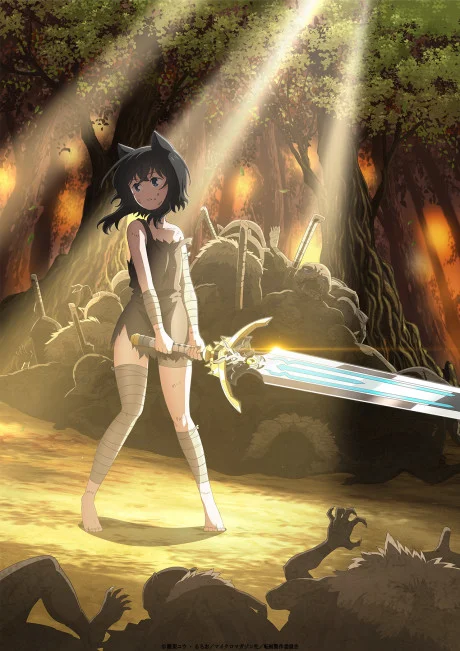
The Father-Daughter Dynamic
This is the series. Everything else is set dressing.
Teacher can’t hold Fran. Can’t pat her head. Can’t physically comfort her when things go wrong. He’s a sword. His entire relationship with Fran exists through telepathic communication, strategic support in combat, and the quiet act of making sure she’s fed, rested, and safe. The limitation forces Tanaka to write their bond through actions and internal narration rather than physical affection, and it works because the protectiveness feels earned rather than manufactured.
Fran is stoic. She doesn’t talk much. Her emotional range on the surface is narrow — she fights, she eats (the food obsession is a running gag that never gets old), and she pursues her goal with single-minded determination. The depth is underneath. She lost her parents. She was enslaved. Teacher saved her. Her attachment to him isn’t just gratitude. It’s the first stable relationship she’s had since her parents died, and Tanaka writes that without ever making it sentimental.
The dynamic works because Teacher’s narration fills the emotional space that Fran’s stoicism leaves empty. You know how much he cares because you’re inside his head. You know Fran cares because of what she does, not what she says. The contrast makes their bond feel real in a way that more expressive character relationships sometimes don’t.
The Game Mechanics
Better than most isekai. That’s a low bar, and Tanaka clears it comfortably.
Teacher absorbs skills from defeated monsters. He can share these skills with Fran. The leveling system drives strategic decisions about which fights to take, which skills to prioritize, and how to build Fran’s combat capability toward her evolution goal. There’s a resource management layer that keeps the power progression from feeling like pure escalation.
Fran’s evolution goal gives the whole system emotional stakes. Black Cat beastkin are locked out of racial evolution. Every other beastkin race can evolve. Black Cats can’t. Fran’s parents died trying. Her entire motivation is to break through a barrier her species has been told is permanent. She’s not grinding to become the strongest fighter in the world. She’s grinding to achieve something that the world’s rules say is impossible, in honor of parents who died trying the same thing.
That goal elevates the game mechanics from window dressing to the emotional core of the series. When Fran levels up, it matters because every level brings her closer to something that carries the weight of her family’s sacrifice. When Teacher finds a new skill, the question isn’t “how overpowered is this” but “does this help Fran evolve.”
The Honest Negatives
The world is generic. Fantasy isekai setting with guilds, dungeons, beastkin races, and a human kingdom. Nothing about the worldbuilding is going to surprise you if you’ve read more than three isekai series. Tanaka isn’t interested in building a distinctive setting. He’s interested in putting Teacher and Fran into situations where their dynamic gets tested.
The side characters are functional but forgettable for the most part. Amanda (Fran’s adoptive mother figure, S-rank adventurer) is the exception — she adds a genuine third dimension to the found family dynamic. Everyone else exists to give Teacher and Fran someone to interact with and then moves on. If you need a rich ensemble cast, this isn’t your series.
The prose is competent, not elegant. Tanaka writes action well and keeps the pacing tight. He’s not crafting sentences you’ll want to re-read for the language. This is workmanlike light novel writing — clear, fast, serviceable. It does what it needs to do. If you’re coming from something like Mushoku Tensei or Ascendance of a Bookworm where the prose itself is a draw, you’ll notice the step down in craft.
Twenty volumes with potentially 20 more to go is a significant time investment for a series that doesn’t dramatically change its formula. The father-daughter dynamic deepens. The stakes escalate. The game mechanics get more complex. But the core loop of “Teacher and Fran fight things, level up, move to a new location, fight more things” stays consistent from volume 1 to volume 20. If that loop works for you, great. If it doesn’t by volume 3, it won’t start working at volume 10.
Who Should Read This
Read it if:
- You want isekai with genuine emotional warmth instead of power fantasy
- Father-daughter dynamics appeal to you more than romance
- You like game mechanics that serve the story rather than dominate it
- You want something fast-paced and action-heavy without being mindless
- You’re looking for a long series with a consistent quality floor
Skip it if:
- You need distinctive worldbuilding
- Generic isekai settings bore you regardless of character quality
- You want literary prose
- A 40-volume commitment sounds exhausting
- Romance is a requirement for you in LN
The Anime
C2C’s adaptation (Fall 2022, 12 episodes) is competent. It covers volumes 1-2 and captures the action well. The main loss is Teacher’s internal monologue — his strategic thinking during fights and his protective reasoning about Fran are richer in prose. The anime shows you a cool sword fight. The novel shows you why Teacher is worried while that fight is happening.
Season 2 drops October 2026. If the anime is your entry point, the novels are worth reading from volume 1 for the full internal narration. Teacher’s thought process during combat is half the appeal, and the anime can only gesture at it through visual cues. If you read the novels first, the anime is a solid companion that gives you the action sequences in motion and Fran’s fight choreography animated, which is fun to see after imagining it on the page.
The anime’s MAL score (7.49) undersells it slightly. It’s a clean, unpretentious adaptation of a clean, unpretentious series. Nothing flashy about the production, but nothing broken either.