

Classroom of the Elite Light Novel Review — Is It Worth Reading?
I’ve read 30 volumes of Classroom of the Elite. All of Year 1, all of Year 2. And the honest answer to “is it worth reading” is yes, with qualifications that matter.
This article contains affiliate links. If you buy through these links, we earn a small commission at no extra cost to you.
TL;DR
- Yes, with qualifications. COTE is the best school-setting light novel series I’ve read. It’s also frustrating because it’s capable of being extraordinary and sometimes chooses not to be.
- 30 volumes across Year 1 and Year 2. Year 3 (final arc) is ongoing. Published by Seven Seas in English.
- The highs are special. Ayanokoji’s manipulation sequences, the exam arcs, the moments where Kinugasa is locked in — nothing else in the genre touches this.
- The lows are disappointing, not bad. Some volumes feel like filler. Some character arcs stall. You notice because the ceiling is so high.
COTE is the best school-setting light novel series I’ve read. It’s also one of the most frustrating, because it’s capable of being extraordinary and occasionally chooses not to be. The highs are genuinely special. The lows aren’t bad so much as disappointing, because you know what Kinugasa can do when he’s locked in. This review covers both years, the things the series does better than anything else in the medium, and the specific places where it stumbles.
| Details | |
|---|---|
| Author | Shogo Kinugasa |
| Illustrator | Shunsaku Tomose |
| Publisher (EN) | Seven Seas Entertainment |
| Volumes | ~33 total (Y1: 15, Y2: 15, Y3: 3 ongoing) |
| Status | Year 3 ongoing (final arc) |
| Genre | Psychological thriller, school drama |
| Verdict | Essential reading if you want the best strategic school LN. Push through the slow start. |
More about Classroom of the Elite
What Kind of Story This Actually Is
COTE gets misread constantly. The anime made it look like a cool-protagonist power fantasy set in a school. It’s not. It’s a first-person psychological character study of someone who was raised in a facility called the White Room, engineered to process humans analytically, and is now trying to figure out what he actually wants when nobody’s giving him orders. The school competition is the framework. Ayanokoji’s head is the story.
The Advanced Nurturing High School sorts students into four classes, D through A. Your class determines your privileges, your monthly point allowance, your future. Special exams determine whether you move up or get expelled. Every student is both an asset and a liability. The school is a controlled experiment in how people behave under competitive pressure, and Ayanokoji is in it with abilities he doesn’t want anyone to know about.
That premise could go in a dozen directions. Kinugasa chose the most interesting one: instead of writing a genius protagonist who dominates from chapter one, he wrote a genius protagonist who actively tries not to dominate and keeps getting pulled into situations where hiding becomes impossible. The tension isn’t “can Ayanokoji win?” He always can. The tension is “what does it cost him to keep pretending he can’t?”
Year 1: The Foundation

Volumes 1 and 2 are slow. This is the universal criticism and it’s accurate. The school system needs explaining, the class hierarchy needs establishing, the cast of 40 students per class needs introducing. Kinugasa front-loads the setup in a way that tests your patience. If you’re coming from the anime, which made this material look more dynamic than it reads, the prose pace might surprise you.
Volume 3 is where the series clicks. The deserted island exam puts the students under survival pressure, strips away the school’s comfortable infrastructure, and forces actual strategic thinking. This is where Ayanokoji starts showing what he can do in ways that feel earned rather than teased. The “tool monologue” happens here. The “don’t pry into my life” speech happens here (in the correct placement, unlike the anime). The community consistently identifies Volume 3 as the inflection point, and they’re right.
Volume 4.5 is where COTE does something no other series I’ve read attempts. It puts load-bearing character development in a bonus volume. The pool scene, which starts the Kiyokei relationship arc, lives here. Kei Karuizawa’s scar complex surfaces here. The anime gave this scene to Horikita and moved it to Season 1, which is why the CotE fanbase organized an actual boycott. The .5 volumes aren’t optional. Read them in order. (Full volume sequence in our CotE reading order guide.)
Volume 7 is the Year 1 peak. The Ryuen confrontation on the rooftop. Everything the first six volumes built toward lands in a single scene that the community still references years later. If you’re reading COTE and haven’t reached Volume 7 yet, keep going. It pays off.
Volumes 8 through 11.5 are strong but more conventional. The exams are well-designed (Paper Shuffle, the class poll, the event selection exam), and the Sakayanagi confrontation in Volume 10 delivers. Volume 11.5 closes Year 1 with a graduation ceremony and character reflections that feel earned after 14 books. Year 1 works as a self-contained arc. You can stop at 11.5 and feel satisfied.
You won’t stop, but you can.
Year 2: Higher Stakes, More Uneven
Year 2 is where most readers think Kinugasa is at his best, and also where the first real cracks appear.
The incoming first-year class (Housen, Amasawa, Yagami, Nanase) expands the character web in ways that make the exam dynamics more complex and unpredictable. The uninhabited island exam across three year groups is the most ambitious setpiece in the series. The unanimous vote special exam in Y2V6 is the single most intense standalone volume Kinugasa has written. If Year 1’s peak was the Ryuen rooftop, Year 2’s peak is Y2V6, and it’s at least as good.
But Year 2 is also where the “everyone fixates on Ayanokoji” problem becomes hard to ignore. By this point, every class leader, every antagonist, every incoming first-year seems primarily defined by their relationship to Ayanokoji. In Year 1, Ryuen had his own agenda. Sakayanagi had her own class strategy. Ichinose was dealing with her own moral crisis. In Year 2, the supporting cast increasingly orbits Ayanokoji specifically, which makes the world feel smaller even as the cast gets larger.
Y2V12’s reception in the community was genuinely mixed. The Nagumo resolution disappointed readers who had been anticipating that confrontation for years. Character decisions in the final stretch felt rushed to some, earned to others. The community split roughly in half on whether the Year 2 conclusion stuck the landing. I fall on the “good but not great” side. It resolves its plot threads but doesn’t reach the emotional height of Y1V7 or Y2V6.
The honest assessment: Year 2’s first half (Y2V1 through Y2V6) is the best stretch of COTE. Year 2’s second half is still good but sags in places. If Year 1 is a consistent 8 out of 10 with a peak at 10, Year 2 is an inconsistent series of 7s, 9s, and a couple of 6s that averages out higher but feels bumpier.
The Ayanokoji Question

The series lives or dies on Ayanokoji. Every chapter is filtered through his perception. If you find his internal voice compelling, COTE will be one of your favorite series. If you find him flat or annoying, nothing else about the series will save it for you.
The community nickname is “Hornykouji,” and it’s earned. In the early volumes, Ayanokoji notices girls constantly. Not in a predatory way, but with the fascination of someone who grew up in total isolation and is encountering normal human interaction for the first time. He’s analytical about everything, including attraction. His observations about Horikita, Kei, Kushida, and Ichinose are simultaneously calculating and genuinely curious. He’s not a sociopath running simulations on human behavior. He’s a person who was trained to process people analytically and is slowly, almost reluctantly, discovering that he cares about outcomes beyond tactical advantage.
The psychological arc across both years is Ayanokoji becoming more human. Small moments accumulate. A choice that wasn’t strictly optimal. A reaction that surprised him. An investment in someone else’s outcome that can’t be fully explained by strategy. The anime stripped all of this by presenting him as a cold robot, which is why readers who come from the anime and then read the books consistently say it’s a different character. It is. (Full comparison in our CotE light novel vs anime breakdown.)
One criticism I agree with: Ayanokoji’s competence level is inconsistent. He’s supposed to be the product of an extreme training program, which justifies his abilities. But Kinugasa occasionally writes him as so far above every other character that the strategic tension evaporates. When Ayanokoji can beat Ryuen, Sakayanagi, Ichinose, and incoming first-year geniuses simultaneously, the question stops being “can he win?” and becomes “why is he pretending this is hard?” The best volumes maintain genuine uncertainty about outcomes. The weaker ones let Ayanokoji’s plot armor show.
The Kiyokei Arc
The Ayanokoji-Karuizawa relationship is the emotional spine of the series. It starts in Volume 4.5 with a pool scene the anime infamously reassigned to Horikita, and it develops across both years into something that’s genuinely credible as a relationship between two damaged people.
Kei Karuizawa enters the series as a social chameleon. Popular, loud, seemingly superficial. The .5 volumes reveal what’s underneath: a scar complex from bullying, a survival strategy built on attaching herself to whoever holds social power, and a deep fear of being exposed as weak. Ayanokoji’s initial interest in her is tactical. He needs someone he can use. But the pool scene cracks something open, and what follows across both years is a slow evolution from manipulation into something more honest.
What makes the Kiyokei arc work is that neither character is straightforward about their feelings. Ayanokoji processes emotion through analysis. Kei tests sincerity through provocation. They don’t have heart-to-heart confessions on a rooftop. They have incremental shifts in behavior that accumulate into trust. It’s messy, it’s sometimes frustrating, and it’s more realistic than 90% of LN romance arcs. The community is split between “Kiyokei is the best LN relationship” and “Ayanokoji doesn’t deserve Kei.” Both readings have evidence.
The Supporting Cast

COTE has 40 students per class across four classes, plus faculty and incoming year groups. That’s over 160 named characters. The fact that maybe 15 of them feel like real people is both impressive and a limitation.
Ryuen is the series’ best antagonist. He’s theatrical, genuinely intelligent, and operates by different rules than Ayanokoji. Where Ayanokoji is surgical, Ryuen is a brawler who uses chaos as strategy. Their confrontation in Volume 7 works because Ryuen isn’t just an obstacle. He has his own logic, his own code, and he pushes Ayanokoji into a corner that requires abandoning the “I’m nobody special” act. When he returns in Year 2, his dynamic with Ayanokoji has shifted from adversarial to something closer to grudging respect. It’s one of the best character relationships in the series.
Horikita’s arc is polarizing. She starts as an isolated, cold perfectionist and gradually opens up through hard lessons in leadership. The anime reframed her as a tsundere love interest, which is wrong. In the light novel, she’s a class leader learning to be a class leader. Her growth is slow and sometimes frustrating, but it’s consistent. The community is divided on whether her Year 2 development pays off or whether Kinugasa gives her too much credit for growth that doesn’t feel earned.
Ichinose, Sakayanagi, Kushida, Hirata, Sudou. Each gets development. Each has moments that land. The problem, especially in Year 2, is that their arcs increasingly revolve around Ayanokoji rather than standing independently. Sakayanagi’s chess-match rivalry with Ayanokoji is excellent. Her existence outside of that rivalry is thin. Ichinose’s moral crisis is compelling until it becomes about how Ayanokoji affects her decision-making. The supporting cast is strong when it’s self-motivated and weaker when it orbits.
What COTE Does Better Than Anything Else
The exam mechanics. No other school-setting LN designs its competitions with this level of detail. Each exam has specific rules, scoring systems, strategic dimensions, and consequences. The deserted island exam, the Paper Shuffle, the unanimous vote, the uninhabited island exam across three year groups. These aren’t generic “the students take a test” scenarios. They’re game-theory problems with real stakes, and Kinugasa thinks through the strategy deeply enough that attentive readers can try to solve them alongside the characters.
The .5 volumes as character development space. This is a structural innovation I haven’t seen elsewhere. By putting character work in bonus volumes set during school breaks, Kinugasa gives himself room to write relationship scenes and personal moments without interrupting exam pacing. The pool scene, the Kiyokei development, the winter break stories. These would feel forced if shoved into an exam arc. In the .5 volumes, they breathe.
The first-person narration. Ayanokoji’s voice carries the series. Other school LNs give you third-person overviews or rotating perspectives. COTE commits to showing you everything through one person’s filter, and that person is simultaneously reliable (he reports what he observes accurately) and unreliable (he doesn’t always understand his own motivations). The gap between what Ayanokoji tells you he’s thinking and what he’s actually feeling is where the real characterization lives.
The Honest Negatives
The translation quality is uneven. This is a documented issue. The Seven Seas translation of Volume 1 has been compared line-by-line to the Japanese original by bilingual readers, and the results aren’t great. Meaning errors, awkward phrasing, and passages that appear to have been based on existing fan translations rather than translated independently of the Japanese. Later volumes improve, but the early volumes’ translation quality is a real barrier. For a series where every line of internal monologue matters, imprecise translation costs more than it would in an action-heavy series.
The slow start is real. Volumes 1 and 2 are setup. They’re necessary setup, but they test your patience. The community universally acknowledges this and universally says to push through to Volume 3. They’re right, but telling someone “it gets good after 500 pages” is a significant ask.
Year 2’s back half sags. After the masterpiece that is Y2V6, the subsequent volumes don’t maintain that intensity. The Nagumo resolution landed flat for a significant portion of the community. Some character arcs in the final stretch felt truncated. Year 2 ends well enough, but the gap between its peak and its conclusion is wider than Year 1’s.
The “everyone orbits Ayanokoji” problem. By Year 2, the supporting cast increasingly defines itself in relation to the protagonist rather than having independent motivations. This makes Ayanokoji feel less like a character in a world and more like the center of a universe that exists for his benefit. The best volumes resist this tendency. The weaker ones lean into it.
The Reading Experience
COTE is addictive in a specific way. Multiple people in the community describe reading it with the same compulsive momentum they get from Mushoku Tensei: finishing a volume at 2am and immediately starting the next one. The exam arcs create natural cliffhangers (who gets expelled? which class wins? what’s Ayanokoji actually planning?) that make “just one more chapter” a genuine risk.
Each volume runs 200–240 pages. A fast reader finishes one in 3–4 hours. A moderate reader takes a day. Year 1’s 15 volumes can be consumed in 2–3 weeks if you’re reading consistently. Year 2 adds another 2–3 weeks. That’s a month of reading before you hit anything ongoing, which is a substantial and satisfying backlog.
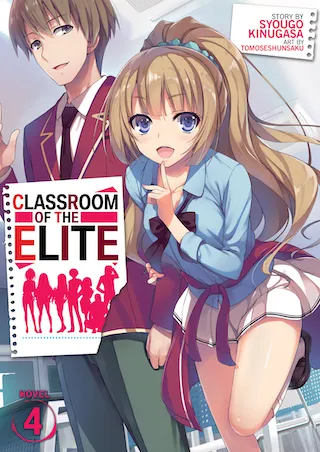
The illustrations by Tomoseshunsaku are excellent. Character designs are distinct, exam scenarios get visual aids, and the occasional full-page illustration hits at exactly the right moment. CotE has some of the best LN art in the medium. The cover art alone tells you a lot about the tone of each volume.
One practical note: the Seven Seas physical editions are standard trade paperback size. They stack well. If you’re buying physical copies, 30 volumes take about two feet of shelf space. BookWalker is the better option for digital readers since the coin cashback system makes a 30-volume purchase meaningfully cheaper than Kindle pricing.
Who Should Read This (And Who Shouldn’t)
Read it if: You want a strategic school setting with real consequences. You enjoy first-person psychological narration. You like protagonists who are more complex than they initially appear. You’re willing to invest in a slow start for a payoff that justifies the patience. You’ve watched the anime and want to know what you actually missed (a lot).
Skip it if: You need fast pacing from page one. You want a completed series (Year 3 is ongoing). You’re looking for a romance-focused story (the Kiyokei arc is significant but it’s not the point). You want a protagonist you can immediately like rather than gradually understand.
Start with: Volume 1 of the light novel. Not the anime. Not the manga. The reading order is straightforward: 1 through 11.5, .5 volumes included. Push through to Volume 3 before deciding if it’s for you. If you’ve only seen the anime, read our comparison to understand what changed. For a quick check on where the series stands, see is CotE finished?
More on this series: our Volume 1 deep dive
The Verdict
Classroom of the Elite is the best strategic school light novel series available. It’s not perfect. The slow start, the uneven translation, the Year 2 inconsistency, and the Ayanokoji-centric gravity well are real weaknesses. But the things it does well, it does better than anything else in the medium: the exam design, the first-person psychological narration, the .5 volume structure, and the long-term character development that pays off across 30 books.
If you’re the kind of reader who can push through two setup volumes for a series that becomes genuinely addictive by Volume 3 and peaks multiple times across its run, COTE is essential. If you need immediate gratification or a completed story, wait for Year 3 to finish. Either way, when you do read it, start from Volume 1 and include the .5 volumes. The anime is not a substitute. The books are the story.
Frequently Asked Questions
Is the Classroom of the Elite light novel worth reading?
Yes, with the caveat that Volumes 1 and 2 are slow. The series becomes genuinely compelling from Volume 3 onward and peaks multiple times across its 30-volume run. It’s the best strategic school LN available. If you’ve watched the anime, the light novel is a significantly different and better experience.
Is Classroom of the Elite better as a light novel or anime?
The light novel is substantially better. The anime adapted roughly 30% of Year 1’s content, stripped Ayanokoji’s inner monologue (which is the actual story), swapped characters in pivotal scenes, and reduced the class size from 40 to 25 students. The light novel is a psychological character study. The anime is a promotional piece.
What is the best volume of Classroom of the Elite?
Year 1 Volume 7 (the Ryuen confrontation) and Year 2 Volume 6 (the unanimous vote exam) are the two peaks the community most consistently identifies. Volume 3 (the island exam) is the inflection point where the series goes from promising to genuinely good. Volume 4.5 (the pool scene) is the most important character development volume.
How many volumes should I read before deciding on Classroom of the Elite?
Three. Volumes 1 and 2 are setup that tests your patience. Volume 3’s island exam is where the series clicks for most readers. If you finish Volume 3 and aren’t interested, COTE probably isn’t for you. If you are, you have 27 more volumes ahead of you and you’ll read them fast.
Is Year 2 of Classroom of the Elite good?
Year 2’s first half (Y2V1 through Y2V6) is widely considered the strongest stretch of the entire series. The second half is more uneven, with the conclusion receiving mixed reviews from the community. Overall, Year 2 is worth reading, but expect higher highs and lower lows than Year 1’s more consistent quality.
Where can I buy the Classroom of the Elite light novel?
Seven Seas Entertainment publishes the English editions. Available on Amazon (Kindle and physical), BookWalker (best for digital LN purchases), Barnes and Noble, and through Seven Seas directly. Year 1 is fully available. Year 2 is being released as translations complete. Year 3 has no English release date yet.