

This is the hill I’ll die on: Konosuba is funnier in print than on screen.
This article contains affiliate links. If you buy through these links, we earn a small commission at no extra cost to you.
TL;DR
- Konosuba is funnier in print. I’ll keep saying it. Kazuma’s internal monologue — the unfiltered running commentary on everything going wrong — is the funniest thing in light novels, and the anime can only gesture at it.
- 17 volumes + 2-volume epilogue, complete. Published by Yen Press. 10 million copies sold. You can binge the whole thing right now.
- The party dynamics carry the series. Four deeply dysfunctional people accidentally saving the world through luck, spite, and one explosion per day. The character relationships develop more than you’d expect from a comedy.
- The post-anime arcs are where it gets good. The Demon King’s generals, the actual endgame, and some legitimately emotional moments that the anime hasn’t touched.
I know. The anime has Sora Amamiya screaming as Aqua. It has the off-model faces, the rubber-band animation, the physical comedy that made Studio Deen’s limited budget work in its favor. The anime is iconic. I’m not arguing against it. I’m saying that Kazuma Satou’s internal monologue, read at your own pace, with his full unfiltered thought process playing out on the page, is the funniest thing in light novels. And you don’t get that in the anime.
Konosuba ran 17 volumes from 2013 to 2020. Natsume Akatsuki wrote a complete story about four deeply dysfunctional people accidentally saving the world through a combination of luck, spite, and one explosion per day. Ten million copies sold. A BookWalker Grand Prix. Four anime seasons and counting. The series earned its reputation.
Here’s the honest review: what works, what doesn’t, and why I’ve reread the middle stretch more times than I’m willing to admit.
More about Konosuba
The Setup
Kazuma Satou dies in an embarrassing way (he thinks he saved a girl from a truck; he actually died of shock, and she was never in danger). He meets Aqua, the goddess responsible for sending the recently deceased to a fantasy world. She mocks him. He’s allowed to bring one thing with him to the new world. Out of spite, he picks Aqua herself.

This is the foundational joke of the entire series. Kazuma chose a goddess as his cheat item, and she’s the worst possible cheat item. Aqua is powerful on paper. In practice, she’s vain, impulsive, terrible with money, attracts undead like a magnet, and cries when things go wrong. Which is constantly.
The premise isn’t original in 2013 terms. Isekai was already saturated. What Akatsuki did differently: he wrote a protagonist who acts the way an actual lazy, selfish, moderately clever person would act in an isekai world. Kazuma doesn’t want to save the world. He wants to eat good food, sleep in a warm bed, and ideally not die again. The Demon King is someone else’s problem. Every heroic thing he does is either accidental or motivated by self-interest.
The Party
The comedy is a four-person ensemble act, and every member carries specific weight.

Kazuma is a genuine anti-hero. Not the “secretly noble” kind. The kind who steals underwear with his Steal skill, blackmails his own party members, gets arrested multiple times for heroic acts that look criminal, and then has genuinely selfless moments that hit harder because you know he’d rather not. His Adventurer class is the weakest in the setting. He compensates with lateral thinking and a complete absence of shame. Reading his internal monologue is like listening to the most entertaining unreliable narrator in isekai. He’s aware of his own hypocrisy and doesn’t care.
Aqua is the chaos engine. A goddess dragged to earth against her will, she has enormous magical power and zero practical intelligence. She can purify anything, turn undead with a wave, and perform resurrection. She also spends the party’s money on booze, starts a cult that becomes a public menace, and has a running feud with a rival church. The joke is the gap between what she is (a literal deity) and what she does (cry in a corner because the party is broke again). It never stops being funny. Seventeen volumes and I still laughed every time she started wailing.

Megumin is the breakout character for good reason. A Crimson Demon archwizard who can cast exactly one spell: Explosion. The most powerful offensive magic in the setting. She fires it once and then collapses, unable to move. She refuses to learn any other spell, insists on casting Explosion every single day whether there’s a target or not. The party has to carry her home after. This is not a gag that gets old. Akatsuki finds new contexts for it across all 17 volumes, and Megumin’s absolute conviction that this is a reasonable way to live makes the repetition work.

Darkness is a crusader (tank class) who can’t hit anything. Literally. Her attack accuracy is described as nonexistent. She absorbs damage for the party because she’s masochistic enough to enjoy it. That sounds like a one-note joke, and in the anime it sometimes is. In the LN, Darkness has genuine depth. She’s nobility (Lalatina Ford Dustiness), her family arc in Volume 7 is one of the best in the series, and her feelings for Kazuma are more complicated than the anime suggests. The Darkness fans who insist she was the intended romantic interest have actual textual evidence.
Where the Volumes Peak
The series hits different quality levels depending on what you’re looking for.
Volumes 1-4: The Foundation
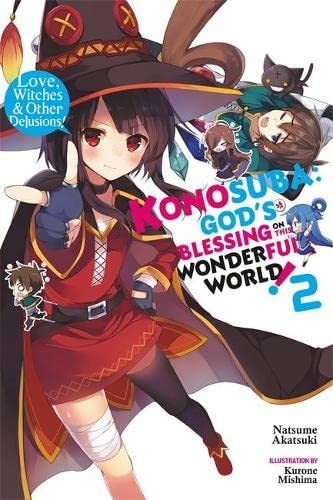

Volumes 1-4 are the foundation. The party forms, the town of Axel becomes home base, running gags establish themselves. These volumes are funny but not the series at its best. The anime covers this stretch well. If you’ve watched Seasons 1 and 2, you’ve seen most of this content adapted competently.
Volumes 5-9: The Peak
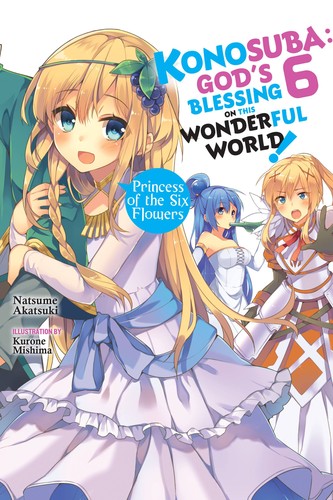
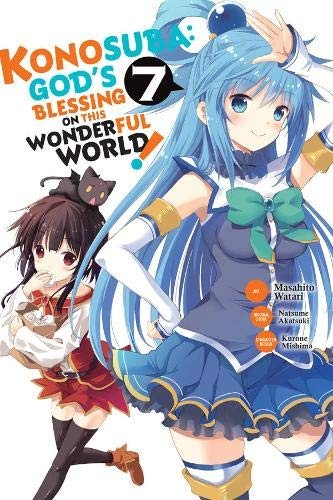
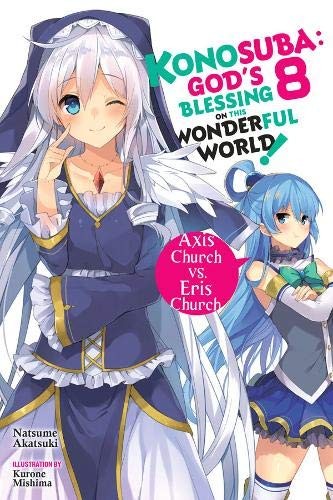
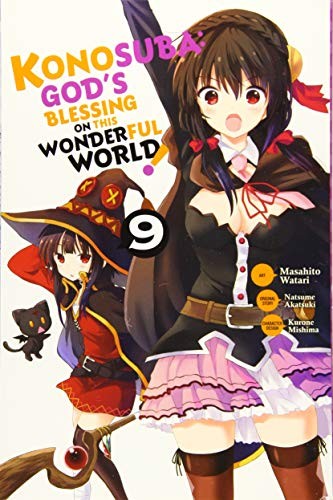
Volumes 5-9 are the peak. This is where I’ve reread most. Volume 5 (the Crimson Magic Clan arc) introduces Megumin’s hometown full of eighth-grade-syndrome chuunibyou wizards, and the Kazuma-Megumin chemistry becomes undeniable. Volume 6 is the castle infiltration where Kazuma goes full tactical operator, and it’s the best action sequence in the series. Then there’s Volume 7, Darkness’s family arc, which is funnier and more emotionally complex than it has any right to be. Volumes 8 and 9 continue the streak.
This stretch has the best balance of comedy and character development. Every arc is self-contained enough to be satisfying on its own, but the character relationships deepen across them.
Volumes 10-14: Maintaining the Run
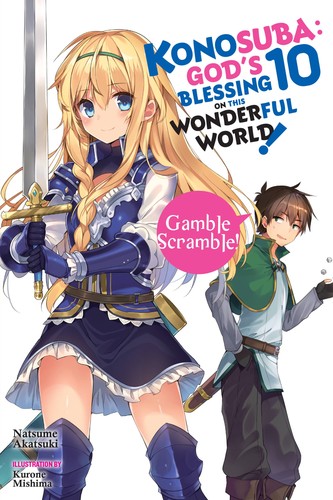
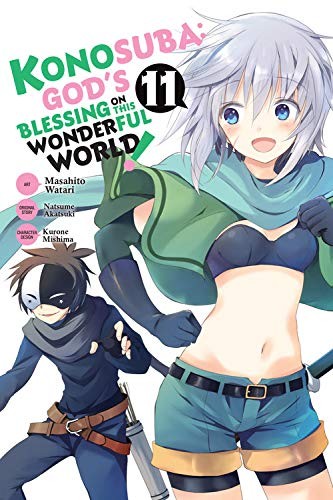
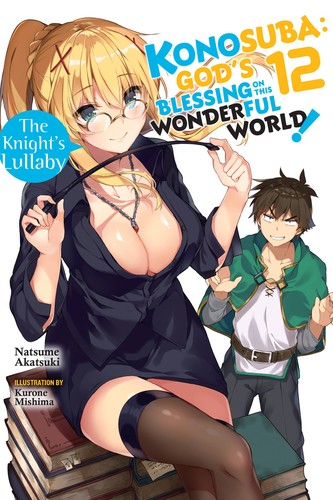

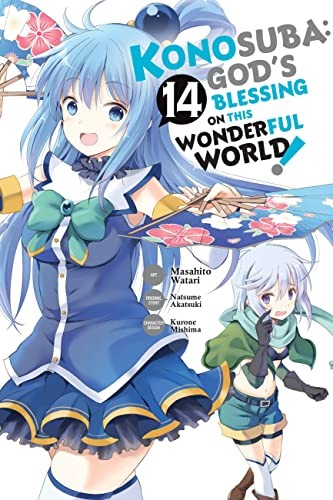

Volumes 10-14 maintain quality but the comedy starts sharing space with actual plot. The Demon King thread becomes more present. Volume 14 has the Kazuma-Megumin emotional peak in the Crimson Demon Forest. A smile, a confession moment. The community calls it the most emotionally resonant scene in the series. I won’t spoil the specifics. But if you’ve been tracking their dynamic since Volume 5, it lands.
Volumes 15-17: The Endgame
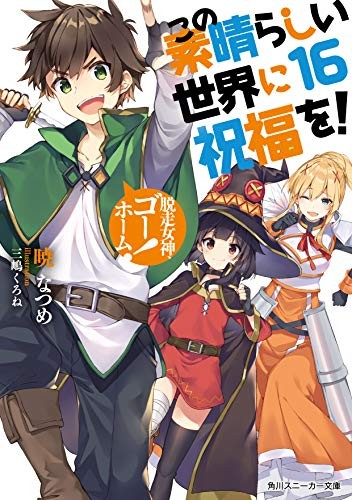
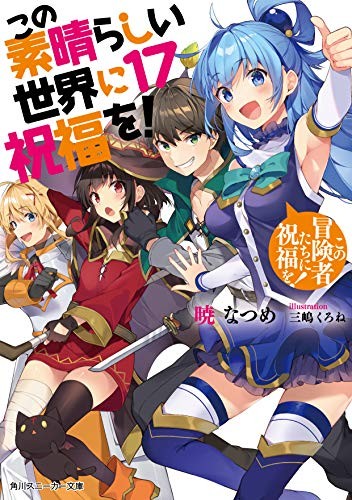
Volumes 15-17 shift gear. The Demon King plot takes over. The comedy is still there, but the tone is more serious. Volume 15 and 16 feel like necessary escalation rather than the breezy standalone arcs of the mid-series. Whether you enjoy this stretch depends on whether you’re reading for the comedy or the story. The comedy readers feel the loss. The invested-in-the-plot readers appreciate the escalation.
The Ending (Volume 17)
I need to be honest about this. The ending is the weakest part of the series.
Volume 17 resolves the main conflict. The Demon King is defeated. Kazuma’s solution is clever in a way that fits his character. The individual character chapters, giving each party member a focused moment with Kazuma before the finale, are genuinely touching.
But it’s rushed. There’s no victory celebration. Side characters who mattered across the series get no closure. Princess Iris, the evil god cat, the Crimson Demons, Vanir’s dungeon. The Demon King’s daughter survives and just becomes the new Demon King, which feels like a reset rather than a resolution. Kazuma’s “true power” as an Adventurer class never pays off satisfyingly. He uses the same tricks he’s been using since Volume 1.
The romance is left open. Kazuma and Megumin are clearly together. Seventeen volumes of buildup, gradual confession, the works. But the final volume doesn’t declare it explicitly. The community has a bookstore bonus short story that confirms the relationship, but that’s a limited edition extra, not the actual ending.
The rushed quality traces back to the web novel. Akatsuki finished the web novel hastily in 2013 when the light novel got picked up. The LN ending is based on that web novel ending, and it shows. For a series with ten million copies and a BookWalker Grand Prix, it deserved a more deliberate conclusion.
The “Funnier in Print” Argument
Here’s why I stand on this hill.
Kazuma’s internal monologue is the series’ best comedic tool, and the anime can only gesture at it. On the page, you’re inside his head for every scheme, every justification, every moment of cowardice dressed up as strategy. His narration is fast, petty, self-aware, and delivered in a voice that the anime’s relatively neutral presentation doesn’t capture. Brad Hawkins does good work in the dub. Jun Fukushima is excellent in Japanese. But neither can compete with reading Kazuma’s thought process at your own pace.
The anime does have advantages. Aqua’s voice acting is irreplaceable. The off-model animation style that Studio Deen accidentally perfected adds physical comedy the prose can’t replicate. Megumin’s explosion scenes hit different with sound design behind them.
Both formats are worth your time. But the LN is the complete version of the story. The anime adapted roughly 9 of 17 volumes across three seasons and a film. If you’ve only watched the anime, you’re missing eight volumes of content plus the ending.
The Spinoffs

Explosion (An Explosion on This Wonderful World): Three main volumes plus two bonus volumes. A prequel following Megumin and Yunyun before they met Kazuma. Universally beloved. The Megumin/Yunyun rivalry (they’re secretly best friends and neither will admit it) is charming enough to carry its own series. Read after Volume 5 of the main series. The LN and manga are both better than the anime adaptation.
Dust Spinoff: Eight volumes, still ongoing. Written by Hirukuma, not Akatsuki. Follows Dust, the delinquent adventurer who swapped parties with Kazuma in an early volume. Fun if you love the extended cast. Not essential.
Vanir Spinoff: One volume, JP only. Set between Volumes 8 and 9.
The Translation
Yen Press publishes the English edition. All 17 volumes are available. The translation is competent. It’s not a series where translation quality generates heated debate the way Overlord or Seven Seas’ Mushoku Tensei did. The prose is clean. Kazuma’s voice comes through.
Kurone Mishima’s illustrations deserve a mention. They’re gorgeous. The character designs, the color inserts, the expressive artwork. The LN illustrations are significantly more polished than the anime’s deliberately loose art style. If visual quality matters to you, the LN wins.
Is Konosuba Worth Reading?
Yes. The funniest isekai light novel series. Not close.
The ending is disappointing. Volumes 15-17 lose some of the comedic momentum that makes the mid-series sing. The romance resolution requires supplementary material to feel complete. These are real flaws.
But Volumes 5-12 are eight books of comedy writing that hits a level most LN authors can’t reach in their best single volume. The ensemble dynamic between four characters who are simultaneously terrible and endearing never gets old across the full run. Kazuma’s narration carries the series the way Rudeus’s carries Mushoku Tensei, through sheer force of voice.
Read the whole thing. Judge the series by Volumes 5-9. The ending is what it is. The journey is worth the price of admission.
17 volumes, Yen Press. Complete. Start at Volume 1.
For a full reading order including spinoffs, see our Konosuba reading order guide. For a comparison of what the anime changes, see our Konosuba LN vs anime breakdown.
FAQ
Is the Konosuba light novel worth reading?
Yes. It’s the strongest comedy series in the light novel space. The internal monologue from Kazuma adds a layer the anime doesn’t capture. Volumes 5-9 are the peak. The ending (Volume 17) is rushed, but the ride is worth it.
How many Konosuba light novels are there?
17 main volumes, all available in English through Yen Press. There are also 5 Explosion spinoff volumes (Megumin prequel), 8 Dust spinoff volumes (ongoing), and various short story collections.
Is the Konosuba light novel finished?
Yes. The main series concluded at Volume 17 in May 2020. Natsume Akatsuki has teased a continuation but no sequel series has been formally published. Season 4 of the anime was announced in January 2026.
Does Konosuba have a good ending?
It’s the series’ most divisive element. The Demon King is defeated. Kazuma and Megumin are clearly together but not explicitly declared. A bookstore bonus story confirms the romance. The ending is rushed and lacks closure on several side threads. Fans who read for the comedy are less bothered. Fans who invested in the plot and romance are frustrated.
Should I read the Konosuba light novel after watching the anime?
Yes, and start from Volume 1. The anime changed and skipped significant material. Seasons 1-3 cover approximately Volumes 1-9. Volumes 10-17 are unadapted. The subreddit moderators “strongly recommend” starting from the beginning.
Is Konosuba funnier in the light novel or the anime?
The LN is funnier on a per-joke basis because of Kazuma’s unfiltered internal monologue. The anime is funnier as a visual experience because of the expressive animation and voice acting. Both are worth experiencing. The LN is the complete version of the story.