
Yes. The Violet Evergarden light novel is finished. The series ended with Vol 3 — subtitled Ever After — on March 27, 2020. Four volumes total: Vol 1, Vol 2, a side story Gaiden, and the final Ever After. Author Kana Akatsuki has not announced a sequel or continuation. KyoAni has not either. The story is done. Both the light novel and the anime are complete, standalone versions of the same premise.
TL;DR: Series Status
- Complete at 4 volumes — Vol 1 (Dec 2015) through Vol 3 / Ever After (Mar 2020).
- No official English translation exists. Fan translations only (JJTranslations most cited).
- The LN and anime are substantially different stories; the 2020 film is entirely anime-original with no book counterpart.
- Reading order: Vol 1 → Vol 2 → Gaiden → Vol 3.
| Details | |
|---|---|
| Series Status | Complete |
| Total Volumes | 4 (3 main + 1 Gaiden side story) |
| Final Volume | Vol 3 / Ever After — March 27, 2020 |
| Publisher (JP) | KA Esuma Bunko (Kyoto Animation) |
| Publisher (EN) | None (no official English translation) |
| Author | Kana Akatsuki |
| Illustrator | Akiko Takase |
| Series Run | December 2015 – March 2020 |
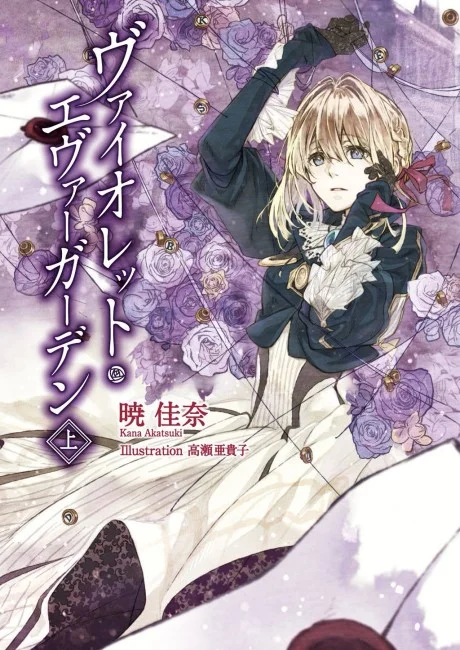
What Volumes Make Up the Violet Evergarden Light Novel?
Four volumes published across five years:
| Volume | Title | Release Date | ISBN |
|---|---|---|---|
| Vol 1 | Violet Evergarden | Dec 25, 2015 | 978-4-907064-43-3 |
| Vol 2 | Violet Evergarden 2 | Dec 26, 2016 | 978-4-907064-44-0 |
| Gaiden | Eternity and the Auto Memory Doll | Mar 23, 2018 | 978-4-907064-81-5 |
| Vol 3 | Ever After | Mar 27, 2020 | 978-4-910052-04-5 |
The Gaiden is a side story, not a main volume. Two chapters: one following Isabella York, a noblewoman Violet tutors at a boarding school, and one following Isabella’s sister Taylor Bartlett. The 2019 Eternity and the Auto Memory Doll film adapts this volume closely. You can read the Gaiden after Vol 1 or Vol 2. It doesn’t spoil the main story’s ending.
Vol 3 arrived in March 2020, roughly eight months after the July 2019 KyoAni arson attack, which killed 36 staff and delayed the Violet Evergarden: The Movie from January to September 2020. The final book and the final film came out within months of each other, both carrying an extra layer of weight because of what had happened to the studio.
One thing the volume count obscures: the full series contains 24 chapters across these four books. The TV anime and the first Eternity film adapted roughly 12 of those 24 chapters. Half the light novel has never been animated. If you’ve watched every episode, every OVA, and both films, you’ve seen about half the story Akatsuki actually wrote.
The series originated at the 5th Kyoto Animation Award in 2014. Violet Evergarden was the only novel to ever win the grand prize at that competition — which fed directly into publication under KA Esuma Bunko and anime production by KyoAni. The IP has existed entirely within the KyoAni ecosystem from the start: they’re the author’s publisher, the anime studio, and the distributor. That explains a lot about the translation situation.

Why Is There No Official English Translation?
This is the most common question from English readers, and it has two real answers.
First: ownership. KA Esuma Bunko is KyoAni’s own imprint. KyoAni holds the IP at every level: publisher, studio, distributor. Any English publisher would need to negotiate directly with KyoAni, not a third-party literary agency or independent rights holder. That kind of deal requires KyoAni to actively want English localization and to find a partner willing to meet their terms. After ten years, that hasn’t happened.
Second: the prose itself. Kana Akatsuki writes in a highly literary, classical Japanese register. Poetic. Elevated. Deliberately slow. This is not standard light novel prose. It reads closer to literary fiction than to Sword Art Online or Re:Zero. That quality is exactly what makes the books feel distinct from every other LN I’ve read. It’s also why translating them well is genuinely hard. The text resists the kind of straightforward conversion that works for action-heavy series. A translation that sacrifices the prose register would lose what makes the books worth translating.
Fan translations exist. JJTranslations is the most cited. Quality varies by chapter and translator. It’s currently the only way to access the series in English. If you read Japanese, the original volumes are available. Everyone else is working from fan work.

How Different Is the Light Novel from the Anime?
More different than almost any other light novel adaptation I can think of. I’ve read enough of them to have an opinion on that scale.
Start with structure. The LN is non-linear and uses a third-party observer POV. Each chapter is narrated from the perspective of someone watching Violet from the outside: a client, a bystander, a soldier who knew her during the war. You reconstruct her history from these fragment accounts, the same way you’d piece together a person from the letters they left behind. The anime flipped this entirely. Linear. Chronological. Told from Violet’s own perspective from episode one.
That structural choice reshapes the characters completely. Book-Violet is already famous and seemingly perfect when the story begins. The timeskip before her career as a Doll is behind us before chapter one. She carries a pistol. In war flashbacks, her weapon is a giant battleaxe called “Witchcraft” — the same length as her body — and her presence in a room reportedly stops people cold. She never expresses regret for wartime kills. She refuses to tell anyone her age, closer to a mythic figure than a traumatized teenager. Anime-Violet is traumatized, still learning, vulnerable. There’s a suicide attempt in episode 9. These are not the same person across mediums.
The Gilbert gap is even wider. Anime-Gilbert is warm, protective, almost paternal. LN-Gilbert is colder. The community observation that stuck with me: “the way Dietfried behaves in the 2020 movie is much closer to how novel-Gilbert actually acts.” Anime fans who came to the LN after the film often describe the book version of their relationship as disorienting.
Supporting cast shifts too. Cattleya in the anime is older and maternal toward Violet. In the LN she’s younger than Violet and described as hyperactive. Iris and Erika are meaningful recurring coworkers in the anime; in the books they barely appear. Leon gets green hair in the LN (his wanderer mother, which became a source of bullying) and is openly sexist when he first meets Violet. Both traits were removed for the anime. These aren’t minor adjustments. KyoAni built a different character ecosystem around the same premise.
Akatsuki put it plainly in an interview about the adaptation: “A novel is a world in which the amount of information is overwhelmingly large, and the author is the sole leader.” She had no issue with where KyoAni took things: “Surely, once it all comes to an end, I think they will be able to understand that both are Violet Evergarden.” That framing is exactly right. These are two separate versions of the same premise. Both are complete. Neither replaces the other.

Is the 2020 Movie Based on the Light Novel?
No. Violet Evergarden: The Movie (2020) is entirely anime-original. Akatsuki did not write it. There is no book version of that ending, no LN chapter the film adapts. The conclusion for Violet and Gilbert that the film provides exists only in the anime continuity.
This matters because the 2020 film is how most international fans experienced the series ending. It’s on Netflix. It’s what everyone watched, emotionally overwhelming and beautifully produced. But it’s a KyoAni creation built on a premise Akatsuki originated — not a direct adaptation of source material.
The 2019 Eternity and the Auto Memory Doll film is a different case. That film adapts the Gaiden volume and follows Isabella York and her sister Taylor, using a structure close to the LN’s own observer-POV approach. The story isn’t about Violet directly. It’s about the girls watching her. That one is reasonably faithful to the source.
But the 2020 film? Vol 2’s ending and Episode 13’s ending diverge completely and cannot be reconciled. They go in different directions. The 2020 film extends one of those directions to its conclusion. If you’re coming to the LN after the film and expecting to find the same ending in book form, you won’t. The LN has its own ending. The film has its own ending. Treat them as parallel stories from a shared starting point.
Is the Light Novel Worth Reading After the Anime?
Yes. But with calibrated expectations.
The straightforward case: about half the LN chapters were never animated. Unaired clients, new letters, fresh moments in Violet’s career that only exist in the books. If you loved the anime, there is Violet Evergarden content you haven’t seen.
Beyond that: the observer-POV structure is an experience the anime cannot replicate by design. Each chapter adds another witness. Each account shifts the angle slightly. By the time you reach Vol 3, the portrait of Violet you’ve assembled feels simultaneously complete and faintly out of reach. That gap is intentional, and it lands differently than anything the anime does. There’s nothing else in the LN space quite like it.
The honest caveats: you’re reading fan translation and quality varies. LN-Violet’s emotional arc is more restrained than the anime’s. The crying-in-the-rain catharsis the anime delivers does not have an LN equivalent. LN-Gilbert being colder is a genuine adjustment for fans who connected with the anime version. The “super soldier with a giant axe” elements in the war flashbacks feel tonally different from the grounded anime version of the same history.
Community consensus going in: treat it as a parallel work. Don’t try to pick up where Episode 13 left off. Start from Vol 1, because the LN’s structure builds from chapter one and the observer-POV rhythm takes a full volume to click. If you read literary fiction and can handle the fan translation gaps, this series is in a different register from most LNs. Akatsuki’s prose (in Japanese) is genuinely unusual in this space. Readers who love it describe it as unlike anything else they’ve read in the genre.

What Reading Order Should You Follow?
Publication order: Vol 1 → Vol 2 → Gaiden → Vol 3 (Ever After).
The Gaiden sits between Vol 2 and Vol 3 in both publication date and narrative timeline. It’s a standalone story that doesn’t spoil the main ending, and reading it in that slot is where it fits best — though after Vol 1 works fine too if you want to break up the main narrative early.
Don’t try to sync up with the anime’s ending point. The LN’s structure is different enough from the anime that there is no clean entry point mid-series for anime viewers. Start from Vol 1 regardless of how far into the anime you are. The first volume establishes Akatsuki’s approach before you can appreciate what the later volumes do with it.
If you’re reading in Japanese, all four volumes are available through KA Esuma Bunko via Amazon Japan and standard import channels. For English readers, JJTranslations is the most cited fan translation source. Neither Yen Press, J-Novel Club, nor any other EN licensor has announced plans to publish the series. That situation may change, but as of 2026 there’s no indication it will.
Frequently Asked Questions
Is the Violet Evergarden light novel finished?
Yes. The series is complete at 4 volumes. The final volume, Vol 3 / Ever After, published March 27, 2020. No continuation or sequel has been announced.
How many Violet Evergarden light novels are there?
Four: Vol 1 (Dec 2015), Vol 2 (Dec 2016), Gaiden: Eternity and the Auto Memory Doll (Mar 2018), and Vol 3 / Ever After (Mar 2020). Three main volumes plus one side story. All published by KA Esuma Bunko (KyoAni’s imprint).
Why is there no official English translation of Violet Evergarden?
Two reasons: KyoAni holds the IP entirely through their own imprint (KA Esuma Bunko), making licensing negotiations unusual, and Akatsuki’s highly literary prose style is notoriously difficult to translate without losing the quality that makes it distinctive. Only fan translations (JJTranslations) currently exist in English.
Is the 2020 Violet Evergarden movie based on the light novel?
No. Violet Evergarden: The Movie (2020) is entirely anime-original — KyoAni created it with no direct LN source material. The 2019 Eternity and the Auto Memory Doll film adapts the Gaiden volume. The 2020 film’s ending exists only in the anime continuity.
Is the Violet Evergarden light novel worth reading if you’ve seen the anime?
Yes. About half the LN chapters were never animated — new clients, new letters, new story. The observer-POV structure and LN-Violet’s characterization (colder, more mythic, armed with a giant battleaxe) offer an experience the anime can’t replicate. Treat it as a parallel version of the story, not a continuation. Start from Vol 1.