

This article contains affiliate links. If you buy through these links, we earn a small commission at no extra cost to you.
OreGairu’s reading order looks straightforward — 14 main volumes, read them in order, done. But it’s trickier than most series. Four short story volumes slot in at specific points, one of them spans two different timeline periods, and there’s a canon sequel plus a non-canon spin-off that both lack official English translations. Get the order wrong and you’ll hit references to events you haven’t read yet. Get it right and the emotional buildup across the back half hits the way Watari intended.
My Youth Romantic Comedy Is Wrong, As I Expected runs 18 volumes in total: 14 main numbered volumes and four short story compilations labeled 6.5, 7.5, 10.5, and 14.5. The complete Yen Press English translation wrapped October 18, 2022, a six-year localization run starting from the September 2016 first volume. Everything is available right now, no waiting required.
TL;DR
- Main series: volumes 1–14 in publication order. Four short story volumes (6.5, 7.5, 10.5, 14.5) slot in after the volume they follow.
- Volume 6.5 caveat: its stories technically span two timeline points, but reading it after volume 6 (publication order) works fine.
- Post-anime starting point: volume 1 for the full interior monologue experience; volume 7 minimum if you only want content the anime hasn’t covered.
- Shin OreGairu (canon sequel, 6 volumes) has no official English translation as of 2025. Fan translations only.
What Is the Complete OreGairu Light Novel Reading Order?
Publication order is what you want. Follow the Yen Press release sequence, which matches the Japanese release schedule exactly. Here’s every volume:
| # | Volume | Type | Notes |
|---|---|---|---|
| 1 | Volume 1 | Main | Hachiman joins the Service Club. The internal monologue starts here, and it never lets up. |
| 2 | Volume 2 | Main | Summer break arc. Hachiman, Yukino, Yui dynamic starts forming. |
| 3 | Volume 3 | Main | Cultural festival arc. The LN version has extensive interior scenes cut entirely from the Season 1 anime. |
| 4 | Volume 4 | Main | Christmas planning arc. Episodic structure, but character cracks start showing. |
| 5 | Volume 5 | Main | School trip. Rumi Tsurumi subplot. She gets more development in the LN than the anime shows. |
| 6 | Volume 6 | Main | Valentine’s arc. Relationship dynamics shift. One of the most LN-expanded volumes in Season 1’s adaptation. |
| 7 | Volume 6.5 | Short stories | Read after vol 6. Contains slice-of-life stories spanning two story periods. See the next section for details. |
| 8 | Volume 7 | Main | “I want something genuine.” The emotional center of the entire series. Where the anime started to pull farthest behind the source. |
| 9 | Volume 7.5 | Short stories | Read after vol 7. Holiday and character-focused stories, entirely unadapted. |
| 10 | Volume 8 | Main | Student council election arc. Iroha Isshiki enters. The series shifts gears here. |
| 11 | Volume 9 | Main | Joint high school cultural festival arc begins. |
| 12 | Volume 10 | Main | Iroha’s request. Relationships start clarifying. Hachiman’s self-analysis gets sharper. |
| 13 | Volume 10.5 | Short stories | Read after vol 10. Entirely unadapted short stories. |
| 14 | Volume 11 | Main | Cultural festival conclusion. The emotional peak of the Season 2 arc. That is where the LN hits hardest. |
| 15 | Volume 12 | Main | The final arc begins. Tone becomes noticeably denser; the lighter comedic register of early volumes is mostly gone. |
| 16 | Volume 13 | Main | The resolution builds. Yukino’s family arc comes to a head. |
| 17 | Volume 14 | Main | The ending. Controversial for a segment of the fandom. I’ll get to that below. |
| 18 | Volume 14.5 | Short stories | Epilogue short stories. Final release: April 2021 (Japan), October 18, 2022 (English). |
You can grab the full Yen Press series on Amazon. All 18 volumes are in print.
Where Do the Short Story Volumes Actually Fit In?
Three of the four short story volumes are simple: 7.5 goes after volume 7, 10.5 goes after volume 10, 14.5 goes after volume 14. Volume 6.5 is the one with a quirk.
Volume 6.5 contains stories from two separate points in the timeline. The first half chronologically belongs between volumes 6 and 7. The second half belongs between volumes 9 and 10. Reading it after volume 6 (publication order) means you’ll hit the second batch of stories before you’ve seen the events they reference. It’s not a spoiler situation — these are slice-of-life moments, not plot reveals, but you’ll encounter a few “wait, when did that happen” instances.
The community default is to read 6.5 after volume 6 and not stress about it. If you want strict chronological immersion, an alternative exists: read 6.5 part 1 after volume 6, continue through volumes 7, 7.5, 8, and 9, then revisit 6.5 part 2 before starting volume 10. Most readers find that’s more bookkeeping than the payoff warrants.
Volume 14.5 is the best of the four compilations. Released two years after the main series ended, it functions as epilogue content. The main ending in volume 14 felt rushed to a segment of readers — volume 14.5 fills some of those gaps with character moments that the final arc didn’t have room for. If the ending left you wanting more time with the cast, 14.5 provides it.
Should You Start From Volume 1 or Volume 7 After Watching the Anime?

Start from volume 1. Not the safe answer. The right one.
The anime adapts the entire main series across three seasons: Season 1 (Brain’s Base, 2013) covers volumes 1–6, Season 2 “Zoku” (feel., 2015) covers volumes 7–11, Season 3 “Climax” (feel., 2020) covers volumes 12–14. You’ve seen the plot. But Hachiman’s interior monologue is a different artifact entirely. The cultural festival arc in volume 3 and the Valentine’s arc in volume 6 contain extended passages where he dissects his own motivations in real time, passage after passage. The anime conveys this through facial expressions and sparse narration. The novel gives you the actual thought process, every step of it.
If you genuinely won’t re-tread adapted material: volume 7 is the minimum starting point that makes sense. But even there, you’re missing context. The emotional climax of volume 11 — Hachiman’s outburst about wanting something genuine — lands differently when you’ve been inside his head through volumes 7, 8, 9, and 10. Starting at volume 7 means getting that scene with less runway. The four short story volumes are all unadapted regardless, so those are fresh content no matter where you start.
Season 2 hit you emotionally? The novel version hits harder. That tension doesn’t come from the scene itself. It comes from four volumes of interior pressure building to it.
What Does the OreGairu Light Novel Add That the Anime Cuts?
The short answer: Hachiman’s inner world. The anime is constrained by episode runtimes and can convey his psychology only through behavior and implication. The novels give you his full analytical process as it’s happening.
Season 1 already cuts significant interior content from volume 3 (cultural festival) and volume 6 (Valentine’s). Season 2 has the largest divergence of the three — the emotional peak of volume 11 builds through hundreds of pages of interior tension the anime can only gesture at. Season 3 is the most faithful, but Iroha Isshiki’s character arc across volumes 12–14 gets compressed. Her motivations during the final arc are clearer in the novels, with interior scenes that clarify why she makes the choices she does.
All four short story volumes are entirely unadapted. Every page of 6.5, 7.5, 10.5, and 14.5 is content you haven’t seen if you’ve only watched the anime.
I have a full breakdown of what each season adapts and what gets cut over in the OreGairu light novel vs. anime comparison. Go there for the detailed version, including which specific scenes are missing and what they add to the story.
What Is Shin OreGairu and Where Does It Fit in the Reading Order?
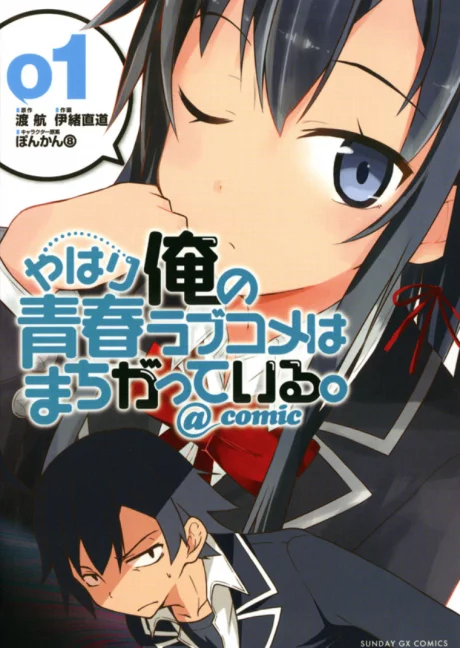
Shin OreGairu is the official canonical sequel. Set one week after the conclusion of volume 14, it follows Hachiman navigating life now that he’s actually in a relationship, which turns out to be as socially complicated as everything before it, just in different ways. Wataru Watari wrote it as six short volumes bundled with Season 3 Blu-ray discs, released between September 2020 and 2021. All six together equal roughly two standard LN volumes in length.
As of 2025, Yen Press has not licensed Shin OreGairu for English publication. Fan translations exist and are the only English option. This is frustrating given that Yen Press completed the entire main 18-volume series, but the license hasn’t materialized.
Reading order position: after volume 14.5. Finish the complete Yen Press release first. Shin is a sequel, not a parallel story — it assumes you’ve seen everything in volumes 1–14 and 14.5.
Is the ANOTHER Spin-Off Canon and Should You Read It?
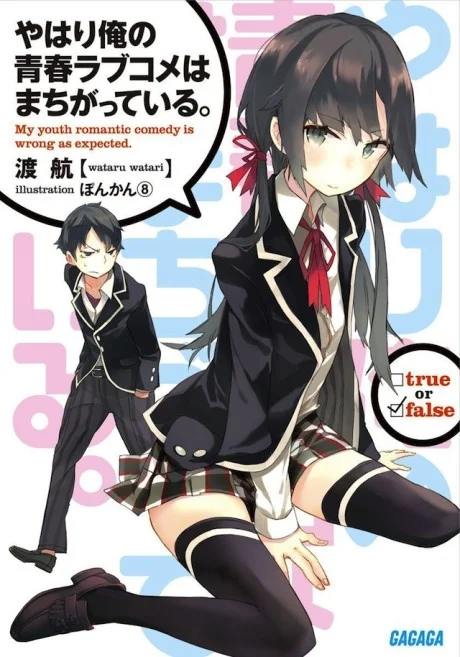
ANOTHER (Oregairu.a) is seven short volumes released as Season 2 Blu-ray bonuses. It presents alternate-route scenarios with different romantic resolutions, including paths that don’t end with Yukino. Wataru Watari explicitly stated it is non-canonical. He said this publicly. Multiple times. The fandom still argues about it anyway.
ANOTHER has no official English translation. If you’re curious about alternate routes — particularly the Yui route that triggered most of the discourse — it’s available via fan translation after you’ve finished the main 14-volume series. Go in knowing it’s what Watari said it is: a what-if spin-off, not a real ending. The main series ending in volume 14 is the intended conclusion. ANOTHER’s main legacy is having generated the most sustained shipping conflict in OreGairu’s fandom history, which is either a selling point or a warning depending on your tolerance for that kind of thing.
What Should You Read After Finishing OreGairu?
Our OreGairu light novel review covers recommendations — Tomozaki, Bunny Girl Senpai, Hyouka, and Classroom of the Elite all scratch different parts of the itch.
Rascal Does Not Dream of Bunny Girl Senpai by Hajime Kamoshida covers similar emotional territory. Witty male protagonist helping girls through unusual personal problems, banter-to-tenderness arc, emotional depth prioritized over action. Easier reading than OreGairu, less philosophically dense, more immediately warm. Sakuta and Mai’s relationship draws comparisons to Hachiman and Yukino regularly, and the comparison holds.
Classroom of the Elite by Syougo Kinugasa shares the hyper-analytical outsider protagonist navigating a school social hierarchy but goes much darker. Psychological thriller elements, morally grey decisions, institutional manipulation. If you liked Hachiman’s manipulative side and want that amplified without the romance arc, this is the series.
Hyouka by Honobu Yonezawa is the literary pick. Houtarou Oreki’s energy-conserving philosophy echoes Hachiman’s deliberate social withdrawal, the prose quality is high, and the slow-burn dynamic between him and Eru Chitanda has the same patience as Hachiman and Yukino’s relationship. Mystery framing rather than romance, but the DNA is recognizable.
Is the OreGairu Light Novel Worth It If You’ve Already Seen All Three Anime Seasons?
Yes. And I say that as someone who watched all three seasons before picking up volume 1.
The case against is obvious: you know the plot, you know the ending, you know who ends up with who. The case for is that the plot is close to the least interesting part of what OreGairu is. The series lives in Hachiman’s head. His commentary on social performance, his analytical dissection of every interaction, his slow and painful recognition that his self-sabotage is exactly that — none of this survives compression to a visual medium at anime scale. The anime gestures at it. The novels are it.
The final arc (volumes 12–14) shifts in tone noticeably: denser, slower, more literary than the lighter earlier volumes. Readers who loved the comedic energy of volumes 1–6 sometimes find the pacing difficult. Our full review gets into the ending controversy in detail. Know that the tonal shift exists going in.
But volumes 7–11 are the best stretch of the series, and they’re also where the LN-to-anime gap is widest. If you watched Season 2 and felt something, reading volumes 7–11 will hit differently. That’s the honest reason to pick up the light novel after the anime.
Frequently Asked Questions
Is the OreGairu light novel series complete in English?
Yes. Yen Press published all 18 volumes — volumes 1–14 plus the four short story volumes (6.5, 7.5, 10.5, 14.5). The final volume was released October 18, 2022. The main series is fully available in English.
How many OreGairu light novels are there?
18 volumes from Yen Press: 14 main numbered volumes plus four short story compilations. The Shin OreGairu sequel adds six more short volumes (fan translation only as of 2025). The non-canon ANOTHER spin-off adds seven more volumes, also without an official English translation.
Does the OreGairu light novel ending differ from the anime?
The Season 3 anime adapts volumes 12–14 and follows the same general resolution. The key differences are the epilogue content in volume 14 (which the anime doesn’t fully show), Iroha Isshiki’s fuller character arc in the novel version, and volume 14.5 — released two years after volume 14 — which adds epilogue short stories absent from the anime entirely.
Where can I read Shin OreGairu in English?
Fan translations are the only English option as of 2025. Yen Press has not announced a license for Shin OreGairu. The fan translation community has completed the series.
Who publishes OreGairu in English?
Yen Press, an imprint of Hachette Book Group, holds the English rights. Jennifer Ward translated the full run for Yen Press — all 18 volumes across six years. Yen Press also publishes the @comic manga adaptation in English.