

My Youth Romantic Comedy Is Wrong, As I Expected Light Novel Review: Is It Worth Reading?
OreGairu is one of those series I came too late and immediately resented myself for not reading sooner. I watched all three anime seasons before I touched the novels, which is probably the wrong order. Not because the anime is bad, but because once you read the LN you realize the anime was giving you maybe thirty percent of Hachiman Hikigaya’s actual personality. The rest was sitting in prose form, waiting.
The short version: this is the best first-person light novel I’ve read. The best school romance LN I’ve read. And the only series where I finished volume 14 and immediately wanted to argue with strangers on the internet about it, in a good way. Wataru Watari wrote something that has genuine literary ambition sitting inside what looks, from a distance, like a standard romcom premise. It’s not. It never was.
[tldr]OreGairu’s light novel is a 14-volume first-person character study disguised as a school romcom. The prose is sharper, funnier, and more philosophically honest than the anime suggests. Complete at 14 volumes (18 with short stories), fully translated by Yen Press. Recommended without reservation — start from volume 1.[/tldr]
| Details | |
|---|---|
| Author | Wataru Watari |
| Illustrator | Ponkan8 |
| Publisher (EN) | Yen Press |
| Volumes | 14 main + 4 short story volumes (18 total) |
| Status | Complete |
| English release span | September 2016 – October 2022 |
| Translator | Jennifer Ward |
| Genre | School, romance, character drama |
| Verdict | Essential. Read it from volume 1. The anime prepared you; the novels will gut you. |
What Is My Youth Romantic Comedy Is Wrong, As I Expected Actually About?
Hachiman Hikigaya is sixteen years old, has no friends by choice, and has constructed an entire philosophy around the idea that trying is embarrassing and caring is for people who haven’t been disappointed enough yet. His homeroom teacher forces him into the Service Club — an after-school group that helps other students with their problems. The other member is Yukino Yukinoshita, who is brilliant, harsh, and doing her own elaborate thing where she has decided she does not need anyone either. Yui Yuigahama joins shortly after, cheerful and perceptive in ways she downplays.
That’s the premise. Three people who are all, in different ways, refusing to want things so they won’t have to lose them. They help strangers with problems that are usually about connection — how to make friends, how to ask someone out, how to survive a school election. And in the process of “helping” they are constantly, unavoidably confronted with every psychological defense they have built against exactly that kind of connection.
What makes OreGairu different from every other school romcom is that it never lets the premise be comfortable. Most series in this genre use the “I don’t need people” protagonist as a starting point and then relax him into normal sociality through the power of friendship and romance. OreGairu makes Hachiman examine why he’s like this, whether it’s actually a philosophy or an excuse, and whether the solutions he keeps imposing on other people’s problems are genuinely helpful or just expressions of his own particular dysfunction.
The anime communicates this. The novels do it at three times the depth and intensity.
Why Is Hachiman’s Inner Monologue So Important?
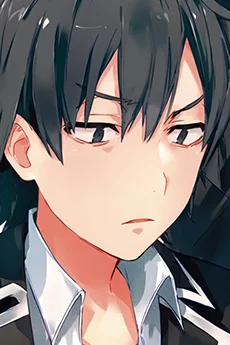
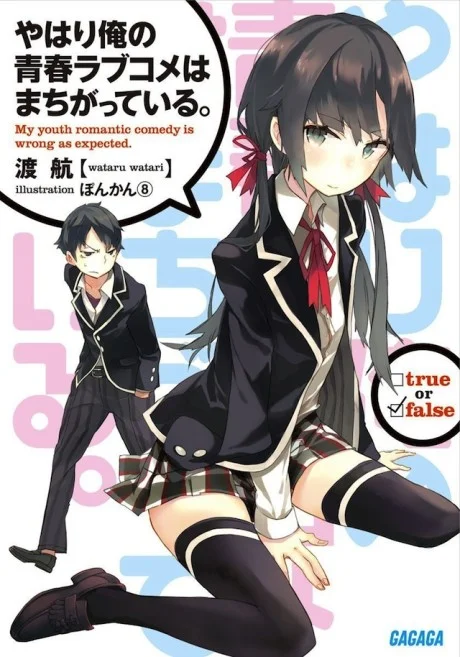
This is the core thing. Hachiman narrates every scene, and his narration is doing two jobs simultaneously: sharp social observation about everyone around him, and continuous elaborate self-justification for his own behavior. The gap between those two tracks is where the entire series lives.
He can identify, precisely and correctly, why someone is performing confidence to hide insecurity. He will spend three paragraphs doing this analysis. Then he will spend another two paragraphs explaining why his own strategy of isolation is not cowardice — it’s wisdom, it’s just clear-eyed acceptance of how youth works, and while he’s doing this you can see the seams. He’s lying to himself. The text shows you the lie even when Hachiman doesn’t notice it.
That gap is invisible in prose when the author isn’t careful. Watari is careful. The unreliable narration is constructed precisely so that attentive readers clock what Hachiman is avoiding before Hachiman does. His growth across fourteen volumes is not a single dramatic moment. It’s just him slowly, grudgingly, noticing the gap more often. Admitting what it is. Starting to want things anyway.
The anime cuts the vast majority of these interior passages. It has to. You can’t broadcast a three-paragraph internal spiral in real time. But what that means is the anime gives you Hachiman’s conclusions — the quotable cynicism, the dry observations — without the mental gymnastics he went through to reach them. Less funny. More shallow. The comedy especially suffers, because half the humor in these volumes is Hachiman approaching a situation through an elaborately incorrect route and arriving at a conclusion that’s technically right for entirely the wrong reasons. Strip the approach, and the conclusion isn’t as funny. (Our reading order guide breaks down exactly what each anime season cuts.)
Volume 6 has a scene — the “I want something genuine” confrontation — that the anime condenses into about ninety seconds of charged silence and a single line. The novel version runs for pages. Hachiman’s narration leading into that moment is some of the most carefully constructed prose in the series, building the tension through layers of self-awareness and denial that make the eventual outburst feel like it tore out of him rather than being said. The anime version is good. The novel version is a gut punch.
How Does the Series Develop Across All 14 Volumes?
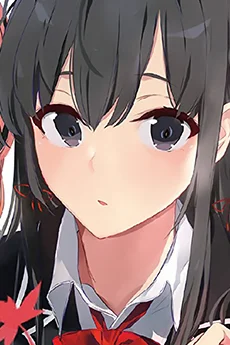
Volumes 1-3 are setup, and honestly more fun than people give them credit for. Hachiman is at peak caustic here — freshest, sharpest, least self-aware. The comedy is genuinely funny. The Service Club cases are self-contained enough to be accessible. Volume 3’s cultural festival arc is the first indication Watari is doing something more ambitious than romcom episodics; the manipulation Hachiman runs to save the festival is effective and costs him something, and the narration knows it even when Hachiman pretends otherwise.
Volumes 4-9 are the weakest stretch. I’ll say it plainly. The “problem of the week” Service Club format starts to drag around Volume 5. The episodic cases become repetitive. Volume 6 has that exceptional climactic scene, but the buildup tests patience. Volume 6.5 (the first short story collection) adds texture without adding plot momentum, and it splits chronologically, with the first half best read between volumes 6 and 7, the second half between volumes 9 and 10.
Some community members argue this stretch was padded for additional anime seasons, and there’s a two-year publishing gap between volumes 11 and 12 (June 2015 to September 2017) that fuels speculation Watari hit structural trouble. I can’t confirm the behind-the-scenes situation. I can say Volume 8 is the volume I had to push myself through hardest. It’s fine. It’s just slow. Push through it.
Volume 10 is where the series’ second half begins in earnest, and it’s a gear-shift. Iroha Isshiki arrives and refuses to be a supporting character. She wants Hachiman to help her become student council president, while definitely not wanting to be student council president, and her dynamic with him is completely different from the main trio’s interactions. She’s perceptive, self-aware about her own manipulation, and in a weird way more honest with Hachiman than Yukino and Yui are. Her presence breaks up the settled dynamic in ways that force everyone to actually move.
Volumes 11-14 are where OreGairu goes literary. Watari’s prose style shifts noticeably around this point. Less comedy, more introspective density. Earlier volumes balance cynical humor with emotional drama; these volumes lean hard into the drama. The pacing is slower. The interior monologues get longer and harder. Whether this works for you will depend on whether slower, more philosophical Hachiman is what you’re reading the series for.
For me, it works. Volume 13’s sequence where Hachiman finally understands what he actually wants — and says it, out loud, to the right person — is the scene the entire series was building toward. The payoff is proportional to the setup. All those volumes of him constructing elaborate defenses against wanting things make the moment he stops defending himself land with real weight.
Who Are Yukino and Yui, Really?

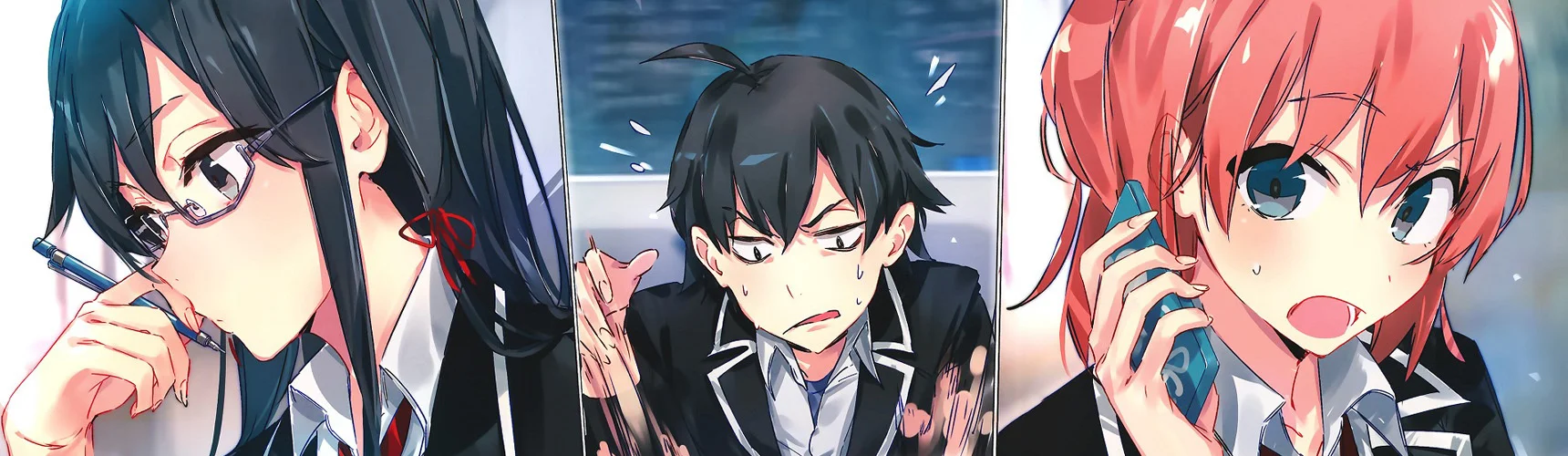
Yukino Yukinoshita is the easy recommendation to people asking “is this series interesting.” She’s the sharpest character in the room, her family situation is the series’ most interesting non-Hachiman subplot, and her relationship with both Hachiman and Yui gets genuinely complicated in the back half in ways I didn’t see coming from the early volumes. She comes across as cold and correct in volumes 1-5. She becomes a person around volume 8. She’s fully human, and fragile in specific ways, by the time the final arc starts.
Yui is the one the anime undersells hardest. The anime keeps her warm, cheerful, slightly tragic in her position in the love triangle. The novels give you considerably more of her actual thinking — her awareness of what she’s doing, her understanding of the situation, her choice to stay in it anyway. She’s not naive. She knows. Her arc across the series is about what it means to choose to stay somewhere that might cost you something, and Watari handles it more carefully than most romance series would.
The Yukino-or-Yui debate was (and still is) a significant fandom fault line. Without spoiling the resolution: Volume 14 makes a clear choice, the choice is supported by what the text built, and the ANOTHER spin-off (non-canon alternate routes, released as Season 2 Blu-ray bonuses) generated significant controversy specifically because it exists as evidence Watari could have written a Yui-centric conclusion. He explicitly said ANOTHER is not canon. People are still mad. I find the main series ending satisfying.
Does Volume 14’s Ending Actually Work?

This is the fandom’s open wound and I’ll give my honest take.
The criticism: after 13 volumes of deconstructing romance tropes, social performance, and the way people use “youth” as a framework to avoid honesty about their actual desires, the series ends with a conventional confession and a relationship starting. Watari had previously described the ending as “bittersweet.” Some readers feel volume 14 is just sweet — that it abandons the philosophical complexity the series was built on to deliver a standard romcom resolution.
My read: the resolution is conventional in form but not in substance. The relationship that starts at the end of volume 14 is between two people who have been systematically dismantling each other’s defenses for fourteen volumes and who understand, precisely, what it costs to stop defending yourself. The confession is simple. What precedes it — in the reader’s accumulated context — is not simple at all. The conventional exterior is the point. Hachiman, who spent the series constructing elaborate rationales for avoiding normal things, is doing the most normal thing. That’s the arc completing itself.
I find the ending satisfying. I understand why some readers don’t. This one is genuinely a matter of what you were reading the series for.
How Does the Yen Press Translation Hold Up?

Translator Jennifer Ward handled all 18 volumes — a six-year localization run from September 2016 to October 2022, and the consistency shows. Hachiman’s voice is maintained across the full series, which matters more than people might expect for a first-person prose-heavy narrative.
The pre-license fan translation (NanoDesu) had a following, and some readers found the shift to official translation jarring — certain idiomatic choices rendered Hachiman’s sardonic tone differently than what they were used to. The Yen Press version has its own character. I came to the series through Yen Press, so my baseline is Ward’s translation, and I find it excellent. The cultural translation notes at the end of each volume are a genuine plus — OreGairu is dense with Japanese wordplay and literary references, and the notes help you catch what you’d otherwise miss.
All 18 volumes are in print and available as e-books on Kindle and BookWalker. Volume 1 is on Amazon here if you want to start there. I read the series digitally and went back for physical copies of the final arc.
What About the Short Story Volumes and Sequels?
The four short story volumes (6.5, 7.5, 10.5, and 14.5) were entirely unadapted across all three anime seasons. They contain slice-of-life moments, holiday episodes, and character interactions that exist outside the main plot arcs. The kind of material that deepens your sense of these people without advancing the central conflict. They’re not optional if you want the full experience; they contain some of the best low-stakes character work in the series.
Volume 6.5 has a timeline quirk — its stories span two different periods. See our reading order guide for the recommended read order.
Volume 14.5 is the proper series farewell — released in Japan in April 2021, English in October 2022. Read it after volume 14. It’s quieter and warmer than the main series’ final stretch. A good place to leave these characters.
For details on Shin OreGairu (the canon sequel) and the ANOTHER spin-off, see our complete OreGairu reading order guide.
What Should You Read After OreGairu?
I’m working on a full “light novels like OreGairu” recommendations piece. For now: Bottom-tier Character Tomozaki, Rascal Does Not Dream of Bunny Girl Senpai, Hyouka, and Classroom of the Elite are the short list.
Is My Youth Romantic Comedy Is Wrong, As I Expected Worth Reading?
Yes. Without qualification.
I started with SAO, have read most of Mushoku Tensei, Re:Zero, Ascendance of a Bookworm, both years of Classroom of the Elite — and OreGairu is the series I think about most when I try to explain why light novels can be literature rather than just genre fiction. It uses the constraints of first-person school romance to do something a third-person novel couldn’t: it traps you inside a narrator who is lying to himself, shows you the lie, and makes you watch him figure it out across seven years of publication.
The weak stretch (volumes 4-9) is real. Push through it. The prose shift in the final arc is real. If you need the series to stay comedic, you will feel the later volumes as a gear-shift. The ending controversy is a genuine interpretive question rather than a clear-cut bad call, and reasonable readers land on both sides.
None of that changes the fact that this is the most precisely observed portrait of adolescent self-deception I’ve encountered in the medium. Hachiman Hikigaya is a genuinely great character. Watari built fourteen volumes around the specific, peculiar architecture of his particular self-destruction, and he stuck the landing.
Start with volume 1 on Amazon. It’s been out for years, the complete series is translated, and there’s no good reason to wait.
Frequently Asked Questions
Is the My Youth Romantic Comedy light novel better than the anime?
Yes, substantially — specifically because of Hachiman’s internal monologue. The anime adapts the plot and the surface-level character moments, but it necessarily compresses Hachiman’s internal monologue to fit episode runtimes. The novels give you all of his actual thinking, which is where the series’ humor, philosophy, and emotional payoff live. Anime Season 3 is excellent, but it’s still a compressed version of its source material. See our reading order guide for specifics on what each season cuts.
How many volumes is OreGairu and is it complete?
The main series is 14 volumes, complete. Add the four short story collections (volumes 6.5, 7.5, 10.5, and 14.5) and the total is 18 volumes. Yen Press published all 18 in English, with the final volume released in October 2022. The canon sequel, Shin OreGairu (6 short volumes), has not been officially translated into English as of 2025.
Where should I start if I’ve watched all three anime seasons?
Start from volume 1. The anime adapted everything through volume 14, but reading from the beginning gives you the complete Hachiman experience. The full internal monologue the anime necessarily cut. The community-accepted alternative for anime veterans is starting at volume 7, which begins the “Too!” arc with fresh material, but you’ll be missing the prose foundation that makes the later volumes hit hardest.
Does OreGairu have a definitive ending or a harem ending?
Definitive single-pairing ending. Volume 14 makes a clear, unambiguous romantic resolution. The ANOTHER spin-off (non-canon, Blu-ray bonus material) presents alternate routes including a Yui-centric path, but Wataru Watari explicitly clarified ANOTHER is not the main story. The main series ending is the intended one.
Is the OreGairu light novel available in English?
Yes, fully. Yen Press published all 18 volumes in English between September 2016 and October 2022, translated throughout by Jennifer Ward. Available in print and digital on Kindle and BookWalker. The manga adaptation (@comic) is also available in English through Yen Press.