

This article contains affiliate links. If you buy through these links, we earn a small commission at no extra cost to you.
The SOS Brigade walked so every school-based supernatural light novel could run. Volume 1 of Haruhi Suzumiya hit shelves in Japan in 2003 and finally reached English readers in 2009, setting a template that half the LN industry has been borrowing from since: sardonic male narrator, a girl with reality-warping power, a cast of supernatural beings hiding behind class schedules. With Volume 13 (The Theater of Haruhi Suzumiya) dropping November 2024 and no confirmed Vol. 14 on the horizon, I needed something to fill the gap. I’ve been hunting for that specific Haruhi feeling for years. Here are the seven that actually scratched the itch.
TL;DR
- Best overall: OreGairu — same sardonic first-person narrator, deeper psychological depth.
- Most structurally similar: Bunny Girl Senpai — explicitly modeled on Haruhi, school + supernatural phenomena format.
- Darkest pick: The Empty Box and the Zeroth Maria — supernatural school setting, zero comedy.
- Best for banter: Spice and Wolf — different genre entirely, same human-vs-supernatural-entity dynamic.
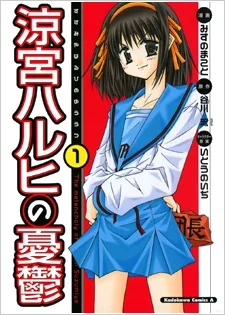
What Makes Haruhi Suzumiya So Difficult to Replace?
A quick word on what we’re actually chasing before I start listing titles.
The obvious answer is “Haruhi herself,” but I’d push back on that. The engine of this series has always been Kyon. His interior monologue, running from page one through all 13 volumes, carries the whole thing. Kyon narrates his own exasperation with such commitment that by the time the supernatural stakes get serious in Volumes 9-11 (the α/β timeline split across The Dissociation and The Surprise), you’ve been so thoroughly colonized by his perspective that the weight of it feels personal. The anime does a great job with Tomokazu Sugita’s voice work, but entire paragraphs of Kyon’s internal commentary exist only in the novels. That’s what I’m hunting for in a replacement.
The secondary thing I’m chasing: Haruhi uses the supernatural as a lens for mundane anxieties. Haruhi isn’t bored with physics — she’s terrified of a universe that doesn’t need her. The aliens and time travelers and espers are metaphors first, plot devices second. The best picks on this list share that quality.
What Are the Best Light Novels Like The Melancholy of Haruhi Suzumiya?
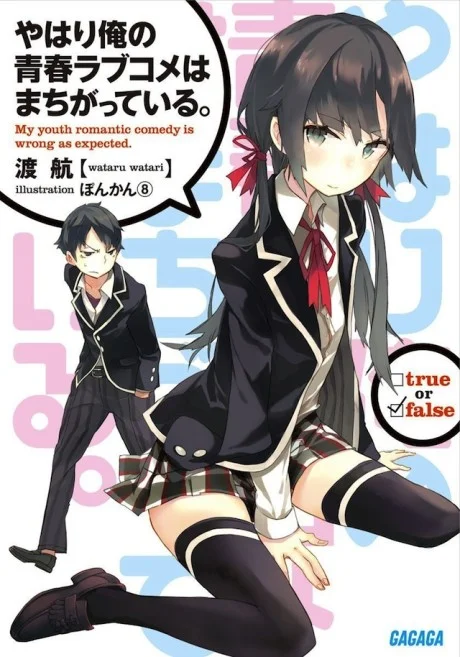
1. My Youth Romantic Comedy Is Wrong As I Expected (OreGairu) — Wataru Watari
If I had to pick one, OreGairu is it.
Hachiman Hikigaya is Kyon with sharper edges and less ironic distance from his own psychology. Where Kyon performs cynicism while clearly caring about the SOS Brigade, Hachiman has genuinely convinced himself that isolation is a rational life strategy. The result is a narrator who is funnier than Kyon in short bursts but more uncomfortable to spend extended time with across the series’ 14 volumes (published by Yen Press under the Yen On imprint).
The setup rhymes: one girl operating on a different social frequency from everyone around her (Yukino Yukinoshita), one enthusiastically oblivious girl (Yui Yuigahama), and Hachiman stuck between them working through his own damage. But where Haruhi’s strangeness is cosmic, Yukino’s is almost entirely psychological. She’s brilliant and cutting, and using her intelligence as a defense system. The series is less interested in supernatural phenomena and more interested in what happens when three emotionally avoidant teenagers try to help other people before they’ve figured themselves out.
OreGairu is called “the mature Haruhi” in a lot of recommendation threads and I don’t think that’s wrong. It’s slower, more psychological, and the resolution in Vol. 14 hits differently than anything Tanigawa has written. No supernatural elements, but the emotional stakes feel real in the way Haruhi’s do.
Best for: Readers who are in it for Kyon’s narration more than the sci-fi premise.
Skip if: You need the supernatural hook to stay engaged.
Find OreGairu Vol. 1 on Amazon →
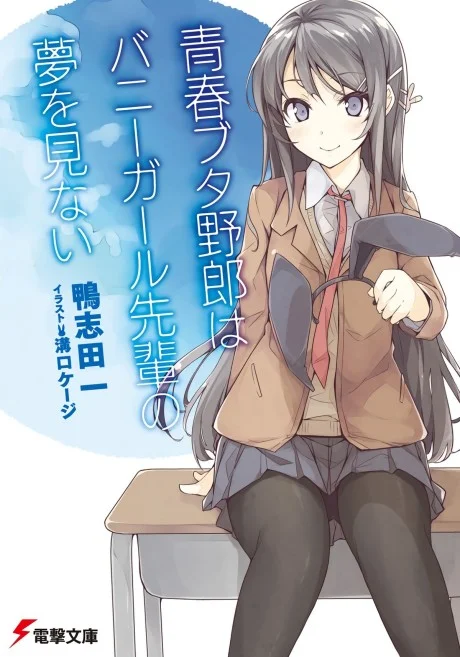
2. Rascal Does Not Dream of Bunny Girl Senpai — Hajime Kamoshida
This one is explicitly modeled on Haruhi. Kamoshida has said as much. The structure maps directly: sardonic male lead (Sakuta Azusagawa), mysterious phenomenon-affected girl (Mai Sakurajima), a supporting cast of supernatural cases rotating through the series. Where Haruhi’s phenomena stem from one unconscious omnipotent god-child, Bunny Girl Senpai‘s “Puberty Syndrome” cases emerge from adolescent psychological wounds made physical. Grounded premise, lighter horror.
Sakuta is funnier than Kyon in a specific way: he commits to saying exactly what he’s thinking with zero social filter, producing moments that are simultaneously the most awkward and most charming in the genre. The main series runs 9 volumes (Yen On) and resolves cleanly. There’s also the sequel series (Rascal Does Not Dream of a Dreaming Girl) plus an accompanying film that functions as a direct follow-up.
Vol. 1 and Vol. 2 (Rascal Does Not Dream of a Sister Venturing Out) are the strongest entry points. Vol. 4 onward starts integrating the various case characters into a larger ensemble, and that’s when it feels most Haruhi-like.
Best for: Fans of Haruhi who loved the seasonal supernatural-phenomena format and the slow-burn romantic tension underneath.
Skip if: You want cosmic stakes and alien faction politics.
Find Bunny Girl Senpai Vol. 1 on Amazon →
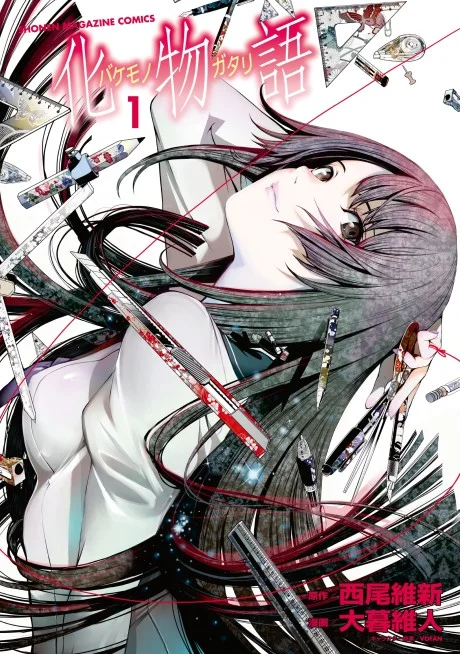
3. The Monogatari Series (Bakemonogatari) — NisiOiSin
Bakemonogatari is Haruhi filtered through a literature degree and an obsession with wordplay. Koyomi Araragi is the spiritual cousin of Kyon: sardonic, self-deprecating, secretly terrified of his own emotions. The supernatural is omnipresent. Oddities (apparitions) attach themselves to psychologically vulnerable humans, and Araragi ends up in the middle of every case.
The crucial difference is prose style. NisiOiSin writes in dense, rapid-fire dialogue with philosophical tangents and metafictional jokes that survive translation through sheer volume. It’s more demanding than Haruhi and less forgiving of readers who want plot momentum. But if what you loved in Volumes 1-6 was Kyon’s rambling interior commentary, Araragi’s narration will feel like a direct upgrade.
The publication order is genuinely complicated in later arcs. Start with Bakemonogatari Part 1 (Vertical/Kodansha, 2-volume arc) and judge by page 50 whether the voice works for you. The anime (shaft, Akiyuki Shinbo) is also excellent but adapts selectively, and both are worth your time.
Best for: Readers who want Kyon’s interior voice dialed to maximum, with philosophical tangents and dense banter.
Skip if: You want a clean plot with forward momentum.
Find Bakemonogatari Part 1 on Amazon →
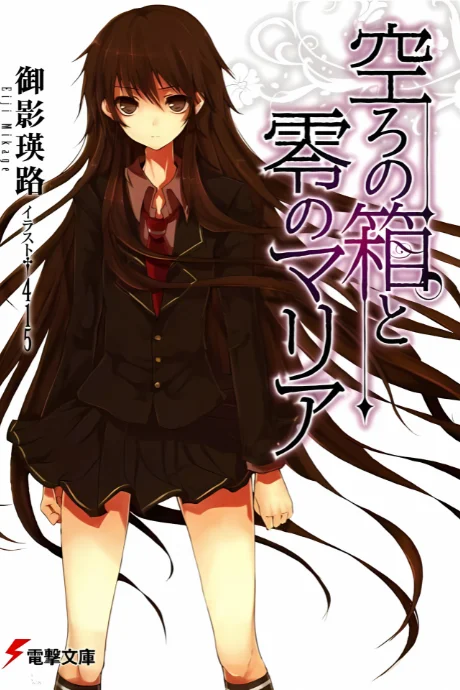
4. The Empty Box and the Zeroth Maria — Eiji Mikage
This is the dark horse. A psychological thriller set in a high school, with a boy trapped in a repeating school year and a girl who remembers every iteration. The comparison to Haruhi is structural: supernatural phenomenon imposed on a school setting, one character who understands the full situation while others don’t, and a male narrator working through his own motivations in real time.
Vol. 1 sets up Kazuki Hoshino and Aya Otonashi with enough ambiguity that the first fifty pages feel like a more intense version of “Endless Eight” — the single chapter in Haruhi Vol. 5 that the anime stretched to eight full episodes. But where Tanigawa’s time loop story is a comedy about summer vacation, Mikage’s is genuinely unsettling. The series runs 7 volumes (Yen On). The payoff across Vols. 5-7 is substantial and earns everything that came before it.
Fair warning: it handles some dark material. Not gratuitously, but the psychological horror element is real from early on.
Best for: Readers who want the supernatural-school premise taken seriously and are OK with very little comedy.
Skip if: You’re here for the lightness and humor of early-series Haruhi.
Find The Empty Box and the Zeroth Maria Vol. 1 on Amazon →
5. Hyouka — Honobu Yonezawa
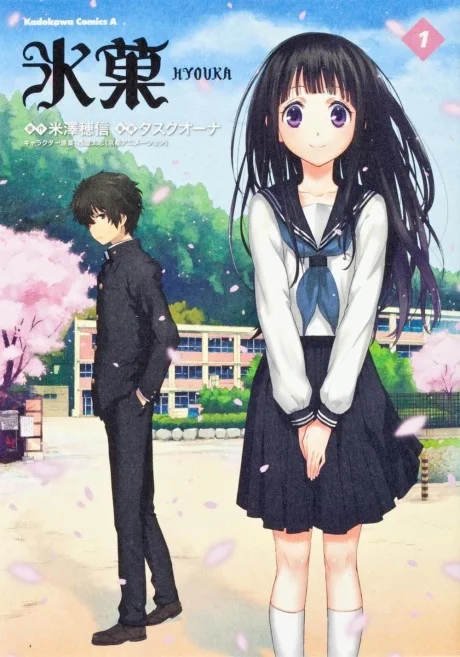
Technically not a light novel. Published under Kadokawa Sneaker Bunko (same imprint as Haruhi) but classified as youth mystery fiction. I’m including it because the connection is specific: KyoAni adapted both series, and the 2012 Hyouka anime shares so much visual DNA with the Haruhi anime that watching them back to back feels intentional. If you loved KyoAni’s execution on Haruhi, Hyouka is the next logical step.
Houtarou Oreki is Kyon if Kyon had fully committed to apathy as a lifestyle philosophy. He conserves energy by refusing to care about anything until Eru Chitanda, his club president, forces him to engage through sheer infectious curiosity. The series is school mystery — small-scale cases, no supernatural elements — but the protagonist dynamic is the closest thing to Kyon and Haruhi in the mystery genre.
The LN series runs 5 volumes in English (Yen On), resolves the main narrative cleanly, and is a short enough commitment that there’s no good reason not to try it.
Best for: Readers who loved Kyon’s reluctant investment in Haruhi’s schemes and want that energy in a quieter, no-stakes setting.
Skip if: You need sci-fi or the supernatural to stay interested.
Find Hyouka Vol. 1 on Amazon →
6. Spice and Wolf — Isuna Hasekura
Different genre entirely. Spice and Wolf is historical fantasy: a traveling merchant and a wolf deity who joins him. No school setting, no modern Japan, no science fiction premise. The reason it’s on this list is the dialogue.
Kraft Lawrence and Holo have the same fundamental dynamic as Kyon and Haruhi: one human who pretends to be less invested than he is, one supernatural entity with more power and less social awareness than the situation warrants. They talk circles around each other while the actual emotional stakes slowly come into focus. The banter across the 16-volume main series (plus the 6-volume New Theory sequel, all on Yen On) is arguably the best in the LN genre. That reputation is earned.
Vol. 1 is pure setup. Vol. 2 is where the series finds its rhythm. The New Theory sequel (Vol. 17 onward) continues the story from a new angle and is ongoing as of 2024.
Best for: Readers who loved the human-vs-supernatural-entity dynamic and want it with the best banter in the genre.
Skip if: Medieval economics bore you. The trade mechanics are central, not incidental.
Find Spice and Wolf Vol. 1 on Amazon →

7. Classroom of the Elite — Syougo Kinugasa
The wildcard on this list. Kiyotaka Ayanokoji is an unreliable narrator in a way Kyon never quite is. He’s a high school student placed in the lowest-ranked class of a prestigious school, and his narration reveals just enough of his actual intelligence to make you question everything he claims to feel or not feel. It’s the most deliberately cold of the seven.
The connection to Haruhi is specific: both series are fundamentally about one person with abnormal capabilities hiding what they are while being surrounded by a group that doesn’t fully understand them. Haruhi hides cosmic power behind cheerful obliviousness; Ayanokoji hides calculated intelligence behind manufactured mediocrity. The 11-volume first series (Yen On) and an ongoing second series explore how long the performance can hold.
Real warning: Vols. 3-5 have genuine pacing problems. Push through to Vol. 6 before deciding whether the series works for you.
Best for: Readers who loved Haruhi’s “person hiding something enormous” premise and want it played for psychological tension instead of comedy.
Skip if: You want a warm ensemble with genuine emotional bonds.
Find Classroom of the Elite Vol. 1 on Amazon →

Which of These Seven Should You Read First?
Depends on what you loved about Haruhi.
If Kyon’s narration was the thing: OreGairu first, Monogatari second. Both are long-term commitments but pay off on the narrator investment.
If the supernatural school premise was the hook: Bunny Girl Senpai to start, then The Empty Box if you want the stakes darker.
If you’re primarily an anime fan who watched the series before reading: Hyouka. KyoAni adapted both, the visual DNA is nearly identical, and it’s the shortest commitment on the list by a wide margin.
If you want something completely different in genre but with the same core dynamic: Spice and Wolf. The human-vs-supernatural-being banter is the best version of that mechanic in the genre. Holo and Kyon would get along.
Frequently Asked Questions
Are any of these actually as good as Haruhi Suzumiya?
Depends on what you mean by “as good.” In terms of cultural impact, no — Haruhi is a one-time historical event. In terms of reading experience, OreGairu Vol. 14 and the full Spice and Wolf run hit as hard as anything Tanigawa has written. Bunny Girl Senpai’s main arc is consistently satisfying in ways the Haruhi anime’s Season 2 wasn’t.
Is Classroom of the Elite really similar to Haruhi Suzumiya?
In one specific way: a person with unusual capabilities who conceals them while affecting everyone around them. But the tone is completely different. Haruhi is warm even at its strangest; Classroom of the Elite is often deliberately cold. It’s the least feel-good option on this list and the one most likely to frustrate readers expecting a Haruhi vibe.
Can I skip the Haruhi anime and just read the light novels?
Yes, but the 2006 anime (particularly in broadcast order) is one of the great LN adaptations ever made. The LN adds Kyon’s full interior life and the completely unadapted content from Vols. 9-13 — the parallel timeline arc and both post-hiatus volumes. Community consensus: watch the anime and the Disappearance film first, then read the LN for everything else. They complement each other rather than compete.
Where do I start with the Monogatari Series?
Bakemonogatari Part 1 (Vertical/Kodansha). The series has a complicated internal chronology in later arcs, but the first four volumes (Bakemonogatari through Nisemonogatari) read cleanly in publication order. If the voice doesn’t grab you by page 50 of Part 1, the series probably isn’t for you regardless of where you start.
Is there a light novel that captures the exact Haruhi Suzumiya feeling of later volumes (Vols. 9-13)?
Honestly, not really — and that’s part of why those volumes hit. The α/β parallel timeline structure in The Dissociation (Vol. 9) and The Surprise (Vols. 10-11) is doing something structurally unique in the genre. The Empty Box and the Zeroth Maria gets closest in terms of using supernatural mechanics to excavate psychological truth, but it’s a different emotional register. If you want that specific late-series Haruhi feeling, you read Haruhi again and wait for Vol. 14.