

This article contains affiliate links. If you buy through these links, we earn a small commission at no extra cost to you.
The Japanese run wrapped. Twenty-two volumes, one complete story, and an ending that divided the fanbase more cleanly than any arc before it. If the only thing stopping you from starting Shield Hero was wondering whether you’d hit a wall mid-series. That excuse is gone.
One Peace Books brought the full main series to English readers. The manga is still printing. The spin-offs have their own timelines. But the core Naofumi story? Done. Finished. You can read it start to finish right now without waiting for anything.
That said, “finished” is doing a lot of work in that sentence. The web novel finished before the light novel, and they’re not the same story. There’s a completed spin-off for readers who want more. And whether the ending actually sticks the landing is a legitimate debate — one I have strong opinions about. Here’s the full breakdown of where the Shield Hero light novel stands in 2026.
TL;DR
The Rising of the Shield Hero light novel completed its Japanese run at 22 volumes and is fully available in English via One Peace Books. The series is readable start to finish as of 2026. The original web novel also concluded, with notable story differences. Spin-offs are complete.
What Is the Current Publication Status of the Rising of the Shield Hero Light Novel?
The main series is complete. Aneko Yusagi finished the Rising of the Shield Hero light novel in Japan, and One Peace Books completed the English release. Twenty-two volumes, fully in print and digital, nothing left to wait for.
This isn’t one of those “technically finished in Japan but English is two years behind” situations that keep isekai readers in a perpetual holding pattern. The English release has the full story. You can open BookWalker or Kindle right now, buy all 22 volumes, and read the complete narrative without stopping for anything.
The light novel ran under Media Factory’s MF Bunko J imprint in Japan. Volume 1 published in 2013. The series ran for close to a decade before Yusagi brought it to its conclusion. One Peace Books licensed the English version and maintained a steady release pace throughout. By the time the third anime season aired, the bulk of the English volumes were already available to readers who wanted more than what the show was giving them.
Compare this to Ascendance of a Bookworm — still in active publication for certain arcs, or Re:Zero, which is nowhere near a conclusion in either language. Shield Hero is one of the cleaner recommendations to make right now specifically because the waiting is over. No release calendar to check. No “Volume X coming Q3” holding pattern. Just a finished series sitting there.
The One Peace Books digital versions are available on BookWalker and Kindle. Physical copies are in print, though some earlier volumes can go in and out of stock depending on print runs. If you’re collecting physical editions, check individual volume availability before buying a set. The early volumes see the most restock fluctuation.
One Peace Books is a smaller publisher than Yen Press or J-Novel Club. They don’t get the same mainstream visibility, but they’ve been Shield Hero’s English licensor from the start and they followed through on all 22 volumes. For a series this long, that consistency matters more than publisher prestige.
How Many Volumes Does the Rising of the Shield Hero Light Novel Have?
The main Rising of the Shield Hero light novel series runs 22 volumes. That’s the complete main narrative — from Naofumi’s summoning through the final arc and ending. No standalone side volumes, no interlude collections separate from the main count. Twenty-two volumes, one complete story.
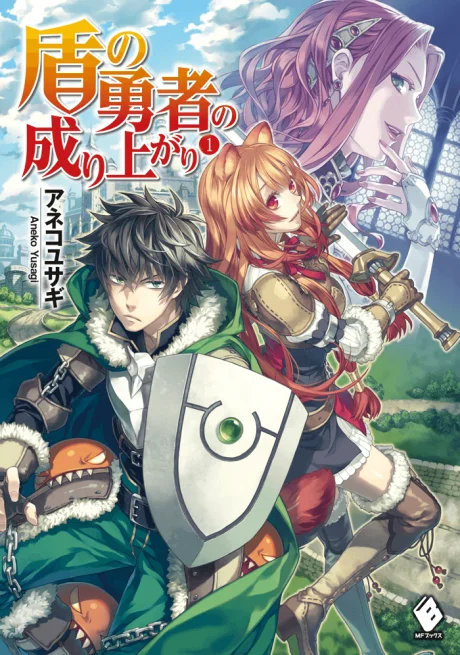
Here’s what those 22 volumes actually cover:
Volumes 1–4 cover the initial summoning, Malty’s betrayal, and Naofumi’s early development as the Shield Hero. This is the foundational material. The stretch that built the fanbase. Raphtalia and Filo join the party. The Four Spirit Weapons tournament happens. The groundwork for the larger conflict begins. This is the peak period for most readers, and it’s not a coincidence the anime spent its strongest season here. The betrayal setup, the way the mechanics function as genuine constraints rather than power fantasy permission slips, Raphtalia’s development in Volume 1 specifically. This stretch earns the investment it asks for.
Volumes 5–8 move into the Three Heroes Church conflict and the expansion of the political worldbuilding. Queen Mirellia’s involvement strengthens considerably. The stakes shift from Naofumi’s personal survival to something with actual geopolitical scope. This stretch also starts building Glass and L’Arc as characters beyond antagonists. They have real motivations, real contexts, and the books use them better than the anime ever did. The quality stays high through here. Yusagi is still building on the foundation rather than replacing it.
Volumes 9–13 are where reader opinions start fragmenting. The Spirit Tortoise arc is here. The Kyo storyline introduces parallel world travel. Naofumi and his party enter other worlds, meet versions of familiar characters, and the scale of what the waves actually represent starts becoming clear. The anime adapted this era across Seasons 2 and 3 and handled it badly. The books aren’t flawless here either, but the Kyo arc has context and character motivation the anime stripped out completely. Significantly better on the page than what aired.
Volumes 14–17 push into the late-game mythology arc. This is the section of Shield Hero that anime-only fans essentially don’t know exists. Different characters take significant roles. The tone shifts. The series stops being primarily about Naofumi’s rehabilitation and becomes something more focused on the cosmological rules of the wave system and the heroes’ roles within it. Whether this works for you depends entirely on what you came to the series for.
Volumes 18–22 cover the endgame and conclusion. The final arc tries to wrap everything Yusagi seeded over 17 volumes. Readers who were invested in the mythology threads from the early books tend to find payoff here. Readers who were primarily in it for Naofumi and Raphtalia’s relationship arc often feel the ending prioritized the wrong things. That split is real and worth knowing about before you invest in all 22 volumes.
Is the English Translation of Rising of the Shield Hero Actually Complete?
Yes. One Peace Books completed the English release of all 22 main series volumes. The full story, including the final arc and ending, is available to English readers in both print and digital formats as of 2026. No language gap, no volumes pending translation.
One Peace Books sat with the Shield Hero license from beginning to end. Smaller publisher, less flashy marketing, but consistent. Some fans who were frustrated with release pace in the middle of the run eventually got everything they needed. The complete series is there now.
Translation quality is a fair point to raise. The Shield Hero community has flagged inconsistencies across volumes — phrasing that works cleanly in early books sometimes reading differently in later ones. It doesn’t obscure the story or make volumes unreadable. But if you’re comparing against J-Novel Club’s translation consistency or Yen Press’s recent work, you might notice a difference in certain volumes. Know that going in.
Digital availability is solid. BookWalker and Kindle both carry the full 22-volume run. No gaps, no volumes pending release. For digital readers, the purchase decision is straightforward. Physical copies are widely available for most volumes. The early ones occasionally cycle through print runs, so check stock before ordering a full set at once.
How Does the Shield Hero Web Novel Compare — And Did It Finish First?
The Rising of the Shield Hero web novel is also complete, and it finished before the light novel, which is the standard trajectory for Narou-origin isekai. But the two versions are different enough that “finished” means something different for each. The light novel is the definitive, refined version. The web novel is the rougher original with notably harder characterization and some structural divergences.
Aneko Yusagi wrote Shield Hero originally on Shōsetsuka ni Narō, the web fiction platform that’s the origin point for most of the major isekai of the 2010s. Overlord, Re:Zero, Mushoku Tensei — same path. Build an audience on the free platform, get the light novel deal, and the LN becomes the polished version that’s treated as canonical.
The WN Naofumi reads considerably harder. More edge, less of the gradual softening that happens as the LN progresses. If you felt like the LN version of Naofumi was too quickly welcomed back into society after the betrayal arc. The WN leans into the isolation longer. His resentment runs deeper and stays more present throughout the story. Some readers prefer that version. Most don’t, but the preference exists.
The structural differences go beyond characterization. Certain arcs appear in different forms between versions. The parallel world travel content that makes up a significant chunk of the mid-to-late LN didn’t exist in the same shape in the WN — it’s one of the clearer examples of Yusagi expanding the mythology during the LN revision process. Readers who’ve gone through both versions consistently describe the LN as the story Yusagi actually wanted to tell, with the WN as the working draft.
If you’re deciding whether to read the WN: start with the LN. The WN is interesting context for readers who finish the 22-volume LN run and want more — it’s a comparison piece, not an alternative starting point. Going WN-first gives you a rougher story and means you miss the version Yusagi refined it into over years of revision.
Does Rising of the Shield Hero Maintain Quality All the Way Through to Volume 22?
Not consistently. The first four to five volumes are the strongest. The series shifts significantly in tone and focus after Volume 8, and whether the late-game mythology arc satisfies depends heavily on what you came to the series for in the first place. Know this before investing in the full 22-volume run.

Volumes 1–4 are why this series has the fanbase it has. Naofumi’s betrayal and psychological response to it is effective storytelling. The way he builds walls, refuses to trust, finds functional relationships despite the damage done. The mechanics function as real constraints rather than escalating power ceilings. Raphtalia’s development in Volume 1 alone is some of the strongest character work in the genre. The party dynamic in this stretch is earned, not manufactured. This part holds up.
The Church arc maintains the quality. The political layer expands in ways that feel like genuine worldbuilding rather than filler. The antagonists get context. Glass and L’Arc start transitioning from obstacles to actual characters. The stretch from Volume 5 through 8 is where I’d put the ceiling for the series — it’s building on the foundation rather than replacing it. Yusagi is still clearly cooking.
Then Volume 9 and the parallel world material arrives. And this is where I start losing the thread personally. The ambition is real — Yusagi is genuinely trying to build out the mythology of the waves, explain what they are, why they exist across multiple worlds, how the Four Holy Heroes fit into a cosmological system larger than any single world. That’s an interesting idea. The execution gets looser. The pacing suffers. Characters who worked in a grounded setting get stretched across a suddenly abstract one, and not all of them survive the transition intact.
Volumes 14 through 17 feel like a different series wearing some of the same clothes. New major figures take significant roles. The emotional register shifts. If you were reading primarily for the core party dynamics (Naofumi, Raphtalia, Filo, Melty) those volumes still include them but they’re not carrying the same weight. The series is doing something else now.

The ending divides people. I’m not going to call it bad. Yusagi had a complete vision and executed it. But it’s not the ending you’d write if you were primarily prioritizing the emotional arcs from Volume 1. It prioritizes the mythology and the lore payoffs instead. Half the fanbase accepts that and finds it satisfying. The other half feels Yusagi lost the thread somewhere around Volume 12 and never fully found it again.
The honest read: if you go in expecting a consistent 22-volume escalation of what Volume 1 set up, you’ll be frustrated. If you go in knowing the series shifts direction after the Church arc and adjust your expectations accordingly, you’ll get more out of it. The early volumes are some of the best in the genre. The late volumes are a different kind of story, not necessarily worse, just operating on different priorities.
Are There Rising of the Shield Hero Spin-offs, and Are They Finished?
The most significant spin-off is The Reprise of the Spear Hero, which follows Motoyasu Kitamura in a time-loop storyline. It’s complete, lighter in tone than the main series, and a genuine recommendation for readers who burned out on the later volumes of the main run. Other Shield Hero manga adaptations exist, but original light novel spin-off content is limited.
Motoyasu is one of the more frustrating characters in the main Shield Hero story. He’s played largely as a comedy antagonist — gullible, easily manipulated by Malty, positioned as the foil to Naofumi’s pragmatism. You don’t get much sympathy for him in the main series, and you’re not supposed to.
Reprise of the Spear Hero gives him an actual arc. Thrown into a time loop with the goal of changing the past, what emerges is a story that’s tonally different from the main series in interesting ways. More self-aware about its own isekai trappings. More comedic. Some readers who burned out somewhere in the teens of the main series found Spear Hero consistently enjoyable precisely because it doesn’t carry the same weight. If you loved early Shield Hero and felt the series drifted away from that energy, Spear Hero is closer to what the early books felt like.
The Reprise of the Spear Hero is complete. If you finish the main 22 volumes and want more Shield Hero content in light novel form, that’s where to look. The manga adaptations exist too. The main series manga has its own readership and some readers who bounced off the anime found it a better entry point, but for LN readers specifically, 22 main volumes plus the Spear Hero spin-off is the complete original content picture.
Should You Start Reading Rising of the Shield Hero in 2026?
Yes — with caveats that are worth stating plainly. The complete 22-volume series is available now. The early volumes are some of the best in the genre. Know going in that quality shifts after Volume 8 and the ending prioritizes mythology over character arcs. Start at Volume 1 and decide by Volume 4.
The case for starting now is simple: the complete story is available. You’re not investing in something that might stall, delay indefinitely, or change direction mid-publication. Twenty-two volumes, finished, sitting there. That’s rarer in isekai than it should be, and it’s a meaningful factor when deciding where to put reading time.
If you watched the anime and Season 1 was your high point, and that’s most people. The books expand on exactly what the anime did best. Naofumi’s interiority is richer on the page. The early party dynamics have room to develop. The Three Heroes Church arc lands better without episode-count constraints. Volume 1 through 4 are a strong read for anyone who connected with the premise.
If you watched and bounced off Seasons 2 and 3, don’t let that stop you. The Spirit Tortoise arc in the books is meaningfully better executed than what aired. The Kyo storyline has context and character motivation the anime stripped out. It’s not the series peak, but it’s not the disaster the adaptation made it look.
The honest caveat: if you’re weighing Shield Hero against Mushoku Tensei or Re:Zero as your primary isekai read this year, those are more consistent investments across their full runs. Shield Hero’s early volumes compete with anything in the genre. The overall 22-volume trajectory is uneven in a way those series aren’t. Read Shield Hero for Volumes 1 through 8. Read it with adjusted expectations for 9 through 22. Don’t read it expecting the energy of Volume 1 to sustain through the finale.
Volume 1 is a low-risk entry point. Start there. If you’re in by the time you finish it, you’ll read all 22. Pick up Volume 1 on Amazon and see where you land after that.
For a detailed look at what the anime changed across all three seasons and what the books add, my article on the Rising of the Shield Hero LN vs anime differences covers that in full. And if you’re trying to sort out the reading order before diving into the full series, the Shield Hero light novel reading order guide has all of it mapped out.
Frequently Asked Questions: Rising of the Shield Hero Light Novel
Is the Rising of the Shield Hero light novel finished?
Yes. The main series completed at 22 volumes in Japan, and One Peace Books has published all 22 volumes in English. The complete story is fully available as of 2026 — no active wait for any remaining volumes.
How many volumes does Rising of the Shield Hero have?
The main light novel series runs 22 volumes. The Reprise of the Spear Hero is a completed spin-off featuring Motoyasu Kitamura in a time-loop storyline, available separately for readers who want more after the main series.
Is the Shield Hero web novel different from the light novel?
Yes, significantly. The web novel features a harder, edgier version of Naofumi with more sustained isolation and resentment. Structural differences exist in several arcs, particularly the parallel world travel content. Both are complete, but the light novel is the definitive version — start there.
Is the English translation of Shield Hero complete?
Yes. One Peace Books published all 22 volumes in English. The full story including the final arc is available in print and digital formats. No volumes are pending translation or release.
Does the Rising of the Shield Hero light novel have a satisfying ending?
Reader opinion divides on this. The ending pays off the mythology and cosmological threads Yusagi built across the series. Readers invested primarily in Naofumi and Raphtalia’s relationship arc often find it less satisfying. The finale prioritizes the lore payoffs over the character dynamics that brought most readers in. Know which camp you’re in before investing in the full run.